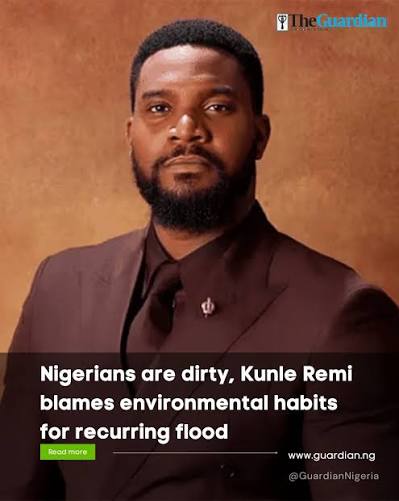
Every rainy season, flooding brings major disruption across Nigeria. Roads become impassable, homes are submerged, businesses suffer losses, and thousands of residents struggle to move around safely. While many people blame poor infrastructure and inadequate drainage systems, Nigerian actor Kunle Remi believes citizens must also accept part of the responsibility.
According to the actor, poor environmental habits, particularly indiscriminate waste disposal, continue to worsen flooding in many parts of the country. As a result, his comments have sparked widespread discussions about personal responsibility, environmental sanitation, and government accountability.
Kunle Remi Sparks Debate
Kunle Remi recently criticized the common practice of dumping refuse in gutters, canals, and drainage channels. He argued that many Nigerians contribute to the flooding they later complain about because they fail to dispose of waste responsibly.
Furthermore, he explained that blocked drainage systems prevent rainwater from flowing freely. Consequently, streets, homes, and businesses become flooded after heavy rainfall.
His remarks quickly gained attention online. While many people agreed with his opinion, others argued that government failures also deserve equal criticism.
Why Flooding Keeps Happening in Nigeria
Flooding across Nigeria is caused by several factors rather than one single issue. Although poor infrastructure remains a major concern, environmental habits also play an important role.
Poor Waste Disposal
One of the biggest causes of urban flooding is the indiscriminate dumping of refuse into drainage systems. For example, plastic bottles, nylon bags, food containers, and household waste often block water channels.
As rainfall increases, these blocked drains prevent water from flowing properly. Eventually, the water overflows onto roads and into nearby homes.
Poor Drainage Infrastructure
In many Nigerian cities, drainage systems are either outdated, too small, or poorly maintained. In addition, rapid urban development has increased pressure on existing infrastructure.
Therefore, even moderate rainfall can overwhelm drainage channels and cause widespread flooding.
Unplanned Urban Development
Another major challenge is uncontrolled construction. In many communities, buildings are erected on natural waterways and floodplains.
As a result, rainwater loses its natural path, forcing it into residential areas and major roads.
Climate Change
Climate change has also contributed to more intense rainfall across Nigeria. Consequently, storms now produce larger volumes of water within shorter periods.
Even where drainage systems exist, they often cannot handle such heavy rainfall.
Mixed Public Reactions
Kunle Remi’s comments generated different reactions on social media.
On one hand, many Nigerians agreed with him. They argued that people frequently throw waste from moving vehicles or dump refuse directly into gutters without considering the consequences.
On the other hand, some people believed the actor placed too much blame on ordinary citizens. Instead, they argued that poor waste management, inadequate drainage infrastructure, weak environmental enforcement, and poor urban planning remain the primary causes of flooding.
Nevertheless, many observers agreed that both government failures and individual actions contribute to the recurring problem.
Environmental Habits That Need to Change
Although infrastructure improvements are essential, citizens also have a role to play in protecting the environment.
To reduce flooding, individuals should:
- Dispose of waste through approved collection systems.
- Avoid throwing refuse into gutters, canals, or rivers.
- Recycle plastic materials whenever possible.
- Participate in community sanitation exercises.
- Report blocked drainage channels to local authorities.
- Encourage responsible environmental practices within their communities.
Collectively, these simple actions can reduce the amount of waste entering drainage systems.
Government Must Also Act
However, individual responsibility alone cannot solve Nigeria’s flooding challenges. Government agencies must also strengthen flood prevention efforts.
This includes:
- Constructing modern drainage infrastructure.
- Maintaining and desilting existing drainage systems regularly.
- Improving waste collection and recycling services.
- Enforcing environmental sanitation laws consistently.
- Preventing illegal construction on waterways.
- Investing in long-term urban planning.
Without these measures, flooding will likely remain a recurring challenge despite public awareness campaigns.
A Problem That Requires Everyone’s Effort
Kunle Remi’s comments have reopened an important national conversation about environmental responsibility. Although his statement may have divided public opinion, it highlights a reality that cannot be ignored.
Flooding in Nigeria is not caused by one factor alone. Instead, it results from poor waste disposal, inadequate infrastructure, weak urban planning, climate change, and inconsistent enforcement of environmental regulations.
Ultimately, lasting solutions will require cooperation between citizens, communities, and government authorities. When everyone plays their part, Nigeria can significantly reduce the devastating impact of recurring floods and build cleaner, safer, and more resilient cities.
Every rainy season, the same scenes dominate headlines across Nigeria: submerged roads, stranded commuters, destroyed homes, and heartbreaking stories of lives disrupted by floods. While many Nigerians blame poor infrastructure and inadequate drainage systems, actor Kunle Remi has sparked a different conversation by pointing to the role of citizens’ environmental habits.
His remarks have reignited a long-standing debate about personal responsibility and the collective role Nigerians play in worsening the country’s flooding crisis.
Kunle Remi’s Take on Flooding
Kunle Remi recently criticized the widespread habit of indiscriminate waste disposal, arguing that Nigerians must take greater responsibility for keeping their environment clean.
According to the actor, clogged drainage channels filled with plastic bottles, food containers, nylon bags, and other refuse are a major contributor to recurring floods. He suggested that while government agencies have a responsibility to provide proper infrastructure and sanitation services, citizens also have a duty to protect public spaces instead of turning them into dumping grounds.
His comments quickly gained traction online, with many agreeing that environmental negligence has become normalized in many communities.
Why Flooding Keeps Happening in Nigeria
Flooding is rarely caused by a single factor. Experts generally identify several interconnected issues that increase the severity of floods across the country.
Poor Waste Disposal
One of the biggest contributors is the indiscriminate dumping of refuse into gutters, canals, rivers, and drainage systems. Once rainfall begins, blocked drains prevent water from flowing freely, causing streets and residential areas to flood.
Plastic waste is particularly problematic because it does not decompose easily and often accumulates in drainage channels.
Inadequate Drainage Infrastructure
Many Nigerian cities have drainage systems that are either outdated, undersized, or poorly maintained. Rapid urban expansion has also outpaced investment in stormwater infrastructure, leaving many communities vulnerable during heavy rainfall.
Unplanned Urban Development
Construction on waterways and floodplains reduces the natural paths through which rainwater flows. Buildings erected on drainage channels often worsen flooding by obstructing water movement.
Climate Change
Increasingly intense rainfall events linked to climate change have made flooding more frequent and severe across many parts of Nigeria. Even well-designed drainage systems can become overwhelmed during extreme weather.
Public Reactions
Kunle Remi’s comments generated mixed reactions on social media.
Supporters argued that he was simply highlighting an uncomfortable truth. Many pointed to the everyday sight of people throwing trash from moving vehicles or dumping refuse directly into gutters.
Others, however, felt his statement oversimplified the issue. They argued that government failures—including poor urban planning, inadequate waste collection, weak enforcement of sanitation laws, and neglected drainage infrastructure—remain major causes of flooding.
The debate illustrates that both individual behavior and systemic challenges contribute to the problem.
Environmental Habits That Need to Change
Reducing flooding requires consistent environmental responsibility from both citizens and public institutions. Some practical steps include:
- Avoid dumping refuse in gutters, canals, or waterways.
- Dispose of waste through approved collection systems.
- Separate recyclable materials where possible.
- Participate in community sanitation exercises.
- Report blocked drainage channels to local authorities.
- Support environmental awareness campaigns.
Small actions carried out consistently across communities can significantly reduce the volume of waste entering drainage systems.
Government’s Role
While personal responsibility is important, effective flood prevention also depends on government action. Authorities must:
- Invest in modern drainage infrastructure.
- Improve waste collection and recycling systems.
- Enforce environmental sanitation regulations.
- Prevent illegal construction on waterways.
- Conduct regular desilting and maintenance of drainage channels.
- Educate the public on environmental protection.
Without these structural improvements, citizens alone cannot solve Nigeria’s flooding challenges.
A Shared Responsibility
Kunle Remi’s remarks have sparked an important national conversation. Whether or not one agrees with the wording of his criticism, the underlying issue remains clear: recurring floods result from a combination of poor environmental habits, inadequate infrastructure, weak urban planning, and increasingly intense rainfall.
Addressing the problem requires cooperation between citizens, communities, and government institutions. Cleaner environmental practices, stronger enforcement of sanitation laws, and sustained investment in flood-control infrastructure will all be necessary if Nigeria hopes to reduce the devastating impact of seasonal flooding.