Poverty in Nigeria is often measured by income, employment and access to basic services, but a new policy analysis argues that the country’s poverty crisis should also be examined through two different lenses: Institutional Poverty and Consequential Poverty.
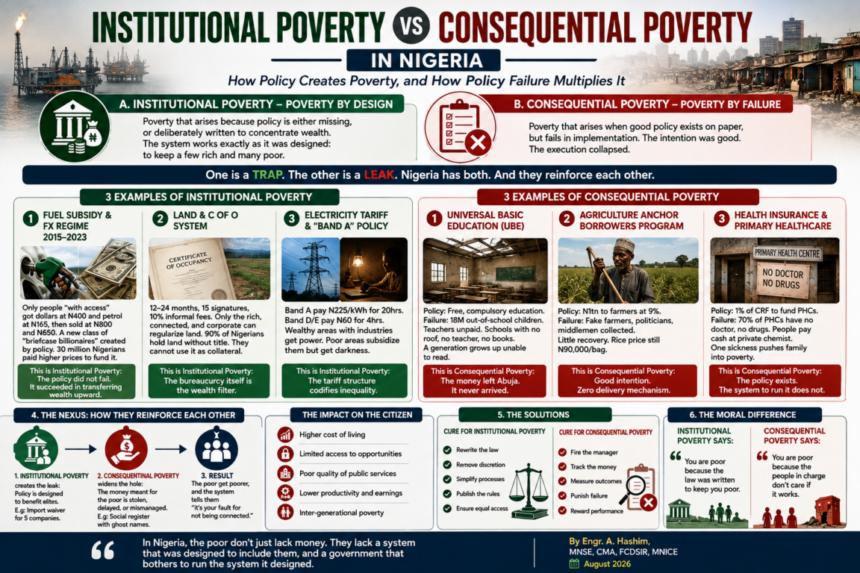
The analysis, titled “Institutional Poverty vs Consequential Poverty in Nigeria: How Policy Creates Poverty, and How Policy Failure Multiplies It,” argues that some Nigerians are pushed into poverty by systems that favour those with money, influence or connections, while others suffer because policies designed to help them fail during implementation.
The distinction is important because the two forms of poverty require different solutions.
Institutional Poverty is described as poverty created by the structure or design of a policy, while Consequential Poverty occurs when a policy may have been well-intentioned but fails to deliver its promised benefits.
According to the analysis, Nigeria experiences both forms simultaneously, creating a cycle that can deepen inequality and weaken public trust.
Institutional Poverty refers to poverty that emerges from the way economic, administrative or regulatory systems are structured.
The argument is that a policy does not necessarily have to fail to produce poverty. It can function exactly as designed while creating advantages for a small group and limiting opportunities for others.
In such situations, access to wealth or economic opportunity may depend on connections, discretionary decisions, complicated procedures or the ability to absorb high costs.
The analysis describes this as “poverty by design.”
One example cited is Nigeria’s fuel subsidy and foreign exchange regime between 2015 and 2023. The analysis argues that access to subsidised petrol and preferential foreign exchange created opportunities for individuals with privileged access while ordinary Nigerians faced rising costs.
The central question is therefore not simply whether the policy was implemented, but who benefited from the way it was structured.
When Bureaucracy Becomes a Wealth Filter
The analysis also points to Nigeria’s land documentation and Certificate of Occupancy process as another example.
Where obtaining formal land documentation requires lengthy procedures, numerous approvals and additional informal costs, poorer citizens may find it difficult to regularise their property.
The consequence goes beyond owning a piece of land.
Without proper documentation, property owners may struggle to use their assets as collateral for formal credit. Meanwhile, people with greater financial resources or stronger connections may be better positioned to navigate the system.
In this sense, bureaucracy can become an economic barrier.
The analysis describes this as a wealth filter, where access to formal economic opportunities becomes easier for those who can afford the cost of navigating the system.
Electricity Tariffs and Unequal Access
Electricity pricing and supply are also presented as another example of Institutional Poverty.
The analysis contrasts customers in areas receiving higher levels of electricity supply with those in poorer areas experiencing significantly fewer hours of power.
The argument is that businesses and households with reliable electricity can operate for longer and potentially reduce their dependence on alternative sources of power, while businesses in poorly served communities face additional costs.
For small businesses, unreliable electricity can mean shorter operating hours, greater dependence on generators and higher production costs.
The resulting economic gap can reinforce existing inequality.
Consequential Poverty: When Good Policies Fail
Unlike Institutional Poverty, Consequential Poverty occurs when the objective of a policy may be positive but implementation fails.
The analysis describes this as “poverty by failure.”
Here, the policy exists.
The budget may exist.
The institutions responsible for implementation may also exist, but the intended beneficiary does not receive the expected result.
One example cited is the Universal Basic Education programme.
The analysis argues that despite policies aimed at providing free and compulsory basic education, problems such as inadequate infrastructure, teacher shortages and the large number of children outside the school system continue to affect educational outcomes.
When public education fails to deliver, poorer families may be forced to seek alternatives they cannot afford.
The long-term consequence can be reduced literacy, fewer employment opportunities and greater vulnerability to poverty.
Agriculture Policy and the Delivery Problem
The analysis also uses the Anchor Borrowers’ Programme as an example of Consequential Poverty.
The programme was designed to provide financing to farmers and support food production.
However, the analysis argues that political influence, fake beneficiaries and middlemen undermined the intended objectives in some cases.
The result, according to the analysis, is a situation where genuine farmers may remain unable to access affordable financing even though a government agricultural financing programme exists.
This illustrates the difference between policy design and policy delivery.
A programme can have a legitimate objective, but if the resources do not reach the intended beneficiaries, the policy can still contribute to economic hardship.
Healthcare Failure Can Push Families Into Poverty
Healthcare provides another example.
The analysis points to Nigeria’s health insurance and primary healthcare initiatives, arguing that inadequate staffing, medicines and facilities can force citizens to rely on private healthcare providers.
For low-income households, the financial consequences can be severe.
A health condition that could have been treated relatively cheaply at a functional public facility can become much more expensive when patients must travel long distances or pay privately for treatment.
In such circumstances, illness does not simply create a health problem.
It can become an economic shock that pushes an already vulnerable household deeper into poverty.
How the Two Forms of Poverty Reinforce Each Other
The analysis argues that Institutional Poverty and Consequential Poverty should not be viewed as completely separate problems.
Instead, they can reinforce each other.
Institutional Poverty creates the initial inequality by restricting access or concentrating opportunities.
Consequential Poverty then widens the gap when programmes designed to address those inequalities fail to reach the people who need them.
The result can become a cycle.
A citizen without connections struggles to access an opportunity. A government programme is subsequently created to address the problem, but implementation fails. The citizen remains excluded while those with resources or connections continue to find alternative routes.
Over time, the public may begin to believe that government programmes are designed only for people with influence.
That perception can further weaken trust in public institutions.
How Can Institutional Poverty Be Measured?
The analysis proposes looking beyond traditional poverty statistics.
For Institutional Poverty, policymakers should examine the rules governing access to opportunities.
Questions should include: Who qualifies? How many approvals are required? How long does the process take? Are informal payments involved? Does personal influence determine access?
Another useful measure is the difference between the official cost of accessing a service and what ordinary citizens actually spend to obtain it.
The same approach can be applied to processing times.
If a government service is officially expected to take a certain period but routinely takes much longer unless an applicant has influence, the difference represents an institutional barrier.
The analysis also suggests examining the access gap between eligible citizens and those who can realistically obtain a government benefit.
Measuring Consequential Poverty
Consequential Poverty requires a different approach.
Here, policymakers need to follow the money and track the results.
A simple framework is:
Budget → Release → Implementing Agency → Project → Beneficiary
At each stage, authorities should ask what was approved, what was released, what was implemented and what citizens actually received.
The difference between the promised outcome and the actual outcome represents what the analysis describes as the delivery gap.
For example, if funding is approved to build 100 classrooms but only 43 are functional, the difference represents a clear implementation problem.
The same principle can apply to healthcare facilities, agricultural programmes, social protection and infrastructure projects.
The Cost of Government Failure
One of the strongest arguments in the analysis is that government failure often becomes a private expense for citizens.
When public electricity fails, households and businesses buy generators or alternative power.
When public healthcare fails, families turn to private providers.
When public education fails, parents who can afford it pay school fees elsewhere.
When roads deteriorate, motorists absorb higher vehicle maintenance costs.
When agricultural policies fail, food prices can rise and consumers bear the cost.
The burden is particularly heavy on poor households because they have fewer resources to purchase alternatives.
As a result, public-sector failure can become another mechanism through which poverty is reproduced.
Two Problems Require Two Different Solutions
The analysis argues that Nigeria cannot address both forms of poverty with the same policy response.
Institutional Poverty requires structural reform.
This means simplifying rules, reducing bureaucratic discretion, publishing clear procedures and making access more transparent.
Digitisation can also reduce opportunities for arbitrary decision-making where properly implemented.
Consequential Poverty requires stronger implementation and accountability.
That means tracking public funds, measuring outcomes, publishing performance data and holding officials and contractors responsible when programmes fail.
The objective should be to determine whether a problem originates from the design of the system or from the failure to operate the system effectively.
Rethinking How Nigeria Understands Poverty
The distinction between Institutional Poverty and Consequential Poverty offers a broader way of understanding Nigeria’s economic challenges.
Poverty is not simply a shortage of money.
It can also be a shortage of access, functioning institutions and reliable public services.
A farmer may remain poor because affordable credit is inaccessible.
A business may struggle because electricity is unreliable.
A family may fall into poverty because healthcare costs become overwhelming.
A child may remain trapped in poverty because the education system fails to provide the skills needed for economic opportunity.
In each case, the question should go beyond how much money the individual earns.
It should also ask what systems are preventing that person from improving their circumstances.
The Question Nigeria Must Ask
Nigeria’s poverty debate often focuses on how many people are poor and how much government spends on poverty reduction.
But the policy analysis proposes a different question:
Which policies, institutions and implementation failures are keeping Nigerians poor?
That question matters because the answer determines the solution.
Where the problem is Institutional Poverty, the rules may need to change.
Where the problem is Consequential Poverty, implementation and accountability may need to change.
And where both exist, Nigeria may need to reform the system while simultaneously ensuring that existing policies actually reach the people they were designed to serve.
Ultimately, the challenge is not only to give people more money.
It is to build institutions that do not exclude them, do not require connections to access opportunity and do not abandon them when public policies are created in their name.