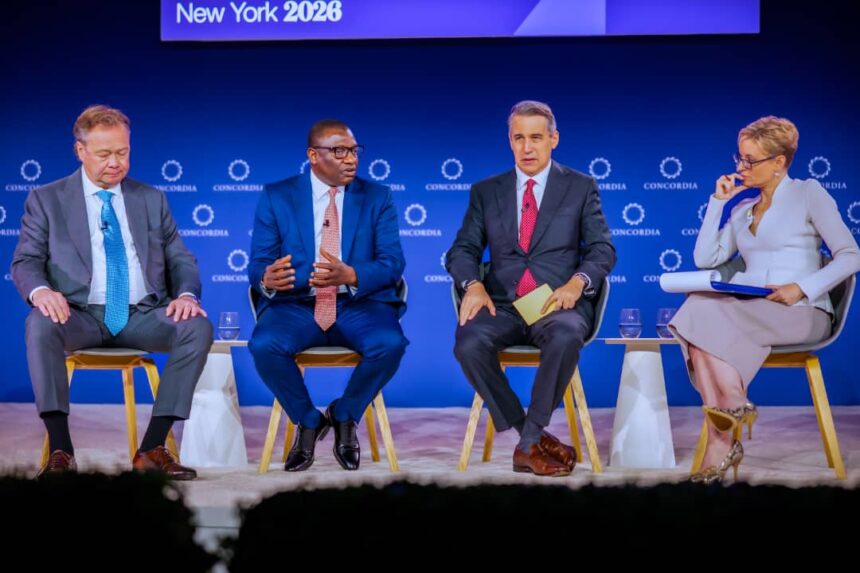
Nigeria’s chairman for World Energy Council, Bala Wunti has call on the nation to turn its mineral wealth into commercially viable projects that generate jobs and broader economic opportunities.
Wunti made the argument during the 2026 Concordia Annual Summit in New York, held alongside the United Nations General Assembly.
His panel focused on critical minerals and changing global supply chains, placing Nigeria’s mineral development ambitions within a wider international competition for strategic resources.
Wunti argued that geological discoveries alone cannot guarantee industrial development or national prosperity.
“We had geology, not reserves – no JORC,” Wunti said.
The distinction is important for investors. Geological potential does not automatically mean that a deposit has been sufficiently assessed to establish commercially recoverable reserves.
The JORC Code provides internationally recognised standards for reporting mineral resources and reserves, giving investors a framework for assessing geological evidence and potential commercial value.
From Geological Potential to Bankable Projects
For Nigeria to attract long-term mining investment, Wunti said investors also need reliable infrastructure, predictable regulations and customers for the minerals produced.
Without those conditions, deposits can remain commercially stranded even when their geological potential is significant.
The issue is particularly relevant as Nigeria seeks to diversify its economy beyond petroleum.
During the same United Nations week, Nigeria signed a separate minerals partnership with the United States covering areas including exploration, processing, infrastructure and technical capacity.
The agreement provides a framework for potential commercial investment. However, an agreement itself does not represent a completed mining or processing project.
The next stage will depend on whether the framework produces bankable projects, financing, infrastructure and measurable economic activity.
Nigeria Already Has Strategic Mineral Potential
Nigeria’s mineral potential is not merely theoretical.
According to the US Geological Survey, Nigeria accounted for approximately 16 percent of global tantalum production in 2024, making it the world’s second-largest producer that year.
Tantalum is used in electronic components and has applications in advanced technologies.
However, extracting minerals is only one part of the economic equation.
The larger opportunity lies in what happens after extraction.
Processing minerals domestically could create additional activity for manufacturers, engineers, transport companies, equipment suppliers and other businesses connected to the mining value chain.
That could create more economic opportunities than exporting raw materials alone.
“Deal, Not a Deck”
Wunti identified Nigeria’s Solid Minerals Company as a potential investment partner in developing the country’s mineral resources.
But he stressed that institutional structures and investment presentations must eventually lead to commercial transactions.
“Deal, not a deck,” Wunti said.
The statement captures a central challenge facing Nigeria’s investment drive: attracting attention is different from attracting capital, and attracting capital is different from completing commercially sustainable projects.
For investors, the underlying economics still matter. Projects need competitive production costs, reliable power and transport infrastructure, regulatory certainty and credible markets.
Why Critical Minerals Matter Globally
The competition for critical minerals has intensified because several minerals are essential to modern technologies, energy infrastructure and defence systems.
China dominates significant parts of global mineral processing. The International Energy Agency has highlighted high levels of concentration in several strategic mineral supply chains, including rare-earth processing.
The IEA estimates that China accounts for more than 90 percent of refined magnet rare-earth production.
These materials are used in electric vehicles, electricity infrastructure and advanced technologies, while rare-earth components also have defence applications.
The concentration of processing capacity has therefore become both an economic and strategic concern for major economies.
What Nigeria Can Learn From the Rare-Earth Investment Race
Wunti pointed to the United States’ agreement with MP Materials as an example of how governments can reduce investment uncertainty.
The arrangement includes a $110-per-kilogram price floor for specified rare-earth products, including neodymium-praseodymium products, alongside a 10-year pricing arrangement and purchasing commitments for manufactured magnets.
The arrangement applies specifically to MP Materials and should not be interpreted as a universal price guarantee for African mineral producers.
For Wunti, however, the broader financing principle is significant.
“Give me price, I give you private capital.”
Predictable revenue expectations can make long-term industrial investments easier to finance, particularly in sectors requiring large upfront capital.
Government can also help address infrastructure and regulatory risks. But public support cannot indefinitely sustain projects whose underlying economics are unviable.
Global Investment Is Becoming More Competitive
The challenge is growing as investment in critical minerals faces a more difficult global environment.
The International Energy Agency reported that critical mineral investment declined by 9 percent globally in 2025.
That environment makes commercially credible projects increasingly important.
Nigeria therefore faces competition not only from other mineral-producing countries but also from established processing centres that already have infrastructure, technical expertise and industrial ecosystems.
Building a processing industry from scratch can be expensive.
Electricity, specialised equipment, transportation, skilled labour and supporting infrastructure all add to production costs.
Nigeria Should Avoid Another Raw-Material Trap
Wunti also drew a connection between mineral development and Nigeria’s experience with petroleum.
For decades, Nigeria exported crude oil while depending heavily on imported refined petroleum products.
That model created a gap between resource extraction and domestic industrial development.
The mineral sector presents another opportunity to close that gap.
Instead of concentrating solely on extracting and exporting raw materials, Nigeria could develop processing capacity that keeps more economic activity within the country.
That could support manufacturing, technical services, engineering and specialised employment.
But processing facilities require reliable electricity, transport networks and significant investment.
“Self-Sufficiency Yes, Isolation No”
Wunti argued that Nigeria and other African countries should pursue greater domestic processing capacity while remaining open to international partnerships.
“Pursue self-sufficiency yes, isolation no.”
The approach recognises that African countries may need foreign capital, technology and expertise to build competitive mineral value chains.
At the same time, international partnerships should support greater local participation rather than leaving producing countries dependent on exporting unprocessed resources.
For Nigeria, that could mean combining foreign investment with domestic processing, workforce development and local supplier opportunities.
What Does Mineral Development Mean for Ordinary Nigerians?
The ultimate test of Nigeria’s mineral strategy will not be the number of investment agreements signed or international conferences attended.
It will be whether mineral development produces tangible benefits for Nigerians.
New mines and processing facilities could create direct employment for engineers, geologists, technicians and other skilled workers.
They could also create indirect opportunities for transport operators, equipment suppliers, construction companies, manufacturers and local businesses.
Government revenue from successful projects could provide additional resources for infrastructure and public services.
But none of these benefits is automatic.
Investment agreements must become operating projects. Operating projects must become productive businesses. And productive businesses must create decent employment and measurable value for surrounding communities.
Development Must Also Protect Mining Communities
Economic development cannot be separated from environmental and social responsibility.
Mining can create employment and government revenue, but poorly managed operations can also expose communities to environmental damage, unsafe working conditions and loss of livelihoods.
The World Bank has emphasised environmental safeguards, community participation and improved livelihoods as important elements of responsible mining.
For communities affected by mining, development therefore means more than the presence of a mine.
It means jobs, safe water, environmental protection, infrastructure, transparent revenue arrangements and opportunities for local businesses.
The Test After New York
Wunti’s appearance at the Concordia Annual Summit has placed Nigeria’s mineral investment ambitions within a wider global debate about critical minerals and supply-chain security.
The US-Nigeria minerals partnership also creates a framework for potential cooperation in exploration, processing, infrastructure and technical capacity.
But the next stage will be measured differently.
Can Nigeria turn geological information into bankable reserves?
Can it attract long-term private capital?
Can processing industries become commercially competitive?
Can local workers and businesses participate meaningfully in the value chain?
And can communities see measurable improvements in their livelihoods?
Those questions will determine whether Nigeria’s mineral wealth becomes another promise of future prosperity or the foundation for a more diversified industrial economy.
The opportunity is therefore bigger than mining itself. It is about converting geological potential into investment, investment into production, and production into jobs, industrial capacity and better livelihoods for Nigerians.
SEO FAQ
What did Bala Wunti say about Nigeria’s mineral wealth?
Bala Wunti argued that Nigeria must move beyond geological potential and develop commercially viable mineral projects capable of attracting investment and creating economic opportunities.
What is JORC in mining?
JORC refers to an internationally recognised framework for reporting mineral resources and reserves. It helps investors assess geological information and the potential commercial viability of mineral deposits.
Why are critical minerals important to Nigeria?
Critical minerals are important because they support technologies, manufacturing, energy infrastructure and other strategic industries. Developing these resources could also help Nigeria diversify beyond petroleum.
Can mining create jobs in Nigeria?
Mining can create direct and indirect employment, including opportunities for engineers, geologists, technicians, transport operators, equipment suppliers and other businesses. The scale of employment depends on actual investment and project development.
Why is mineral processing important?
Processing minerals domestically can retain more economic activity within the country and create opportunities in manufacturing, engineering and technical services instead of relying primarily on raw-material exports.