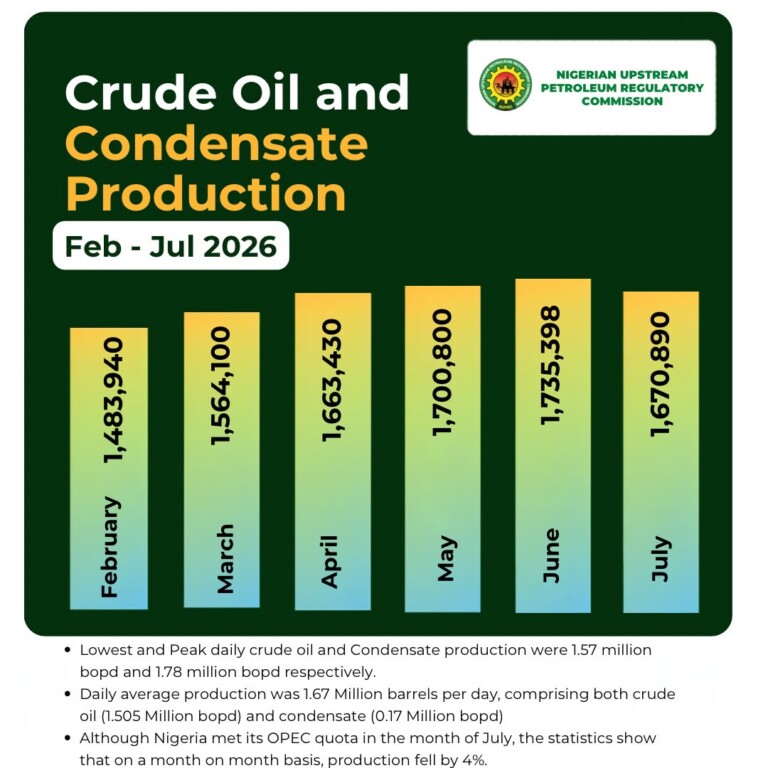
Nigeria has met and exceeded its OPEC quota for the third consecutive month, with the country’s combined crude oil and condensate production reaching 1.67 million barrels per day in July 2026, according to the latest statistics from the Nigerian Upstream Petroleum Regulatory Commission (NUPRC).
The latest figures indicate that Nigeria’s crude oil production remained above the country’s 1.5 million barrels per day OPEC quota during the month, despite operational challenges that affected output at some major producing fields.
In July, Nigeria produced an average of 1.505 million barrels per day of crude oil, while condensate production stood at 0.17 million barrels per day. Combined, the figures brought total daily production to 1.67 million barrels.
The development represents another positive month for Nigeria’s oil production, although the figures also reveal a month-on-month decline in output.
Nigeria Maintains OPEC Quota Compliance
The July production figures mean Nigeria has now met or exceeded its OPEC quota for three consecutive months. The development is significant for the country’s oil sector because crude production remains a major source of government revenue and foreign exchange.
Nigeria’s ability to maintain production above the 1.5 million barrels per day benchmark comes amid ongoing efforts to improve output from existing assets and address operational challenges affecting production.
According to the NUPRC statistics, production during July remained within a relatively strong range throughout the month. Daily peak production of crude oil and condensate reached 1.78 million barrels per day, while the lowest recorded daily production was 1.57 million barrels per day.
The figures show that despite disruptions at some fields, production remained above the country’s OPEC quota when crude oil and condensate volumes are considered together.
Oil Production Falls 4% Month-on-Month
While Nigeria maintained its OPEC quota performance, the latest statistics also show that national production declined by four per cent compared with the previous month.
The NUPRC attributed the decline to operational challenges experienced at the Erha and Akpo fields, which affected production during the period under review.
According to the Commission, the disruptions constrained production volumes and contributed significantly to the overall reduction in national crude oil output. The challenges therefore prevented the country from sustaining the higher production levels recorded previously.
The month-on-month decline highlights the continuing sensitivity of Nigeria’s oil production to operational disruptions at individual fields, even as output across much of the country’s producing assets remains relatively stable.
Erha and Akpo Fields Affect Output
The operational challenges at Erha and Akpo played a significant role in July’s production decline, according to the NUPRC.
Both fields form part of Nigeria’s offshore oil production network, meaning disruptions affecting their operations can have a noticeable impact on national output. The Commission said the challenges experienced at the fields contributed significantly to the four per cent month-on-month reduction.
However, the NUPRC noted that production operations across most other producing assets remained relatively stable during the month.
Operators also implemented measures aimed at maintaining production efficiency and reducing the effect of operational constraints. These efforts helped limit the impact of the disruptions and allowed Nigeria to maintain production above its OPEC quota when crude oil and condensate volumes were combined.
What the July Figures Mean for Nigeria
The latest production figures provide a mixed picture for Nigeria’s oil industry. On one hand, maintaining output above the OPEC quota for three consecutive months suggests that production recovery efforts are beginning to deliver more consistent results.
On the other hand, the four per cent month-on-month decline demonstrates that operational challenges remain a significant risk to production stability. Continued disruptions at major fields could affect the country’s ability to sustain higher output levels over time.
For Nigeria, maintaining and increasing crude oil production remains particularly important because higher output can support government revenues and strengthen the country’s position within the international oil market.
The NUPRC’s latest figures therefore underline both the progress and challenges facing the sector. Nigeria has succeeded in meeting its OPEC quota again, but sustaining that performance will depend on the stability of producing assets and the industry’s ability to resolve operational constraints.
Nigeria’s Oil Output Faces a New Test
The July figures suggest that Nigeria has made further progress in maintaining production around and above its OPEC allocation. However, the decline recorded during the month also demonstrates why sustained investment, efficient operations and rapid responses to production disruptions remain important.
With combined crude oil and condensate production reaching 1.67 million barrels per day, Nigeria remained above its 1.5 million barrels per day OPEC quota in July.
The immediate challenge will be to sustain that performance while addressing the operational problems that affected the Erha and Akpo fields.
For now, the latest NUPRC data gives Nigeria another month of OPEC quota compliance, even as the country’s oil industry continues to navigate the operational challenges that can quickly influence national production levels.