
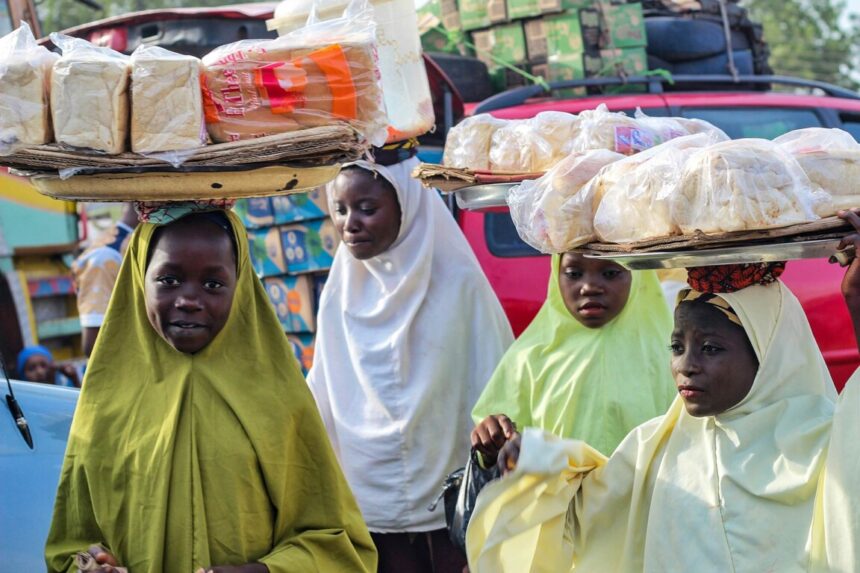
Child labour in Nigeria has become one of the major drivers of the country’s out-of-school children crisis, with millions of children denied access to education, poverty forces families to depend on their labour for survival.
Across Nigeria, millions of children, wake up not to the sound of a school bell but to the demands of work, they hawk goods in crowded markets, wash cars, work as domestic servants, tend farms, or assist artisans.
While conflict and displacement contribute to the problem, they do not explain all these cases, instead, many families deliberately keep their children away from classrooms because they struggle to survive.
Nigeria faces the world’s largest out-of-school children crisis. Between 18.3 million and 20 million children lack access to education. Nearly one in every five out-of-school children globally lives in Nigeria.
Insecurity, poor infrastructure, and underfunding fuel the problem. However, poverty has created an even harsher reality. For many households, a child’s labour has become an economic lifeline.
For families living below the poverty line, education often appears to be a luxury. Parents who struggle to provide daily meals see schooling as a long-term investment they cannot afford. Consequently, survival comes first. Instead of attending classes, children head to markets, workshops, farms, and busy intersections. Their earnings, in many cases, help sustain household income.
Many parents defend the decision as a necessity rather than neglect.
“If my son stays at home, we won’t eat,” says a mother of five.Her 13-year-old son works as a mechanic’s apprentice. “School doesn’t put food on the table today.”
The numbers paint a disturbing picture. About 86 percent of out-of-school children live in rural communities. Moreover, 65 percent come from the poorest households. Girls account for nearly 60 percent of those excluded from education. In many instances, families prioritise domestic duties, early marriage, or household labour over formal schooling.
Northern Nigeria bears the heaviest burden. Indeed, roughly two-thirds of out-of-school children live in the North-West and North-East. Kebbi and Sokoto rank among the worst-affected states. As a result, large numbers of school-age children have never entered a classroom.
Economic hardship has blurred the line between helping at home and child labour. According to international standards, child labour disrupts education, harms development, or exposes children to danger. Yet thousands of Nigerian children spend long hours hawking on highways, carrying heavy loads, or operating equipment. Furthermore, many work in environments that threaten their health and safety.
Education advocates warn that keeping children out of school traps families in poverty for generations.
“When children lose access to education, their opportunities shrink dramatically,” says an education specialist. “The income they generate may help families survive today. Nevertheless, it limits their prospects for the future.”
Social and cultural beliefs also contribute to the crisis. In some communities, boys must learn trades at an early age. Similarly, girls often prepare for marriage and domestic responsibilities. Therefore, many families place traditional expectations ahead of formal education, especially during difficult economic times.
Meanwhile, insecurity has deepened the crisis. Armed conflict, banditry, and attacks on schools have displaced millions of families. These threats have disrupted learning across northern Nigeria. Consequently, parents who already question the value of education become even more reluctant to send their children to school.
Experts say Nigeria needs more than new classrooms. Instead, they recommend social protection programmes, conditional cash transfers, school feeding schemes, and stricter enforcement of child labour laws.
Nigeria’s education budget remains below UNESCO’s recommended benchmark of 15 to 20 percent of national expenditure. As a result, schools continue to struggle with poor infrastructure, overcrowded classrooms, and a shortage of teachers. Without sustained investment, the country risks losing an entire generation to poverty and illiteracy.
For children like Musa, the future hangs in the balance. Every day spent hawking goods instead of learning in a classroom represents more than a missed lesson. Rather, it represents a lost opportunity, a delayed dream, and a childhood exchanged for survival.
As Nigeria confronts its education crisis, one question remains. When poverty forces parents to choose between feeding their families and educating their children, who should ensure that childhood is not sacrificed for survival?