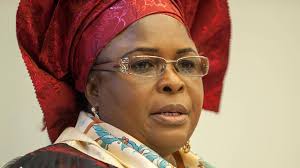
Former First Lady Patience Jonathan has described Azikel Group President, Dr Azibapu Eruani, as a “small boy” she helped mentor on his journey into the world of big business.
She made the remark during an inspection of the Azikel Refinery in Obunagha, Bayelsa State, where she joined other dignitaries to witness a major stage in the development of the project.
Speaking in a video that later went viral, Patience Jonathan recalled how she encouraged the young Eruani to learn from some of Nigeria’s biggest businessmen, including Aliko Dangote and Aminu Dantata. She said Eruani often spent time around the businessmen and that she pushed him to watch, learn and dream bigger.
According to her, Eruani once told her that he wanted to become like Dangote. At the time, she thought the young businessman was aiming very high. But rather than discourage him, she said she prayed that God would grant him his ambition.
Years later, she said, that ambition has taken Eruani into the petroleum industry and towards the development of a major refinery in his home state.
From Ambition to Refinery
Eruani’s journey into refining did not happen overnight. Azikel Group has interests across several sectors, including petroleum refining, power generation, aviation, dredging and construction. The company has also pursued the development of a refinery in Bayelsa for several years.
In 2019, the Nigerian Content Development and Monitoring Board, NCDMB, announced an equity investment in Azikel’s proposed 12,000-barrel-per-day modular refinery. The project formed part of efforts to increase local refining capacity and reduce Nigeria’s dependence on imported petroleum products.
The latest inspection signals another step in that journey. The visit coincided with the arrival of the refinery’s Crude Distillation Unit, or CDU.
So, what exactly does that mean?
The CDU serves as one of the key units in a refinery. It separates crude oil into different fractions, which can then go through further processing to produce products such as petrol, diesel, kerosene and aviation fuel. For Bayelsa, the arrival of the equipment represents more than another piece of industrial machinery.
It brings the long-discussed refinery project closer to becoming an operating facility.
Patience Jonathan Recalls the Licence Battle
During the inspection, Patience Jonathan also recalled Eruani’s earlier efforts to secure approval for a refinery. She said Eruani and others approached her during the administration of former President Muhammadu Buhari after deciding to pursue refinery projects.
At the time, she questioned whether the administration would approve the plan. She recalled telling Eruani that even her husband, former President Goodluck Jonathan, had not given him a refinery licence, and wondered whether the APC-led government would do so.
According to her account, the situation later changed, and she learnt that the government had approved refinery licences. However, the specific number of licences in her account requires independent confirmation.
What Could the Refinery Mean for Bayelsa?
Beyond the political stories surrounding the project, the refinery has attracted attention because of what it could mean for the state’s economy.
NDDC Managing Director Samuel Ogbuku, who joined the inspection, praised Eruani for staying with the project over the years. Ogbuku said he attended the refinery’s groundbreaking ceremony about eight years ago. He described the project as a potential catalyst for investment, employment and economic growth in Bayelsa.
He also urged young people in the state to prepare themselves for the opportunities that the refinery could create. The Bayelsa State Government has also supported the project. Governor Douye Diri, represented at the inspection by his deputy, Peter Akpe, has backed efforts to improve infrastructure around the refinery.
The improved road leading to the site could make it easier for workers, suppliers and businesses to access the facility.
But the Real Test Comes Next
For Bayelsa, the excitement around the refinery goes beyond the arrival of one major piece of equipment. The bigger question is what happens when the facility begins operations.
Will it create enough jobs for young people?
Will local businesses benefit from the activity around the refinery?
Will it attract new investors to Bayelsa?
And perhaps most importantly, can the project help turn the state’s oil resources into wider economic opportunities for the people who live there?
Those are the questions that will matter when the construction dust settles.
For now, the arrival of the Crude Distillation Unit marks another step forward.
And for a businessman once described by Patience Jonathan as her “small boy”, the refinery represents something much bigger — the transformation of a young man’s ambition into an industrial project that could reshape part of Bayelsa’s economy.