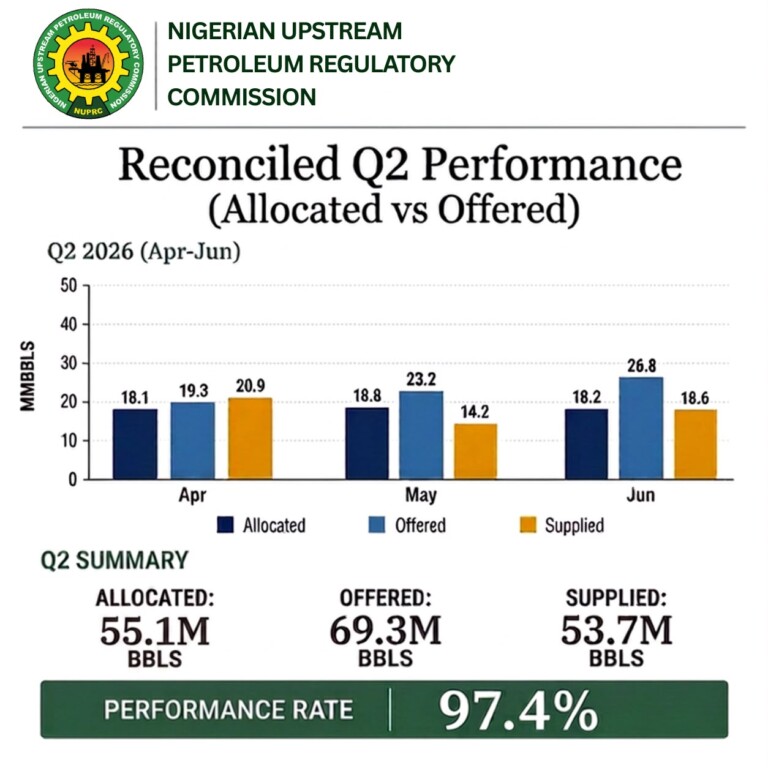
The Nigerian Upstream Petroleum Regulatory Commission (NUPRC) says 53.7 million barrels of crude oil and condensate were supplied to local refineries between April and June 2026, representing a 97.4 per cent performance under the Domestic Crude Supply Obligation (DCSO).
The Commission released the figures in its Q2 2026 DCSO report, issued under the provisions of Section 109 of the Petroleum Industry Act (PIA).
According to the report, the figures show that the NUPRC is actively administering and enforcing the domestic crude supply framework as Nigeria works to increase local refining and improve energy security.
Under the DCSO framework, the NUPRC meets with crude oil producers and licensed domestic refineries each month to determine supply requirements.
The Commission then allocates specific volumes of crude oil and condensate to producers for supply to local licensed refineries.
However, the framework operates on a “willing buyer, willing seller” basis in line with the PIA, meaning that while the Commission sets supply allocations, the final volumes supplied can depend on agreements between producers and domestic refiners.
April Records Strong DCSO Performance
In April, the NUPRC allocated 18.13 million barrels of crude oil and condensate to producers who offered 19.31 million barrels to local refiners, exceeding the volume allocated by the Commission.
Local refineries eventually received 20.88 million barrels, representing 114.9 per cent performance against the allocation, the April figures therefore showed that actual supply exceeded the volume initially allocated by the regulator.
May Supply Falls Below Allocation
The pattern changed in May as the Commission allocated 18.78 million barrels to producers, while producers offered 23.19 million barrels to local refiners.
However, local refineries received 14.23 million barrels by the end of the month.
That represented 75.8 per cent compliance, making May the weakest month in the quarter.
The figures also show a gap between the volume producers offered and the volume domestic refineries eventually received.
June Performance Improves
DCSO performance improved again in June.
The NUPRC allocated 18.17 million barrels to producers, while producers offered 26.84 million barrels to local refiners.
Domestic refineries eventually took 18.61 million barrels, representing 102.4 per cent performance.
The June result pushed overall Q2 performance to 97.4 per cent.
Higher Production Supports Crude Supply
The NUPRC said the improvement in DCSO performance coincided with an increase in local oil production.
The Commission also linked the improvement to the signing of long-term crude supply agreements, supported by bankable Sales and Purchase Agreements between producers and domestic refiners.
These agreements could provide greater certainty for both sides by establishing clearer arrangements for crude supply and purchases.
For Nigeria’s domestic refining sector, reliable access to crude remains essential because refineries need steady feedstock to operate consistently.
Dangote Refinery Receives Majority of Offered Volumes
The report also highlighted the role of the Dangote Refinery in domestic crude supply.
The refinery required 63 million barrels during Q2, while producers offered 68.1 million barrels.
The volume offered to the refinery accounted for 98 per cent of all crude volumes offered during the period.
However, the Dangote Refinery eventually accepted 52.6 million barrels.
This means the refinery accepted about 78 per cent of the volume offered to it.
The figures show that the challenge is not only the amount of crude producers offer, but also the volume domestic refineries ultimately accept.
NUPRC Reaffirms Energy Sufficiency Commitment
The NUPRC said it remains committed to supporting the government’s objective of achieving greater energy sufficiency.
The Commission said it would continue to use the framework established by the Petroleum Industry Act 2021 to enforce the DCSO while supporting efforts to sustain recent improvements in crude oil production.
The Q2 figures suggest that domestic crude supply remains an important part of Nigeria’s strategy to strengthen local refining.
What the Q2 Figures Mean for Nigeria
The 97.4 per cent DCSO performance represents a strong overall result for the second quarter, although the monthly figures show significant variations.
April recorded performance above allocation, while May fell below the target before June recovered to more than 100 per cent.
The figures also highlight the importance of stronger commercial agreements between crude producers and domestic refiners.
For Nigeria, sustained crude supply could help domestic refineries operate more consistently and support the broader goal of reducing dependence on imported refined petroleum products.
However, maintaining that progress will depend on continued crude production, effective enforcement of the DCSO framework and workable agreements between producers and refiners.
As Nigeria expands its domestic refining capacity, the ability to consistently move crude from producers to local refineries will remain critical to achieving greater energy sufficiency.