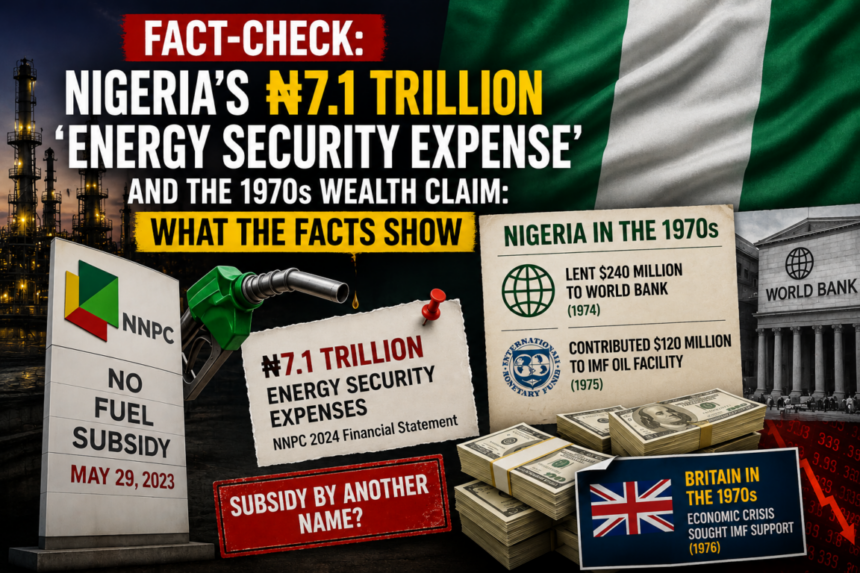
A viral political argument about Nigeria’s fuel subsidy payments, the ₦7.1 trillion “energy security expense” and the country’s financial position in the 1970s mixes verified facts with claims that require important clarification.
The strongest historical claim is correct: in December 1974, Nigeria agreed to lend US$240 million to the World Bank, with the money disbursed in two US$120 million instalments in December 1974 and January 1975. A World Bank document also records that Nigeria contributed US$120 million to the IMF Oil Facility and purchased US$240 million in World Bank bonds.
However, the claim that Nigeria simply “lent US$120 million to the IMF” is an oversimplification. The historical record confirms the US$120 million contribution to the IMF Oil Facility, but that is not exactly the same as saying Nigeria made a straightforward loan directly to the IMF in the same way it lent US$240 million to the World Bank.
The fuel subsidy claim also has a factual basis, although the figures and terminology require careful explanation.
What Happened to the ₦7.1 Trillion?
NNPC Limited’s audited 2024 financial statements recorded ₦7.1 trillion under “energy security expenses”, compared with ₦4.8 trillion in 2023.
The company’s explanation was that the expense arose from a difference between the exchange rate used to determine the ex-coastal price of Premium Motor Spirit and the exchange rate that applied when import payments were settled. NNPC also said the cost was connected to its role as an energy supplier of last resort and that the amount was recovered through deductions from remittances due to the Federation.
Several media reports have described the expense as effectively a fuel subsidy or subsidy-like payment because the government maintained a regulated petrol price while the cost of importing the product was higher.
Therefore, the statement that ₦7.1 trillion was recorded in 2024 under “energy security expenses” is supported by the available financial reporting.
However, saying that the government simply “hid” ₦7.1 trillion by changing the name from subsidy to energy security expenses goes beyond what the documents themselves establish. The financial statements use the term “energy security expense” and provide an explanation for the accounting treatment, while analysts and media organisations have argued that the economic effect was similar to a subsidy.
The distinction matters because a fact-check should separate what the financial statements say from the interpretation of what that spending means.
Did Tinubu Announce That Fuel Subsidy Was Gone?
President Bola Tinubu announced the removal of the petrol subsidy during his inauguration speech on May 29, 2023.
The announcement led to a sharp increase in petrol prices.
NNPC later insisted that the subsidy had been completely removed. The company also said in January 2024 that it had not continued paying petrol subsidies.
However, reports and subsequent financial disclosures showed that the economics of petrol pricing remained complicated.
Reuters reported in April 2024 that NNPC faced a multibillion-dollar backlog in payments to fuel traders, with the situation effectively increasing the cost of maintaining petrol prices below market levels. The report described this as indicating a return or continuation of subsidy-like support.
A later government policy document also projected ₦5.4 trillion in fuel subsidy spending for 2024, although the final NNPC financial statements recorded ₦7.1 trillion in “energy security expenses”.
The clearest conclusion is therefore this: Tinubu announced the removal of the petrol subsidy, but the financial burden associated with keeping petrol prices below certain market costs did not disappear immediately.
Whether that should legally or technically be called a subsidy, an under-recovery or an energy security expense is part of the debate.
Was Buhari’s Government Using the Term “Under-Recovery”?
The comparison with the previous administration also needs context.
Nigeria’s fuel pricing system has historically used terms such as under-recovery to describe situations where the cost of supplying petrol exceeds the regulated selling price.
In such cases, the difference has to be absorbed somewhere in the system.
NNPC’s later financial reporting also used the language of energy security expenses and under-recovery to explain the financial gap created by the difference between regulated prices, exchange rates and import costs.
The broader criticism about transparency is therefore a legitimate subject for public debate.
However, it is important not to present every change in terminology as proof that money was deliberately concealed. The evidence shows that different administrations and institutions have used different terms to describe different aspects of the financial burden created by regulated petrol prices.
Did Nigeria Really Lend US$240 Million to the World Bank?
A World Bank archival document dated December 17, 1974 confirms that Nigeria offered a US$240 million loan to the International Bank for Reconstruction and Development, commonly known as the World Bank.
The agreement provided for two instalments of US$120 million each, with payments scheduled for December 19, 1974 and January 16, 1975. (The World Bank Docs)
This was not a donation.
The agreement described the transaction as a loan from Nigeria to the World Bank.
The historical record therefore supports the claim that Nigeria was, at that time, financially strong enough to provide substantial resources to an international financial institution.
But the fact should also be placed in context.
Nigeria’s oil revenues had risen sharply following the oil price boom of the 1970s. The country accumulated significant foreign exchange reserves and used some of those resources to purchase international financial assets and support international financial institutions.
The World Bank document also recorded that Nigeria had received more than US$700 million in Bank and IDA lending commitments by April 1975, meaning Nigeria could simultaneously be a borrower for development projects and a lender or investor in international financial institutions.
This is an important distinction: a country can borrow for specific development projects while also holding foreign reserves and investing part of those reserves in financial assets.
Did Nigeria Give US$120 Million to the IMF?
The claim is broadly based on a real historical event, but the wording needs correction.
A World Bank country document stated that Nigeria had contributed US$120 million to the IMF Oil Facility and purchased US$240 million in World Bank bonds. The document described Nigeria as becoming the first developing country to become a donor in that context.
So, the evidence supports the existence of a US$120 million Nigerian contribution to an IMF facility.
But it is more precise to say Nigeria contributed US$120 million to the IMF Oil Facility than to simply say Nigeria “lent US$120 million to the IMF” without further explanation.
Was Britain Facing a Serious Economic Crisis in the 1970s?
Britain faced serious economic difficulties during the 1970s, including inflation, balance-of-payments pressures, a weakening pound and concerns about the country’s external finances.
The IMF’s own historical account describes the United Kingdom’s economic problems as deep-rooted and says the country faced pressure on its external position and currency.
In 1976, the United Kingdom sought financial support from the IMF.
The IMF later approved a major stand-by arrangement for Britain worth SDR 3.36 billion, wh
The British Parliament also recorded that the country had substantial foreign borrowing and had drawn on IMF facilities during the period.
Therefore, the claim that Britain faced a serious economic crisis and required IMF support in the 1970s is accurate.
What Does the Historical Comparison Really Tell Us?
The comparison between Nigeria in the 1970s and Nigeria today is emotionally powerful, but history requires more than comparing two figures from two different periods.
Nigeria’s economy in the 1970s benefited from a major oil boom and a much smaller population.
The value of US$240 million in 1974 was also significantly different from the value of the same amount today.
The country also had different levels of debt, a different economic structure and a different relationship with global financial institutions.
Still, the historical record remains significant.
Nigeria did have substantial foreign exchange resources in the 1970s. It lent US$240 million to the World Bank and contributed US$120 million to an IMF oil facility, while Britain faced serious economic pressures and sought IMF support.
That history does not, by itself, prove that every current economic problem is the result of corruption or poor leadership.
It does, however, provide a basis for asking a serious question: how did Nigeria move from a country with enough foreign exchange to support international financial institutions to one now facing intense pressure from debt, inflation, currency weakness and declining purchasing power?
The Bigger Issue Is Transparency
The most defensible part of the political argument may be the call for greater transparency.
The fuel subsidy debate shows how difficult it can be for Nigerians to understand the real cost of government policies when similar financial burdens are described using different terms.
“Subsidy”, “under-recovery” and “energy security expense” may have different technical meanings, but the public still needs to know how much money is being spent, who ultimately bears the cost and how the arrangement affects government revenue.
A government can defend a policy while still presenting the numbers clearly.
For Nigerians, the central question is not only whether subsidy exists or has been removed.
It is also how much the government spends to keep petrol prices below the full cost of supply, where that money comes from and whether the public can independently verify the figures.
Fact-check verdict
- ₦7.1 trillion recorded as “energy security expenses” in 2024: True, based on NNPC’s 2024 financial statements.
- The ₦7.1 trillion was officially called “subsidy”: Misleading. NNPC used the term “energy security expense”; media and analysts have described the economic effect as subsidy or subsidy-like.
- Tinubu announced petrol subsidy removal in 2023: True.
- Nigeria lent US$240 million to the World Bank in 1974: True.
- Nigeria gave or lent US$120 million directly to the IMF: Needs clarification. The historical record confirms a US$120 million contribution to the IMF Oil Facility, but the wording “lent directly to the IMF” is too broad.
- Britain faced a serious economic crisis and sought IMF support in the 1970s: True.