
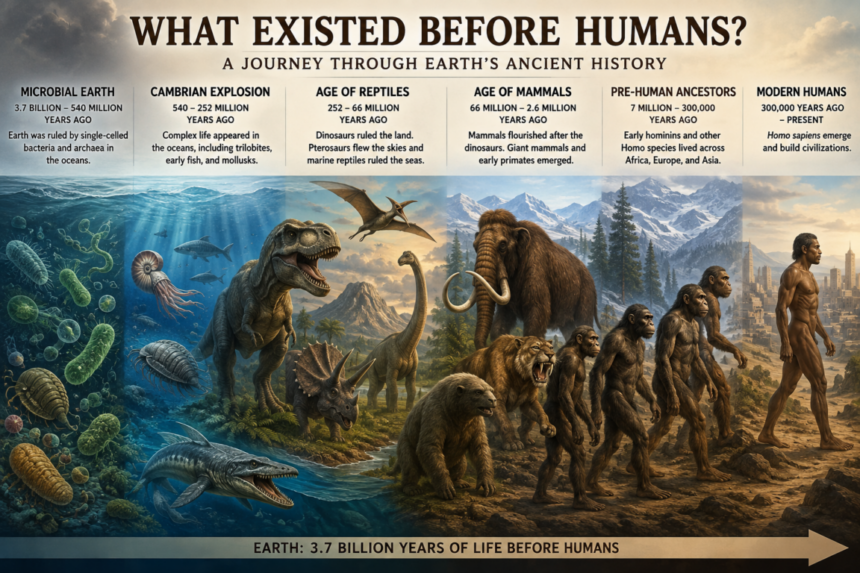
What existed before humans? It’s a question that sparks curiosity about Earth’s incredible past,while modern humans have lived on Earth for only about 300,000 years, life has existed for roughly 3.7 billion years.
Long before people built cities or explored space, countless species rose, thrived, and disappeared, our closest ancestors appeared millions of years before Homo sapiens.
Early hominins such as Sahelanthropus and Ardipithecus lived around seven million years ago, later came the australopithecines, including the famous “Lucy” fossil, who walked upright but had much smaller brains than modern humans. Other human relatives, including Neanderthals, Denisovans, and Homo erectus, also shared the planet before eventually becoming extinct.
Long before humans evolved, mammals ruled the Earth. After an asteroid wiped out the dinosaurs about 66 million years ago, mammals rapidly diversified. Giant creatures such as woolly mammoths, saber-toothed cats, giant ground sloths, and the enormous Indricotheres roamed forests, grasslands, and icy landscapes. Early primates also appeared during this period, setting the stage for human evolution millions of years later.
Before mammals became dominant, dinosaurs controlled the planet for more than 170 million years during the Mesozoic Era. Towering species like Tyrannosaurus rex, Triceratops, and massive sauropods dominated the land. Meanwhile, pterosaurs soared through the skies, while giant marine reptiles such as mosasaurs and plesiosaurs hunted in ancient oceans.
Even earlier, Earth looked completely different. Vast swamp forests filled the landscape with giant ferns and towering club mosses. Huge insects buzzed through the air, while early amphibians and reptile-like synapsids became some of the first large land animals.
Around 540 million years ago, the Cambrian Explosion transformed life in Earth’s oceans. Many major animal groups appeared during this remarkable period. Trilobites, primitive fish, and early mollusks evolved, laying the foundation for the rich biodiversity seen today.
If you travel even farther back in time, the planet had no plants, animals, or dinosaurs. For nearly three billion years, Earth belonged almost entirely to microscopic organisms. Single-celled bacteria and archaea dominated the oceans and slowly changed the atmosphere by producing oxygen. Their activity made complex life possible millions of years later.
The history of life before humans reminds us that our species occupies only a tiny chapter in Earth’s long story. Every era shaped the next, creating the diverse planet we call home today.