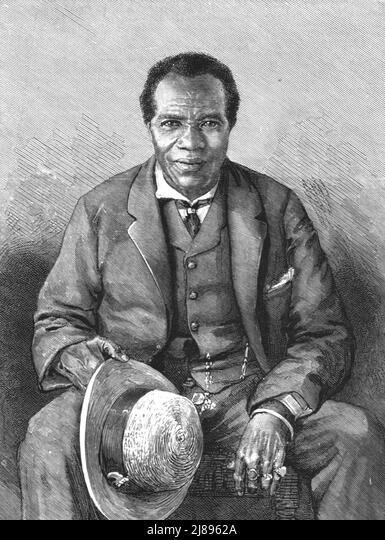
King Jaja of Opobo, born Jubo Jubogha around 1821, remains one of the most remarkable figures in the political and economic history of the Niger Delta. From being captured and sold into slavery as a young boy, he rose to become a powerful merchant, the founder of the Opobo Kingdom and a formidable African ruler who challenged British commercial and political ambitions in the late 19th century.
His story is one of resilience, economic power, political independence and resistance to colonial expansion.
From Captivity to Leadership
Jaja was born around 1821 in Umuduruoha, Amaigbo, in present-day Imo State. Historical accounts indicate that he was taken from Igboland as a young man and sold into slavery, possibly through the activities of the Aro Confederacy.
He was eventually brought to Bonny, one of the most important commercial centres in the Niger Delta. There, Jaja’s circumstances gradually changed.
After years of service, he gained his freedom and became involved in the region’s thriving trade. Following the death of his former master, Jaja inherited responsibility for the trading enterprise and eventually emerged as the leader of the Anna Pepple House, one of Bonny’s major merchant factions.
His rise demonstrated the economic opportunities available within the complex trading networks of the Niger Delta, even though those networks were deeply connected to the institution of slavery and the wider Atlantic economy.
The Rise of a Powerful Merchant
Jaja’s influence grew as he expanded the Anna Pepple House’s commercial activities. Under his leadership, the trading house absorbed several smaller interests and became one of the dominant economic forces in Bonny.
However, Jaja’s growing power brought him into conflict with another influential merchant faction, the Manilla Pepple House, led by Chief Oko Jumbo.
The rivalry eventually developed into an armed conflict.
Rather than submit to Oko Jumbo’s influence, Jaja and his followers moved eastward from Bonny and established a new political and commercial settlement.
This became the foundation of the Opobo Kingdom.
Founding the Opobo Kingdom
Jaja established Opobo in 1869, approximately 26 miles east of Bonny. By 1870, he had consolidated his authority and was formally recognized as the kingdom’s first Amanyanabo, or king.
His reign is generally dated from 25 December 1870 until his exile in 1887.
The creation of Opobo was not simply the establishment of another traditional kingdom. It was also the creation of a powerful commercial state whose influence was built around control of trade.
Jaja understood that economic independence could provide the foundation for political independence.
That principle would eventually put him on a collision course with the British.
Opobo and the Palm Oil Economy
During the 19th century, palm oil became one of the most valuable commodities exported from West Africa to Europe.
European industries increasingly required palm oil for soap, candles, lubricants and other industrial purposes. The Niger Delta consequently became a major centre of the palm-oil trade.
Jaja recognized the strategic importance of controlling this trade.
Under his leadership, Opobo became a major trading centre. He sought to prevent European and African middlemen from bypassing his commercial authority and established a system that gave his kingdom significant control over the movement of palm oil.
At its height, Opobo reportedly exported thousands of tons of palm oil and maintained direct commercial links with British traders and Liverpool.
This made Jaja extremely wealthy and politically influential.
More importantly, it demonstrated that African rulers and merchants were not passive participants in international commerce. Jaja actively negotiated, controlled markets and defended his economic interests.
Education and Modernisation
Despite his reputation as a powerful traditional ruler and businessman, Jaja also recognized the importance of education.
He sent some of his children to schools in Glasgow, Scotland, and established a secular school in Opobo. European personnel were reportedly employed to teach at the school.
His approach reflected a desire to acquire useful aspects of European knowledge while maintaining political and cultural control over his kingdom.
At the same time, Jaja restricted the activities of Christian missionaries in Opobo.
This reflected his determination to prevent external religious institutions from developing an independent influence within his territory.
For Jaja, education could be useful without necessarily requiring political or cultural surrender.
His Conflict With British Interests
The expansion of British influence in the Niger Delta created increasing tension with Jaja.
British merchants wanted greater access to the palm-oil trade, while Jaja wanted to preserve Opobo’s commercial monopoly and political autonomy.
The dispute became more serious following the 1884–1885 Berlin Conference, where European powers formalized principles for the partition and occupation of African territories.
Opobo was subsequently regarded within the British sphere of territorial ambition.
Jaja, however, resisted British attempts to impose their authority over his kingdom.
He continued to demand taxes and commercial payments from British traders operating in his territory.
For the British, such demands increasingly became unacceptable.
For Jaja, they were an assertion of sovereignty.
The 1887 Abduction
The confrontation reached its decisive point in 1887.
British Vice Consul Henry Hamilton Johnston invited Jaja to negotiations. Jaja accepted the invitation, but instead of returning to Opobo after the meeting, he was taken aboard a British vessel and effectively abducted.
He was subsequently tried in Accra, then part of the British Gold Coast, and sentenced to exile.
The episode became a major example of the increasingly coercive methods through which British imperial power was being extended in West Africa.
Jaja was first sent to London and later transferred to the Caribbean, including Saint Vincent and Barbados.
His exile removed one of the strongest political and economic opponents of British expansion in the Niger Delta.
A King in Exile
Jaja’s treatment in exile attracted attention beyond West Africa.
His presence in the Caribbean reportedly generated considerable sympathy among people of African descent, particularly in Barbados, where his treatment as an African king was viewed with concern.
His story resonated because it reflected a broader experience of African societies confronting European imperial expansion.
Jaja had been a ruler of a commercially powerful African state, yet he was transported thousands of miles from his homeland after resisting British demands.
His exile therefore became part of the larger history of African resistance to colonial domination.
His Final Journey Home
In 1891, Jaja was granted permission to return to Opobo.
However, he did not make it home.
He died while travelling back from exile, around 1891, in Tenerife, Spain.
His remains were eventually buried at Opobo.
His death marked the end of the life of a ruler who had transformed himself from an enslaved youth into one of the most powerful commercial and political figures in the Niger Delta.
The Decline of Opobo’s Power
Following Jaja’s exile and death, the political and economic power of the Opobo state declined rapidly.
Without the leadership of the man who had built its commercial system and defended its autonomy, the kingdom was less capable of resisting the growing influence of the British.
The trajectory of Opobo reflected a wider pattern across Africa during the late 19th century: independent African political authorities were increasingly incorporated into European colonial systems.
Jaja’s resistance could delay that process, but it could not ultimately prevent the expansion of British power.
Prince Waribo and the Scottish Connection
Jaja’s relationship with Britain was more complicated than simple confrontation.
His son, Prince Waribo, was sent to Britain for education. He attended Manor House School in Frodsham, Cheshire.
Waribo died in 1882 at the age of approximately 13 or 14 from inflammation of the lungs.
His grave remains associated with St Laurence’s Church in Frodsham.
The story of Prince Waribo illustrates the contradictions surrounding Jaja’s engagement with Britain. While Jaja resisted British political domination, he also recognized the value of Western education and sent members of his family to Britain to acquire it.
A Legacy of Economic Nationalism
One of the most important aspects of Jaja’s legacy is his understanding of the relationship between economic power and political sovereignty.
He recognized that whoever controlled trade could exercise enormous influence over political affairs.
By attempting to maintain control over the palm-oil trade, Jaja was not merely protecting personal wealth. He was defending the economic foundation of Opobo’s independence.
His confrontation with the British therefore had both commercial and political dimensions.
The British sought freer access to trade, while Jaja sought to maintain the authority of his kingdom over its economic resources.
A Symbol of African Resistance
King Jaja of Opobo has subsequently become a symbol of resistance to colonial expansion.
His life challenges the simplistic portrayal of pre-colonial African rulers as powerless in the face of European influence.
Jaja negotiated with European merchants, built commercial institutions, established educational initiatives and maintained a political structure capable of challenging one of the world’s expanding imperial powers.
His defeat was ultimately linked not to a lack of political or economic sophistication, but to the enormous military, diplomatic and imperial resources available to Britain during the period of the Scramble for Africa.
Remembering King Jaja
In 1903, a memorial was erected in his honour in Opobo town centre.
The memorial reflects the enduring place of Jaja in the history and collective memory of the Niger Delta.
His story continues to raise important questions about leadership, sovereignty, economic independence, colonialism and the ability of African states to negotiate with global economic powers.
From slavery to kingship, from merchant prince to political ruler, and from independence to exile, Jaja’s life followed an extraordinary trajectory.
Lessons From the Life of King Jaja
The first lesson from Jaja’s life is the importance of resilience. His early experience of enslavement did not permanently determine his future. He transformed himself into a successful merchant and eventually became a king.
The second lesson is the connection between economic power and political sovereignty. Jaja understood that political independence was difficult to sustain without control over economic resources.
The third is the importance of strategic education. Although he resisted missionary influence, he still recognized the value of formal education and sent his children to Britain while establishing a school in Opobo.
The fourth is the importance of defending institutional independence. Jaja’s conflict with Britain demonstrates the difficulties faced by African rulers who attempted to maintain control over their territories and resources during the era of European imperial expansion.
Finally, his life demonstrates that history is often shaped by individuals who operate at the intersection of commerce and politics. Jaja was simultaneously a merchant, political leader, institution builder and defender of territorial authority.
King Jaja of Opobo died far from the kingdom he founded, but his legacy survived. His rise from an enslaved boy to the founder and first king of Opobo remains one of the most extraordinary stories in Nigerian history—and a powerful reminder of the political and economic agency of African leaders before and during the colonial era.