The Independent National Electoral Commission (INEC) has reaffirmed its decision to exclude governorship candidates whose political parties failed to submit their membership registers as required by law, despite protests from affected aspirants.
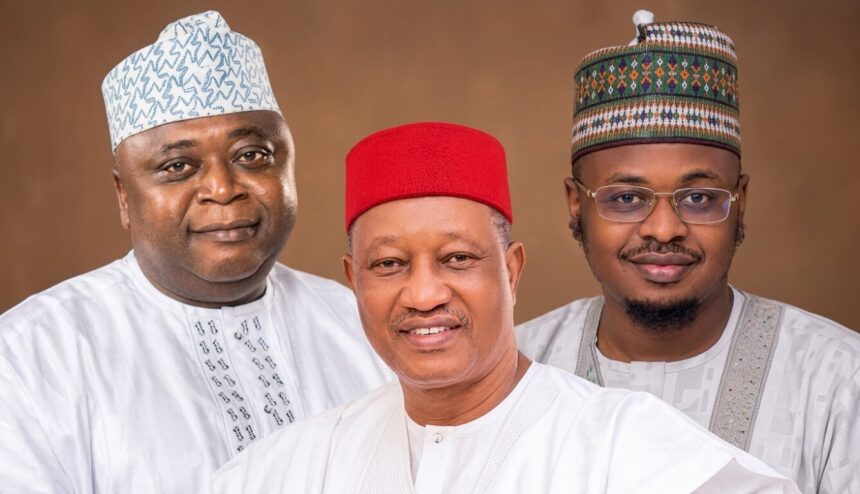
The commission’s position affects several prominent politicians, including former Minister of Communications and Digital Economy, Prof. Isa Ali Ibrahim Pantami, who was cleared by the Peoples Democratic Party (PDP) to contest the 2027 governorship election in Gombe State, and the PDP’s Ladi Adebutu in Ogun State.
Other affected candidates include Comrade Aminu Abdussalam Gwarzo of the Nigeria Democratic Congress (NDC) in Kano State and Danjuma Laah of the NDC in Kaduna State.
In Bauchi State, INEC also excluded governorship candidates of the Social Democratic Party (SDP), New Nigeria Peoples Party (NNPP), Action Alliance (AA) and Accord Party (AP), identified as Abdullahi Yakubu, Musa Zubairu, Ahmed Shuaibu and Mohammed Aminu, respectively.
According to Daily Trust, the commission reached the decision after a meeting of its top officials in Abuja that lasted several hours.
In a statement issued on Tuesday and signed by Mohammed Kudu Haruna, National Commissioner and Chairman of INEC’s Information and Voter Education Committee, the commission said the exclusions followed a September 24, 2026, Supreme Court judgment affirming the constitutionality of Section 77(5)–(7) of the Electoral Act, 2026.
The provisions make it mandatory for political parties to submit their membership registers before conducting valid primary elections.
INEC explained that the Supreme Court, in INEC v. Zenith Labour Party, Appeal No. SC/CV/495/2026, upheld the relevant provisions of the Electoral Act and overturned an earlier Court of Appeal decision that had nullified them.
The apex court also upheld Item 2 of INEC’s timetable for the 2027 general elections, which required political parties to submit their membership registers between April 21 and May 10, 2026.
The commission said the court further ruled that political parties that failed to meet the requirement would be ineligible to sponsor candidates in the elections.
INEC added that it applied the judgment while finalising the governorship candidates’ list in compliance with Section 287(1) of the 1999 Constitution, as amended, which requires authorities to enforce decisions of superior courts.
The commission noted that the final lists of presidential and National Assembly candidates had already been published on September 12, 2026, before the Supreme Court delivered its judgment.
However, INEC said political parties that believe their candidates were wrongly omitted can formally notify the commission under Section 32(2) of the Electoral Act, 2026.
The deadline for such notifications is October 24, 2026.
INEC reiterated its commitment to transparency, the rule of law and the credibility of the electoral process.
Pantami, Adebutu Challenge Exclusion
The commission’s decision has triggered reactions from affected politicians and their supporters, with some questioning the circumstances surrounding the omissions.
Pantami, on Monday, issued a three-day ultimatum to INEC, demanding the publication of his name as the PDP’s governorship candidate in Gombe State.
In a letter dated October 12, 2026, and addressed to the INEC chairman, his lawyers, Ahmed Raji & Co., described the omission as unlawful and demanded that the commission correct the list within three days.
The Kwankwasiyya Movement also appealed to its members and supporters to remain calm, expressing confidence that the matter could be resolved through available administrative and legal channels.
In a statement issued on Sunday, the movement’s spokesperson, Dr. Habibu Sale Mohammed, said the development had generated concern among supporters but urged them to avoid speculation and the circulation of unverified information.
The movement also called on the NDC to act swiftly to protect the interests of its candidates.
In Ogun State, Adebutu questioned why he and his running mate, Yemi Sowunmi-Kolapo, were omitted from INEC’s list despite other PDP candidates contesting legislative seats appearing on the published lists.
In a statement posted on his X and Facebook accounts on Sunday, Adebutu said the circumstances surrounding their exclusion raised serious questions.
He maintained that the matter would be pursued through the appropriate channels, insisting that due process must be respected.
INEC Chairman, Prof. Joash Amupitan, had last week confirmed that the commission received the certified true copy of the Supreme Court judgment and was reviewing it.
Tuesday’s decision by the commission’s top officials is understood to represent its position on the affected governorship candidates.
The development has also renewed debate over the extent of INEC’s authority to exclude candidates on the basis of the Supreme Court judgment, particularly where political parties have already conducted primaries and announced their preferred candidates.
How the Dispute Began
The dispute originated from a legal challenge instituted by the Zenith Labour Party against provisions of the Electoral Act concerning political party primaries and membership registers.
The party approached the Federal High Court in Abuja, arguing that the provisions were inconsistent with the 1999 Constitution and amounted to unconstitutional interference in the internal affairs of political parties.
Its arguments relied, among other provisions, on Sections 221 and 222 of the Constitution, which establish the constitutional framework governing political parties.
However, the Federal High Court, presided over by Justice Mohammed Umar, dismissed the suit in a judgment delivered on May 5, 2026.
Dissatisfied with the ruling, the party appealed to the Abuja Division of the Court of Appeal in a case marked CA/ABJ/CV/750/2026.
On July 16, 2026, the appellate court allowed the appeal in part and nullified provisions of the Electoral Act relating to party primaries and membership registers.
INEC subsequently approached the Supreme Court to challenge the Court of Appeal’s decision.
After hearing arguments from the parties, a seven-member panel of the Supreme Court, presided over by Justice Adamu Jauro, reserved judgment before delivering its decision on September 24, 2026.
The Supreme Court’s ruling has since become the basis for INEC’s decision to exclude candidates whose parties failed to comply with the membership-register submission requirement, setting the stage for further administrative and potential legal challenges ahead of the 2027 elections.