
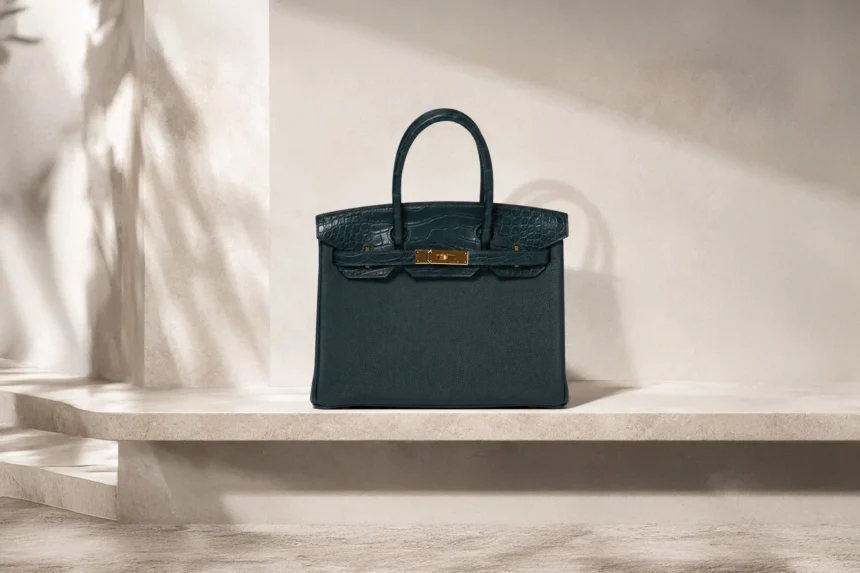
“I was wondering why the Birkin is so expensive. I mean, it’s just a bag.”
It’s a question many people ask when they first discover that a Hermès Birkin can cost anywhere from $10,000 to well over $100,000.
At first glance, it looks like a beautifully crafted leather handbag with a clean, timeless design. Nothing about its appearance immediately explains its staggering price.
So, what exactly are people paying for?
The answer has surprisingly little to do with fashion trends and everything to do with craftsmanship, scarcity, history, and one remarkable conversation at 30,000 feet.
The story of the Birkin began in 1984 during an Air France flight from Paris to London.
English actress and singer Jane Birkin found herself seated next to Jean-Louis Dumas, the CEO of Hermès. At the time, Birkin carried an oversized wicker basket filled with everything she needed for her busy life, from scripts to diapers.
As she tried to place the basket in the overhead compartment, its contents spilled into the aisle.
Dumas immediately helped gather her belongings, and the incident sparked a conversation. Birkin explained that she had searched for years without finding a handbag that looked elegant while remaining spacious and practical enough for everyday life.
She reportedly joked that if Hermès ever made such a bag, she would happily abandon her famous wicker basket.
Inspired by the challenge, Dumas grabbed an airplane sick bag and sketched his first ideas for what would eventually become the Birkin.
Few people could have imagined that a simple travel mishap would inspire one of the world’s most recognizable luxury accessories.
Contrary to popular belief, Hermès never intended the Birkin to become a symbol of wealth.
Jean-Louis Dumas designed the bag as a practical companion for women with demanding lifestyles. He combined generous storage space with a structured silhouette, sturdy handles, a secure flap closure, and protective metal feet that reduced wear when the bag rested on the ground.
Instead of chasing fashion trends, the design focused on functionality.
The understated appearance also reflected Hermès’ philosophy. Rather than relying on oversized logos or flashy branding, the company allowed exceptional craftsmanship to speak for itself.
More than four decades later, the overall design remains largely unchanged because practical elegance rarely goes out of style.
Many people assume the Birkin commands such a high price simply because it carries a luxury label.
Craftsmanship tells a different story.
Unlike most designer handbags, which pass through multiple workers during production, one highly trained artisan creates every Birkin from start to finish.
Before earning that responsibility, artisans spend years mastering Hermès’ traditional techniques. Once qualified, they hand-stitch every bag using the brand’s signature saddle stitch, a method that demands extraordinary patience and precision.
Completing a single Birkin can take anywhere from 18 to 40 hours, depending on the leather, hardware, and level of customization.
Materials also play a significant role.
Hermès sources premium leathers such as Togo, Clemence, and Epsom from carefully selected suppliers around the world. For rare editions, the company also works with exotic skins, including crocodile, alligator, and ostrich. Depending on the design, artisans finish the bag with hardware plated in gold or palladium.
Every material must meet the brand’s exacting quality standards before production even begins.
Exceptional craftsmanship explains part of the Birkin’s value.
Scarcity explains the rest.
Hermès deliberately limits production because every artisan can complete only a small number of bags each year. Instead of increasing output to satisfy demand, the company protects its reputation by maintaining strict production standards.
As a result, customers usually cannot walk into a boutique and purchase a Birkin immediately.
Many spend years building relationships with Hermès before a sales associate offers them the opportunity to buy one. Even then, buyers often have little control over the color, leather, or hardware available.
The company also limits how many quota bags a customer may purchase each year, further restricting supply.
Basic economics does the rest.
When demand consistently exceeds supply, prices continue to rise.
Over time, the Birkin evolved far beyond its original purpose.
Celebrities, collectors, and investors gradually transformed it into one of the world’s most sought-after luxury items. Today, many collectors view certain Birkin models as financial assets rather than fashion accessories.
Rare colors, discontinued leathers, and limited editions often appreciate in value. Some sell for double or even triple their original retail prices on the resale market.
Unlike many luxury purchases, a carefully maintained Birkin can become more valuable with age.
Ironically, the woman who inspired the Birkin never treated it like an untouchable collector’s item.
Jane Birkin decorated her bags with stickers, ribbons, charms, and pins. She filled them with everyday essentials and carried them until they showed obvious signs of wear.
She reportedly donated the royalties Hermès paid for the use of her name to charity.
Her generosity extended even further. Birkin auctioned several of her personal bags to raise money for AIDS research, disaster relief in Japan, and other humanitarian causes.
For her, the Birkin remained exactly what it had always been,a practical bag designed for everyday life.
Whether a Birkin deserves its extraordinary price depends on how you define value.
Anyone searching for a functional handbag can find countless alternatives that perform the same job for a fraction of the cost.
However, buyers rarely purchase a Birkin solely for its function.
They invest in exceptional craftsmanship, generations of artisan expertise, carefully sourced materials, remarkable scarcity, and one of fashion’s most fascinating origin stories.
That combination has turned a practical leather bag into a global symbol of luxury.
So, is the Birkin “just a bag”?
Physically, yes.
Culturally, economically, and historically, it has become something much bigger.
Perhaps that’s the real logic behind the Birkin. People don’t simply buy leather and stitching—they buy craftsmanship, heritage, exclusivity, and a story that began with an ordinary conversation on an airplane.