
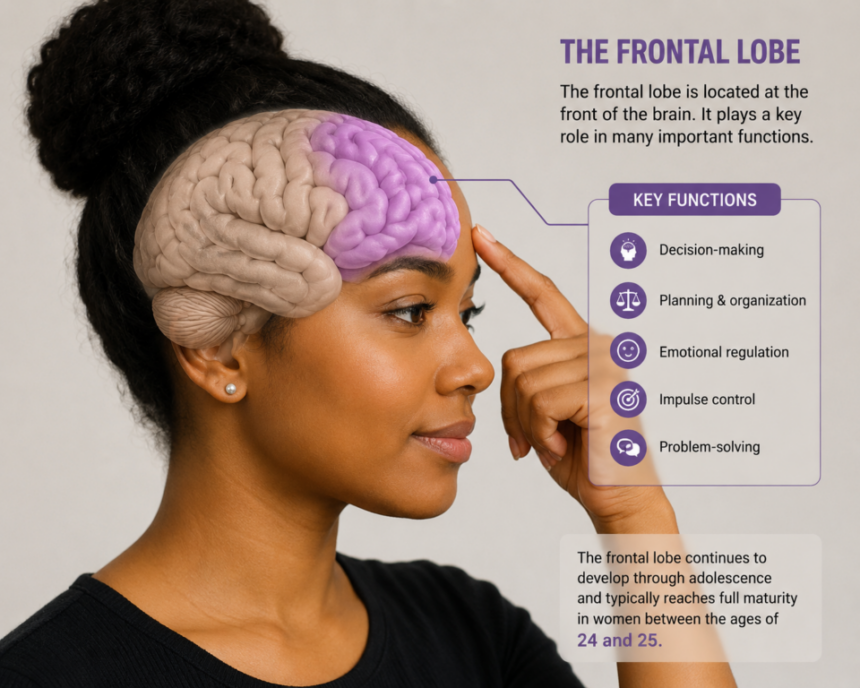
Many people have heard the phrase, “Your brain isn’t fully developed until you’re 25.”
While often repeated casually, the statement reflects scientific findings about the frontal lobe, particularly the prefrontal cortex, which plays a vital role in decision making, emotional regulation, planning, and impulse control.
Researchers have found that this area of the brain continues to develop throughout adolescence and early adulthood. In women, the frontal lobe generally reaches maturity between the ages of 24 and 25, although development varies from person to person.
“The frontal lobe is responsible for many of the skills associated with adulthood,” explains neuroscientists. “It helps individuals evaluate consequences, manage emotions, and make long term decisions.”
Growing Beyond Adolescence
Brain development does not end with the teenage years. During adolescence, the frontal lobe undergoes significant changes as neural connections strengthen and become more efficient.
For many young women, these developmental changes coincide with important life transitions such as entering university, beginning careers, establishing relationships, and gaining independence.
As the frontal lobe matures, individuals often show greater self-control, improved judgment, and stronger problem-solving abilities.
Scientists also continue to study the influence of hormones on brain development. Changes associated with puberty and adulthood may affect emotional processing and cognitive function, contributing to the unique developmental experiences women encounter throughout their lives.
Understanding Maturity
The continued growth of the frontal lobe may help explain why perspectives and behaviors often change between the late teenage years and the mid-twenties.
Experiences that once seemed overwhelming may become easier to manage as cognitive and emotional skills strengthen.
Experts caution, however, that brain development does not follow a strict timeline. While many women reach frontal lobe maturity around age 25, genetics, environment, education, and personal experiences can influence the pace of development.
Looking Ahead
Advances in neuroscience continue to reveal how the brain evolves over time. Researchers believe that understanding frontal lobe development can improve conversations about mental health, education, and personal growth.
Although scientists consider the mid-twenties an important milestone in brain maturation, they emphasize that learning and adaptation continue throughout life.
The human brain remains capable of forming new connections, acquiring new skills, and responding to new experiences well beyond early adulthood.
For many women, the journey toward maturity involves more than age alone. It reflects a gradual process of growth, learning, and self-discovery shaped by both biology and experience.