
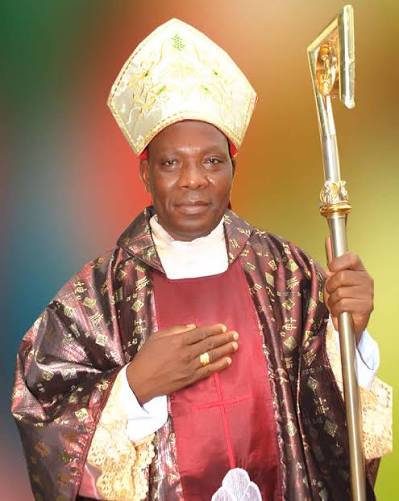
The Catholic Bishop of Maiduguri Diocese, Most Rev. Oliver Dashe, has called on Christians to intensify prayers for an end to insecurity and the Boko Haram insurgency in Borno State.
Bishop Dashe, however, stressed that prayers must be complemented by decisive action from government and security agencies to achieve lasting peace in the state and across Nigeria.
He made the call in Maiduguri after a church session at St Patrick’s Cathedral to commemorate the Solemnity of the Assumption of the Blessed Virgin Mary.
The bishop acknowledged the relative improvement in security across parts of Borno State after years of devastating insurgency, but warned that the progress should not lead to complacency.
“From the religious angle, we know that prayers will crush Boko Haram. However, we should know that as we pray, human beings must also do their work,” he said.
According to him, Christians have a responsibility to remain vigilant and deepen their commitment to prayer as part of efforts to confront the security challenges facing the country.
“It is very important that Christians should be on alert, and one of the best ways to be alert is to be prayerful,” Dashe added.
He said the celebration of the Assumption provided an opportunity for Catholic faithful to seek divine intervention for Borno State and Nigeria while appreciating God for the relative peace recorded in parts of the region.
“This is what we have done today. We have come in order to pray, thank our Mother Mary and to ask for more of her own intercession in our lives, our state and our country,” he said.
The bishop also attributed the relative calm experienced in parts of Borno to what he described as the intervention of the Virgin Mary.
Reflecting on the early years of the insurgency, Dashe recalled the devastating impact Boko Haram had on communities across the state.
“One of the things she has done is the fact that she brought relative peace in this axis. We know that when the Boko Haram crisis started about 17 years ago, it was not funny, but now, we are experiencing peace,” he said.
He noted that the improvement in the security situation had enabled some residents who fled their communities during the height of the insurgency to return home.
“People who fled have come back and are now serving their own God and that can be attributed to the intervention of our Mother Mary,” he maintained.
Despite the progress, Dashe emphasised that prayer alone cannot address the security crisis.
He urged the Federal Government and the Borno State Government to continue providing security agencies with the resources and operational support required to confront insurgents.
The bishop specifically called for sustained military operations in forests and mountainous areas where remnants of terrorist groups may still be hiding.
He said lasting peace would require security agencies to pursue terrorists and dismantle their remaining operational networks.
“In this wise, I call on the government, both at the federal and state levels, to do the needful in ensuring that security personnel are able to go to the forest and mountains in order to fetch these terrorists and their members for peace to return to our state and country at large,” Dashe said.
The bishop also used the occasion to highlight the importance of the Solemnity of the Assumption to Catholics, describing the Virgin Mary as central to the spiritual life of the Maiduguri Diocese.
He said Marian devotions, including the recitation of the rosary, the use of miraculous medals and pilgrimages, remained important aspects of the Catholic faith in the diocese.
“I have been the Bishop of this diocese for the past 17 years, and as I stand here before you, it is because of her intercession,” Dashe said.
He added that the diocese had continued to reconsecrate families and individuals to the Immaculate Heart of Mary as part of its spiritual response to the challenges facing the faithful.
The bishop’s comments come against the backdrop of more than a decade of Boko Haram violence that made Borno State the epicentre of the insurgency in Nigeria’s North-East.
The conflict displaced large numbers of residents, disrupted livelihoods and destroyed homes, schools, health facilities and other critical infrastructure across several communities.
Although sustained military operations have significantly reduced the ability of insurgents to seize and control large territories as they did during the height of the conflict, security threats remain, particularly in remote communities and areas vulnerable to infiltration.
The security situation has also continued to influence the state’s reconstruction and resettlement efforts, with government authorities working to facilitate the return of displaced residents to their communities.
The Borno State Government has continued to provide support to security agencies as part of efforts to strengthen counter-insurgency operations.
In June, Governor Babagana Zulum handed over two Mine Resistant Ambush Protected vehicles, operational vehicles and motorcycles to the military to enhance troops’ capacity to respond to ambushes and improvised explosive devices.
The administration has also pursued the reconstruction and resettlement of communities affected by the insurgency while supporting rehabilitation and reintegration initiatives for repentant insurgents.
For Bishop Dashe, however, the pursuit of lasting peace requires both spiritual and practical action.
His message reflects a broader argument that while faith and prayer remain important sources of hope for communities affected by violence, effective security operations, intelligence gathering, reconstruction, rehabilitation and community engagement are equally necessary to prevent a resurgence of terrorism.
The bishop’s call therefore places responsibility on both citizens and government: citizens must remain vigilant and prayerful, while authorities must sustain the security and development measures required to consolidate the gains made against insurgency.