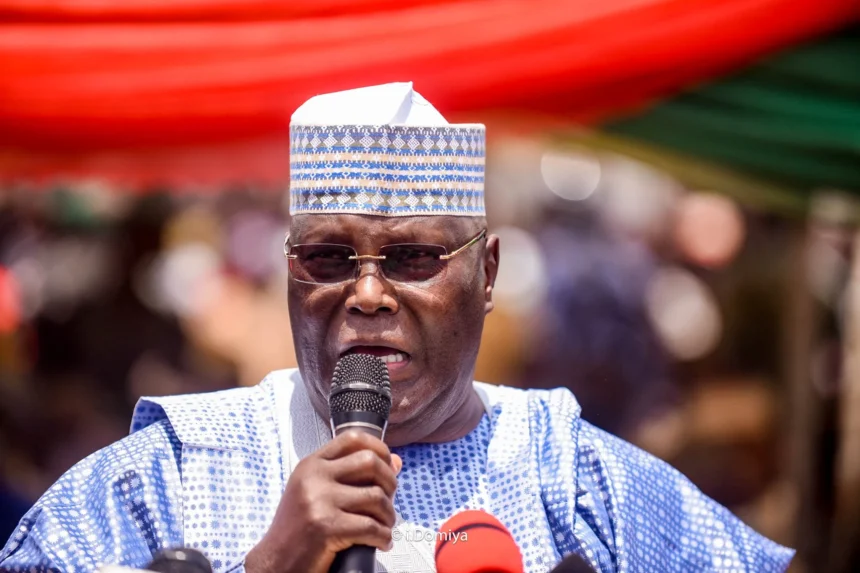
The Presidential Candidate of the African Democratic Congress (ADC), Atiku Abubakar, has criticised the Federal Government’s decision to increase fees for Federal Unity Colleges and approve a uniform ₦50,000 examination fee for the West African Examinations Council (WAEC) and the National Examinations Council (NECO), warning that the policy could force thousands of Nigerian children out of school.
The former Vice President described the decision as “cruel and economically insensitive,” arguing that it comes at a time when millions of Nigerian families are already struggling with rising inflation, high food prices, increased transportation costs, electricity tariff hikes and widespread unemployment.
The Federal Government recently approved a review of the Senior School Certificate Examination (SSCE) fee from the current ₦27,500 to a uniform ₦50,000 for both WAEC and NECO examinations, beginning in 2027.
According to a statement issued on June 18 by the Director of Senior Secondary Education in the Federal Ministry of Education, Adeniji Ibrahim, the decision followed a meeting between examination bodies and the Minister of Education, who directed both WAEC and NECO to adopt a uniform examination fee.
Reacting to the development in a statement released on Sunday through his Senior Special Assistant on Public Communication, Phrank Shaibu, Atiku said the increase contradicts the government’s constitutional obligation to make education accessible to every Nigerian child.
He said education remains the most effective pathway out of poverty and warned that imposing additional financial burdens on parents would deny many children the opportunity to complete their education.
“A government that genuinely believes in the future of its people does not erect financial barriers between children and education. It removes them,” Atiku said.
The ADC presidential candidate expressed concern that Nigeria already has one of the highest numbers of out-of-school children globally, estimating that between 10.5 million and 15 million children are currently outside the classroom.
According to him, rather than introducing policies that could worsen the situation, government should be investing more resources to bring children back to school.
He argued that the increase in Unity School fees and the higher cost of WAEC and NECO examinations would disproportionately affect children from low-income and middle-income families, many of whom are already struggling to meet basic household needs.
Atiku also warned that making secondary school examinations more expensive could limit access to tertiary education, as many qualified students may be unable to afford the examinations required for university admission.
He questioned the government’s education priorities, saying investments in education should focus on improving access rather than creating additional financial barriers.
The former Vice President further argued that education should never become another avenue through which citizens bear the consequences of economic hardship and policy failures.
He called on President Bola Ahmed Tinubu to reverse the increase in Unity School fees and the proposed ₦50,000 WAEC and NECO examination fee.
Atiku also urged the Federal Government to convene an urgent stakeholders’ dialogue on sustainable financing for public education, while investing more in public schools, educational infrastructure, teacher recruitment and expanded access to quality education.
The Federal Government has maintained that the revised examination fee is intended to support the effective conduct of the Senior School Certificate Examinations beginning in 2027.