
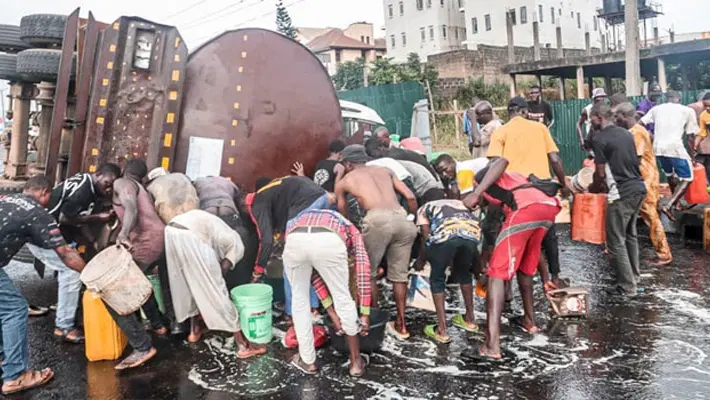
For many Nigerians, the sight of an overturned fuel tanker may appear to be an unexpected opportunity to get petrol or diesel without paying for it.
People often arrive at accident scenes with buckets, jerrycans, containers and other improvised materials, attempting to collect fuel that has spilled from a damaged tanker. But what may look like a chance to obtain free fuel can quickly become a life-threatening disaster.
Experts, emergency agencies and road-safety authorities have repeatedly warned Nigerians to stay away from fallen petroleum tankers and allow trained emergency responders to secure the area.
The warning has become increasingly urgent following a series of deadly tanker explosions in different parts of the country, several of which involved people gathering around crashed tankers to scoop spilled fuel.
What Does “Scooping Fuel” Mean?
Fuel scooping refers to the act of collecting petrol, diesel or other petroleum products that have leaked or spilled from a fallen, damaged or overturned tanker.
In Nigeria, the practice has become a recurring feature of some tanker crashes. People may use buckets, jerrycans, bowls or other containers to collect the spilled product for personal use or resale.
The danger is that a tanker accident involving fuel is not an ordinary road accident.
Even when there is no visible fire immediately after a crash, the area may already contain highly flammable fuel vapour capable of igniting suddenly.
According to the United States Centers for Disease Control and Prevention, gasoline is a volatile, flammable liquid whose vapours can travel to an ignition source and flash back. The vapour is also heavier than air, meaning it can accumulate in low-lying areas. (CDC)
The UK Health and Safety Executive similarly warns that petrol is highly flammable and can produce vapour that is easily ignited, potentially resulting in serious fires or explosions. (HSE)
This means a person does not necessarily have to stand beside the leaking tanker for an explosion to occur. Fuel vapour can spread away from the original spill and encounter an ignition source elsewhere.
Why Is Scooping Fuel So Dangerous?
The first danger is fuel vapour.
Petrol evaporates quickly, creating vapour that can mix with air. Under the right conditions, that mixture can ignite and produce a rapidly spreading fire.
The second danger is that the ignition source may not be obvious.
A cigarette, open flame, hot surface, electrical equipment, vehicle component or spark can potentially ignite flammable vapour. The United States CDC notes that gasoline vapours can travel to an ignition source and flash back to the location where the vapour originated. (CDC)
The third danger is static electricity.
People approaching a tanker with containers, moving around the spilled product or transferring fuel may unknowingly create conditions capable of producing an ignition source.
The fourth danger is the tanker itself.
A damaged tanker may still contain a substantial quantity of fuel. Structural damage, pressure, heat and further movement can make the situation unstable. Approaching the vehicle, climbing onto it or attempting to transfer its contents can expose people to additional hazards.
The fifth danger is the crowd.
Once people begin rushing toward a fallen tanker, emergency responders may struggle to establish a safety perimeter. A large crowd also creates confusion and makes evacuation more difficult if fire suddenly breaks out.
The Deadly Lesson From Jigawa
One of the clearest examples came on October 15, 2024, at Majiya in Taura Local Government Area of Jigawa State.
A petrol tanker crashed and spilled fuel. Residents gathered around the wreckage to collect the product. The tanker subsequently exploded, killing more than 140 people according to early reports, while many others sustained injuries. Reuters initially reported at least 94 deaths, while later reports put the death toll at 147. (reuters.com)
The tragedy demonstrated how quickly an apparently ordinary fuel spill can turn into a mass-casualty incident.
Safety professional Timothy Iwuagwu, president of the Institute of Safety Professionals of Nigeria, said many tankers were not designed in accordance with international best practices for preventing fuel spillage during accidents. He also pointed to inadequate enforcement and insufficient public awareness as part of the problem. (Al Jazeera)
But the lesson from Majiya did not end the practice.
The Dikko-Suleja Explosion
On January 18, 2025, another devastating tanker explosion occurred near Dikko Junction in Niger State.
A petrol tanker overturned, after which people gathered around the vehicle to collect the spilled fuel. The explosion killed at least 86 people and injured 55 others, according to the Niger State Emergency Management Agency as reported by Reuters. (reuters.com)
The scale of the tragedy was so severe that emergency responders had to deal with mass casualties and a large number of burn victims.
The incident again exposed the deadly combination of economic desperation, easy access to spilled fuel and inadequate compliance with safety warnings.
The National Emergency Management Agency has repeatedly described fuel scooping as a dangerous practice responsible for deaths, injuries, destruction of property and environmental damage. (Voice of Nigeria)
NEMA has also urged the public to keep away from tanker accident scenes and allow emergency agencies to take control. (NEMA Nigeria)
Another Warning From Niger State
The problem resurfaced in October 2025.
On October 21, a fuel tanker overturned and exploded in Niger State, killing at least 35 people, according to the Federal Road Safety Corps and Reuters. Reports said residents had approached the tanker to retrieve its contents before the explosion. (reuters.com)
The Federal Government subsequently condemned the incident, noting that Nigerians had continued to engage in fuel scooping despite repeated public warnings.
In a statement dated October 22, 2025, Minister of Information and National Orientation Mohammed Idris said the incident demonstrated the devastating human and material consequences of tanker accidents and directed the National Orientation Agency to intensify public awareness, particularly in rural and high-risk communities. (Federal Ministry of Info)
Lagos Incident Shows The Danger Is Still Present
The practice has not disappeared even in heavily populated urban areas.
On January 19, 2026, residents gathered around a fallen tanker at Liverpool Bridge in the Apapa area of Lagos and attempted to scoop spilled diesel.
The tanker had overturned on the bridge, spilling large quantities of diesel onto the carriageway and into the area below. Reports said about 100 people gathered around the accident scene before emergency responders intervened. (The Guardian Nigeria)
LASTMA officials dispersed the crowd and emergency agencies secured the scene to prevent a possible fire.
The Lagos State Fire and Rescue Service subsequently carried out a controlled transfer of the remaining diesel and secured the tanker, preventing what officials described as an imminent secondary incident. (The Guardian Nigeria)
The incident prompted Lagos State Governor Babajide Sanwo-Olu to condemn the practice, describing it as reckless and warning residents against risking their lives for spilled petroleum products. (The Guardian Nigeria)
In other words, even when an explosion does not occur, that does not mean the decision to approach the tanker was safe. It may simply mean disaster was narrowly avoided.
A Spark Does Not Need To Come From The Tanker
One of the most misunderstood aspects of fuel accidents is the belief that the tanker must catch fire before people are in danger.
That is incorrect.
Petrol can release vapour rapidly. The CDC warns that gasoline vapours can travel to a source of ignition and flash back. (CDC)
Government safety guidance on petrol similarly notes that vapour-air mixtures can be explosive, and that vapour can travel along the ground before encountering an ignition source. (GOV.UK)
Consequently, a person may be scooping fuel while believing there is no immediate danger, only for an ignition source some distance away to trigger a rapidly spreading fire.
This is why experts describe a crashed fuel tanker as a hazardous scene that should be treated as an emergency zone, not a source of free petroleum products.
The Economic Argument
Why, despite repeated deaths and warnings, do people still scoop fuel?
There is an economic dimension.
Nigeria’s prolonged increase in petrol prices and wider cost-of-living pressures have made spilled fuel increasingly attractive to some people. Reuters noted that the rise in fuel prices following the removal of the petrol subsidy contributed to the economic incentives surrounding fuel collection from accident scenes. (reuters.com)
For some individuals, the calculation may be simple: collect what appears to be free fuel rather than spend money to purchase it.
For others, the objective may be resale.
But the potential value of a few litres of fuel cannot be compared with the consequences of severe burns, permanent disability or death.
The challenge, therefore, is not merely to condemn those who scoop fuel. It also requires government and communities to recognise the economic conditions that can encourage people to take extraordinary risks.
What Experts And Agencies Are Saying
The message from safety authorities is consistent: stay away.
The Nigerian Safety Investigation Bureau has specifically reminded citizens of the grave dangers associated with scooping fuel from tanker accident scenes and urged people to avoid such locations. (Nigerian Safety Investigation Bureau)
The Federal Road Safety Corps has also participated in nationwide public-awareness efforts aimed at preventing fuel scooping and other dangerous road practices. The Corps has urged Nigerians to support measures designed to prevent deaths and property destruction associated with tanker crashes. (FRSC)
NEMA has called for stronger safety practices, public awareness, better tanker maintenance, driver training and improved emergency response. (Voice of Nigeria)
Safety professional Timothy Iwuagwu has argued that the problem also requires stronger regulatory enforcement, safer tanker design and greater public compliance with safety rules. (Al Jazeera)
These interventions point to an important reality: stopping fuel-scooping deaths is both a public responsibility and a government responsibility.
What Should Nigerians Do After A Tanker Crash?
The safest decision is simple: do not approach the tanker.
Do not attempt to collect leaking petrol or diesel.
Do not smoke or light a fire near the scene.
Do not start a generator or operate equipment unnecessarily around a fuel spill.
Do not encourage children or other people to go closer to the tanker.
Do not attempt to transfer the fuel yourself.
Instead, move away from the area and alert the police, fire service, road safety authorities, NEMA or the appropriate emergency agency.
NEMA’s safety campaigns specifically advise members of the public to maintain a safe distance from accident scenes involving tankers while emergency responders take control. (NEMA Nigeria)
The Bigger Problem: Tanker Safety
Fuel scooping is only one part of the tanker explosion problem.
NEMA has identified several contributing factors behind tanker disasters, including reckless driving, poor vehicle maintenance, inadequate road infrastructure, human error and other safety failures. (NEMA Nigeria)
The Federal Road Safety Corps has also continued to push for stronger enforcement and safer transportation practices for petroleum products. (FRSC)
This means prevention must begin before the tanker reaches the highway.
Tankers must be properly maintained. Drivers must be adequately trained and monitored. Speed limits must be enforced. Dangerous routes and road sections require attention. Emergency response must be rapid. Most importantly, the public must understand that a fuel spill is an emergency, not an opportunity.
The Cost Of One Mistake
A person approaching a fallen tanker may think the risk is worth it because he or she expects to collect five, 10 or even 20 litres of fuel.
But the potential consequences are far greater.
A single ignition can produce a fire involving multiple people within seconds. A person can suffer extensive burns, lose limbs, become permanently disabled or die.
The consequences also extend beyond those scooping fuel. Nearby residents, motorists, traders, emergency workers and entire communities can become victims.
The destruction can include vehicles, shops, houses, roads, bridges and other public infrastructure.
The Majiya tragedy in Jigawa and the Dikko tragedy in Niger State are painful examples of what can happen when a fuel spill becomes a gathering point.
The Message Is Simple
A fallen tanker is not a petrol station.
Spilled fuel is not free money.
An overturned tanker is an active emergency scene capable of becoming a fireball without warning.
The repeated tragedies across Nigeria show that the danger is not theoretical. People have died in Jigawa. People have died in Niger State. Crowds have been dispersed from tanker accident scenes in Lagos because emergency agencies recognised the possibility of a major fire.
The National Emergency Management Agency, the Nigerian Safety Investigation Bureau, the Federal Road Safety Corps, state emergency agencies and safety professionals have all issued variations of the same warning.
Nigerians should stay away from fallen fuel tankers.
No quantity of spilled petrol or diesel is worth a human life.
The choice should not be between getting free fuel and watching it go to waste.
The choice should be between walking away alive and taking a risk that has repeatedly ended in mass deaths.