

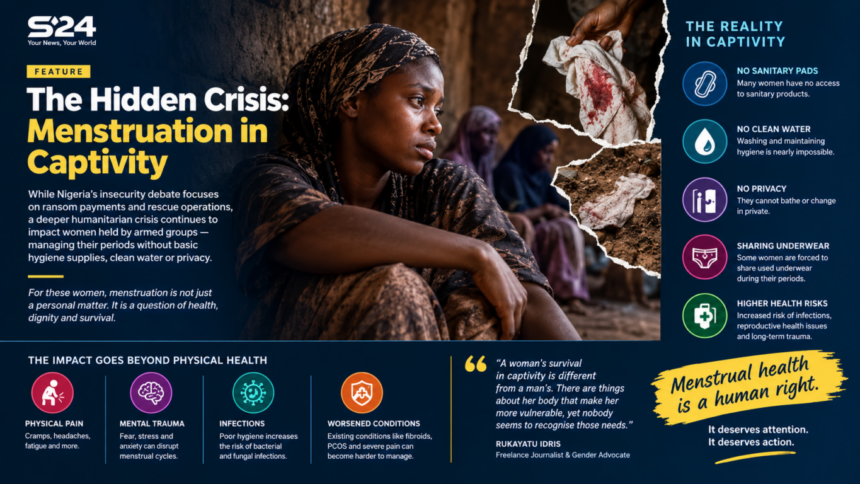
While Nigeria’s insecurity debate focuses on ransom payments, rescue operations and casualty figures, a largely overlooked humanitarian crisis continues to affect women held captive by armed groups: the struggle to manage menstruation without basic hygiene supplies, clean water or privacy.
For these women, menstruation is not merely a personal or private matter. It is a question of health, dignity and survival.
When Lami’s period began while she was held by Boko Haram, she had no sanitary pads, clean underwear or private place to wash. With nothing available to absorb the blood, she sometimes sat on the sand and allowed it to soak into the ground.
Another survivor recalled how women in captivity shared underwear during their periods. After one woman had used and washed it, she passed it to the next woman waiting for her turn.
These accounts, documented in a HumAngle investigation based on interviews with women who survived Boko Haram captivity, reveal a neglected dimension of Nigeria’s conflict: the challenges women face when a natural biological process continues under conditions that deny them basic hygiene and privacy.
A SILENT STRUGGLE
Public discussions of kidnapping and insurgency in Nigeria often centre on abductions, ransom negotiations, military operations and the circumstances surrounding victims’ release. Less attention is paid to the everyday realities of life in captivity, including how women manage menstruation without essential supplies.
For women in ordinary circumstances, menstrual health can involve cramps, headaches, fatigue, lower back pain and emotional distress. Access to sanitary products, clean water, private toilets, pain relief and spare clothing can make these challenges manageable.
Women held by insurgents and other armed groups, however, may have none of these necessities. Their menstrual cycles continue despite the violence and disruption surrounding them, leaving them to improvise with whatever materials they can find.
Rukayatu Idris, a freelance journalist and gender advocate based in Borno State, says the lack of attention reflects a wider reluctance to discuss menstruation openly.
“We still see menstruation as a taboo,” she says, arguing that the subject receives limited media attention because it is often not recognised as a serious problem.
Even in communities unaffected by conflict, menstruation can be difficult to discuss openly. In humanitarian emergencies, where food, shelter and security understandably dominate attention, menstrual health is often pushed further down the list of priorities.
For women in captivity, however, the consequences are immediate. Survivor testimonies describe a lack of sanitary materials, clean water, bathing facilities and private spaces. Some women resorted to using the ground to absorb menstrual blood, while others shared underwear because no alternatives were available.
According to Idris, these experiences reveal how captivity can affect women differently from men.
“A woman’s survival in captivity is different from a man’s,” she explains. “There are things about her body that make her more vulnerable, yet nobody seems to recognise those needs.”
Already struggling with fear, uncertainty and the threat of violence, women in captivity must contend with another monthly challenge—often in silence and without the means to protect their health or dignity.
WHEN THE BODY BECOMES ANOTHER BATTLEFIELD
The consequences extend beyond discomfort. Dr Michael, a gynaecologist and public health expert, says the experiences described by survivors reflect a broader humanitarian and public health problem affecting women who lose access to essential services during conflict, displacement and captivity.
“Women and children are the most vulnerable in any humanitarian crisis,” he says. “When women lose access to basic services, menstrual hygiene is one of the areas that is significantly affected.”
The problem is not limited to women held by armed groups. Women living in internally displaced persons’ camps, conflict-affected communities and areas devastated by disasters such as flooding can also struggle to manage menstruation when clean water, toilets, healthcare and menstrual products are unavailable.
Without suitable sanitary products or clean alternatives, women may be forced to use whatever materials they can find. Where water is scarce and washing facilities are absent, maintaining menstrual hygiene becomes particularly difficult.
Dr Michael warns that prolonged exposure to unhygienic conditions can increase the risk of genital irritation and infections, including bacterial and fungal infections. Contaminated materials and inadequate cleaning facilities can further compound these risks.
Survivors have also described sharing underwear during menstruation. While such practices may be driven by desperation, sharing items contaminated with blood or other bodily fluids can create additional health risks, particularly when hygiene is poor.
The effects of captivity can also reach beyond physical health. Prolonged fear and psychological stress may disrupt the hormonal processes that regulate menstruation, potentially contributing to irregular periods or changes in menstrual symptoms. The effects vary from one woman to another.
For women living with conditions such as fibroids, polycystic ovary syndrome (PCOS) or severe menstrual pain, the absence of regular medication and medical supervision can make existing symptoms harder to manage.
“Depending on the woman’s condition,” Dr Michael explains, “these existing health problems can be exacerbated because she is unable to manage them properly.”
The combination of physical pain, psychological trauma, poor hygiene and limited access to healthcare can leave women increasingly vulnerable. Conditions that might otherwise be treated may go unmanaged for extended periods.
For this reason, he argues, rescue operations should be followed by comprehensive medical and psychological care.
“There needs to be a holistic assessment of the women,” he says. “Not just a physical assessment, but also a mental assessment.”
Such care may include reproductive health examinations, screening for infections and pregnancy where clinically appropriate, as well as mental health support. The specific services required will depend on each survivor’s circumstances and medical needs.
“In many cases, mental healthcare is not something we primarily look at,” he adds. “But providing mental healthcare for every woman who has gone through that ordeal is very important.”
Freedom from captivity, therefore, should mark the beginning of recovery rather than the end of the response. Survivors need sustained support to address physical injuries, reproductive health concerns and the psychological consequences of their experiences.
MORE THAN A HYGIENE ISSUE
For Idris, the neglect of menstrual health during conflict reflects a deeper social problem: the tendency to treat menstruation as a private matter rather than an essential aspect of women’s health.
“People talk about food, shelter and security, and rightly so,” she says. “But menstrual hygiene is also a basic need. When we ignore it, we ignore the dignity and health of women.”
She argues that menstrual dignity should be treated as a core component of humanitarian assistance, not a luxury to be considered after other needs have been met.
The ability to manage menstruation safely and privately affects more than physical health. Being denied basic supplies and facilities can undermine a woman’s confidence, self-esteem and overall wellbeing, particularly when she is already enduring violence, uncertainty and isolation.
These consequences may persist long after survivors return home. While public attention often centres on their release, some continue to require treatment for infections and other health conditions, reproductive healthcare and psychological support.
Dr Michael says post-rescue services should assess survivors’ physical, reproductive and mental health needs rather than focus exclusively on visible injuries.
For Idris, addressing these gaps also requires a change in how the media reports insecurity.
“If we continue to overlook women’s specific experiences, we will never fully understand the true cost of conflict,” she says.
Nigeria’s insecurity has generated countless headlines, statistics and policy debates. Yet the experiences of women in captivity reveal how much remains hidden behind the figures. Survival is not measured solely by escaping armed groups or returning home alive. It also involves enduring pain without medication, menstruating without sanitary products, living without privacy and struggling to maintain basic hygiene in inhumane conditions.
Recognising these realities does not diminish the importance of rescue operations, security measures or efforts to end abductions. Rather, it broadens the understanding of what protecting victims and supporting survivors must entail.
Humanitarian responses should account for women’s specific needs, including access to menstrual products, clean water, safe toilets, appropriate healthcare and privacy. These provisions should also be considered in support for displaced women and others affected by conflict and disasters.
RESTORING DIGNITY AFTER CAPTIVITY
The experiences of women held by Boko Haram challenge Nigeria to look beyond ransom payments, rescue operations and casualty figures. They highlight the gender-specific costs of conflict and the need to treat dignity as an essential part of humanitarian protection.
Armed groups can take away a woman’s freedom, separate her from her family and deprive her of the necessities of daily life. But captivity does not stop her body from functioning. Menstruation continues, even when the conditions required to manage it safely have disappeared.
That reality should not remain invisible!
As Nigeria confronts persistent insecurity, the experiences of women in captivity deserve greater attention from policymakers, humanitarian organisations, healthcare providers and the media. Their needs must be recognised both during emergencies and after their release.
Because the true cost of captivity cannot be measured by ransom payments or casualty figures alone. It must also be measured by the human dignity denied, the health risks endured and the support survivors need to rebuild their lives.
A woman’s freedom is essential. So is her dignity. Neither should be overlooked.