


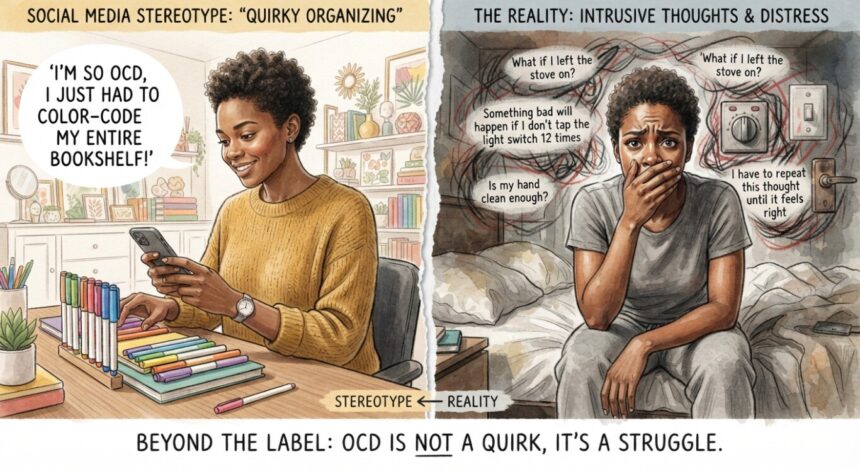
You see a picture frame hanging slightly crooked. You straighten it. You arrange the shoes by the door, line up the items on your desk and rearrange everything until it looks just right. Then you say, almost proudly, “I’m so OCD.”
You have probably heard someone say it, or perhaps you have said it yourself. On social media, the phrase has become a familiar way to describe people who love clean spaces, organised rooms and perfectly arranged objects. Sometimes, people even use it as a badge of honour, as if having OCD means they simply have better taste, higher standards or an eye for detail.
But what if the condition people casually claim to have is nothing like what they imagine?
Obsessive compulsive disorder (OCD) is a recognised mental health condition that can turn ordinary moments into exhausting struggles. It involves unwanted, recurring thoughts and repetitive behaviours or mental rituals that people feel driven to perform. For some, the distress can interfere with work, relationships, sleep and everyday activities.
This raises an uncomfortable question: has social media turned a serious mental health condition into a personality trait people use to describe themselves?
When OCD became a social media personality
Scroll through social media and you will find countless examples of people celebrating their need for order. A desk must look perfect. Clothes must sit in the right place. A kitchen counter must remain spotless. Even a minor change to an arrangement can become the subject of a joke about being “OCD”.
The problem is not that people enjoy cleanliness or organisation. There is nothing wrong with wanting a tidy room or feeling satisfied when everything falls into place. The problem begins when these ordinary preferences become the main public image of a condition that can be far more distressing.
Research suggests that this is not just an online impression.
A 2023 study published in The Professional Counselor examined 50 popular TikTok videos created by women and tagged with #OCD. Researchers found that 28 videos, representing 56 per cent of the sample, minimised OCD symptoms or portrayed the condition inaccurately. Some videos treated the disorder as a synonym for being neat, organised or particular about details.
That means more than half of the videos in this small sample risked reinforcing an incomplete or misleading picture of OCD.
A separate study published in 2025 examined 117 TikTok videos about the condition. Researchers classified 64 videos, or 54.7 per cent, as accurate. However, 31 videos, representing 26.5 per cent, overgeneralised OCD, while 22 videos, or 18.8 per cent, contained inaccurate information.
Together, the findings reveal a complicated picture. Social media can help people learn about mental health, but it can also spread misconceptions when creators simplify a disorder for entertainment or engagement.
These studies examined selected TikTok videos, not all social media content or Nigerian users. They cannot tell us how widespread the trend is in Nigeria. However, they show why the way people portray OCD online deserves closer attention.
The part of OCD that a neat desk cannot explain
If OCD were simply about liking things in their proper places, the conversation would end here. But the clinical reality goes much deeper.
According to the United States National Institute of Mental Health, obsessions are recurring, unwanted thoughts, urges or mental images that cause distress. Compulsions are repetitive behaviours or mental acts that a person feels driven to perform, often to manage that distress.
Imagine locking your door before leaving home. Most people check once and continue with their day. Someone experiencing OCD may feel overwhelming doubt about whether the door is secure. They might return to check it repeatedly, even after seeing that it is locked. The checking may provide temporary relief, but the doubt can return and start the cycle again.
For another person, the fear might involve contamination. They may wash their hands repeatedly because ordinary contact leaves them feeling intensely anxious. Someone else may experience unwanted thoughts about accidentally harming a loved one, despite having no desire to cause harm.
These experiences can be frightening precisely because the thoughts may conflict with what the person wants or believes. Some people hide their symptoms because they fear judgement or worry that others will mistake an unwanted thought for an intention.
And not everyone with OCD has symptoms involving cleaning. Some struggle with repeated doubts, mental rituals, intrusive thoughts or the feeling that they must repeat an action until it feels right.
This is what the familiar social media stereotype leaves out: OCD is not simply about what looks wrong to someone. It can involve a persistent cycle of distress and compulsions that the person finds difficult to control.
What the numbers tell us
OCD is not a personality label invented by social media. It is a recognised condition that can significantly affect a person’s ability to function.
The United States National Institute of Mental Health estimates that 1.2 per cent of American adults experienced OCD in a given year, while 2.3 per cent experienced it at some point in their lives.
The agency’s data also show the condition’s potential impact. Among adults with OCD in the survey, 50.6 per cent experienced serious impairment in daily functioning. Another 34.8 per cent experienced moderate impairment, while 14.6 per cent experienced mild impairment.
These figures come from the US National Comorbidity Survey Replication, which collected the relevant data between 2001 and 2003. They are not current Nigerian estimates, but they demonstrate that OCD can affect far more than a person’s preference for an orderly environment.
Nigeria needs reliable, nationally representative data to establish how many people live with OCD and what challenges they face when seeking care. Without such evidence, assigning a Nigerian prevalence figure would be misleading.
Still, the available research raises an important question: when people repeatedly encounter OCD as a joke about cleanliness, how easily can they recognise symptoms that look nothing like that stereotype?
When a joke becomes a problem
Calling yourself “so OCD” because you dislike a messy room may seem harmless. Most people who use the phrase probably do not intend to mock anyone. They may simply be repeating language they have heard from friends, celebrities or online creators.
Yet repeated jokes can shape public understanding. When people reduce OCD to perfectionism, they risk overlooking the distress, shame and disruption that some people experience.
Consider someone who spends hours repeating actions because they fear something terrible will happen if they stop. If everyone around them treats OCD as a quirky love for neatness, they may struggle to explain why their experience feels so different. They may even question whether their symptoms deserve attention because they do not fit the popular image.
The problem is not that every casual use of the term directly harms someone with OCD. Rather, the repeated oversimplification can reinforce stereotypes and make accurate conversations about the condition more difficult.
There is also a difference between recognising a possible symptom and diagnosing yourself. Liking symmetry, disliking dirt or checking something twice does not automatically mean you have OCD. Mental health professionals consider the nature of a person’s symptoms, the distress they cause and their effect on daily life before making a diagnosis.
So, is OCD a disorder or a flex?
The answer depends on what we mean by the word.
Enjoying a clean home, arranging your clothes carefully or wanting your work to meet high standards does not automatically indicate OCD. These can be ordinary preferences, and people should not feel that every habit requires a medical explanation.
But OCD is not a badge of perfection. It can involve distressing obsessions, compulsions and a cycle that interferes with everyday life. Effective treatments exist, including cognitive behavioural therapy that uses exposure and response prevention. Clinicians may also recommend medication when appropriate.
Anyone experiencing persistent, distressing symptoms can seek an assessment from a qualified mental health professional rather than relying on social media descriptions.
Social media does not have to stop people from talking about OCD. In fact, open conversations can help challenge stigma and encourage people to seek support. What matters is whether those conversations reflect the condition accurately.
The next time someone says they are “so OCD” because a picture frame sits at an angle, it may be worth remembering that a preference for straight lines and a mental health disorder are not the same thing.
The real flex is understanding the difference.