
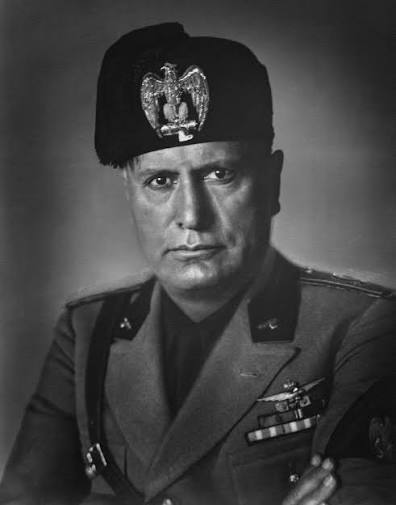
Benito Mussolini rose from a socialist journalist to one of the most powerful and feared political figures in 20th-century Europe, he promised to restore Italy’s strength, built a movement around nationalism and political violence, and eventually created a dictatorship that controlled nearly every part of Italian life.
His story began far from the grand stages of European politics.
Born on July 29, 1883, in Dovia di Predappio, Mussolini grew up in a modest family. His father, Alessandro, worked as a blacksmith and supported socialism, while his mother, Rosa, worked as a schoolteacher.
Mussolini entered politics through socialism. He joined the Italian Socialist Party and developed a reputation as an aggressive journalist and political speaker. In 1912, he became editor of the party newspaper Avanti! and dramatically increased its circulation.
However, World War I changed his political direction.
Mussolini initially opposed Italy’s participation in the war. He later began supporting intervention, arguing that the conflict could strengthen Italian nationalism. His position put him against the Socialist Party, which expelled him.
That break became one of the most important turning points in his life. Mussolini abandoned orthodox socialism and embraced nationalism.
The Birth of Fascism
In 1919, Mussolini founded the Fasci Italiani di Combattimento, the movement that eventually became the National Fascist Party.
The movement attracted former soldiers, nationalists, disillusioned socialists and other Italians who wanted a stronger state. Fascist squads, known as Blackshirts, soon became central to the movement.
They used intimidation and violence against socialists, communists, trade unionists and other political opponents. Their attacks helped create an atmosphere of fear and instability across Italy.
Mussolini understood that political power required more than street violence. He transformed his movement into a political organisation and entered parliament in 1921.
Then came the moment that changed Italy forever.
The March on Rome
In October 1922, thousands of Fascists mobilised for the March on Rome.
King Victor Emmanuel III refused to approve a military order that would have imposed a state of siege on Rome. Instead, he invited Mussolini to form a government.
On October 31, 1922, Mussolini became prime minister.
The transfer initially followed Italy’s constitutional framework, but Mussolini quickly used his position to dismantle that system from within.
He weakened political opposition, strengthened the Fascist Party and expanded the power of the state.
Building a Dictatorship
Mussolini gradually turned Italy into a one-party dictatorship.
His government restricted political opposition, attacked independent organisations and used intimidation to silence critics. Fascist institutions increasingly replaced democratic structures.
Propaganda also became a powerful weapon.
The regime presented Mussolini as Il Duce, the strong leader who could supposedly restore Italy’s greatness. His image appeared throughout public life, while the state promoted Fascist ideas through education, political organisations and the media.
Mussolini also intervened heavily in the economy. His government expanded state control over businesses and introduced policies designed to make Italy more economically self-sufficient.
But Mussolini’s ambitions extended beyond Italy.
The Pursuit of Empire
Mussolini wanted Italy to become a major imperial power.
In 1935, Italy invaded Ethiopia. The conflict brought international condemnation and sanctions from the League of Nations.
Instead of retreating, Mussolini moved closer to Nazi Germany.
The Ethiopian invasion marked an important shift in his foreign policy. The sanctions damaged Italy’s relationship with Britain and France and encouraged Mussolini to strengthen his relationship with Adolf Hitler.
By 1936, Italy and Germany had formed the Rome-Berlin Axis. Mussolini also sent military forces to support Francisco Franco during the Spanish Civil War.
His growing partnership with Hitler eventually became one of the most consequential decisions of his career.
Mussolini and World War II
When Germany invaded Poland in 1939, Italy initially stayed out of the war. Mussolini knew his country lacked the resources for a prolonged conflict.
But in June 1940, after Germany achieved major victories, Mussolini entered the war on Hitler’s side.
The decision proved disastrous.
Italian forces suffered major defeats in North Africa and on the Eastern Front. At home, Allied bombing disrupted industry, food shortages worsened and public confidence in Mussolini collapsed. Large strikes broke out in northern Italy in 1943, revealing the growing opposition to his government.
The image of the powerful dictator began to crumble.
The Fall of Il Duce
The Allied invasion of Sicily in July 1943 pushed Italy toward collapse.
The Fascist Grand Council turned against Mussolini. King Victor Emmanuel III dismissed him and placed him under arrest.
German forces later rescued him from captivity.
Hitler then installed Mussolini as the leader of the Italian Social Republic, a German-backed regime in northern Italy. By this stage, however, Mussolini no longer controlled Italy as he once had. Germany held the real military power.
The man who once promised to make Italy a great power now depended on Hitler for his survival.
A Violent End
By April 1945, Germany’s position in Italy was collapsing.
Mussolini attempted to flee as Allied victory approached, but Italian partisans captured him and his mistress, Clara Petacci.
On April 28, 1945, the two were executed near Mezzegra.
His death ended one of the most notorious political careers in modern European history.
The Legacy of Mussolini
Mussolini’s rise demonstrated how political instability, nationalism, propaganda and violence can help an authoritarian movement gain power.
He entered government through a constitutional appointment, but then weakened the institutions that had brought him to power. He built a personality cult around himself, suppressed opposition and pursued military expansion that ultimately left Italy devastated.
His political journey also shows how quickly ideological transformation can reshape a nation. Mussolini began his career as a socialist journalist before becoming the founder of fascism.
His final years offered a stark contrast to his earlier image of strength. As Italy collapsed around him, the dictator who once claimed to embody the nation became dependent on Nazi Germany and eventually fell into the hands of the resistance.
Mussolini’s story therefore remains more than the biography of one dictator. It is a warning about the consequences of political violence, unchecked power and the destruction of democratic institutions.