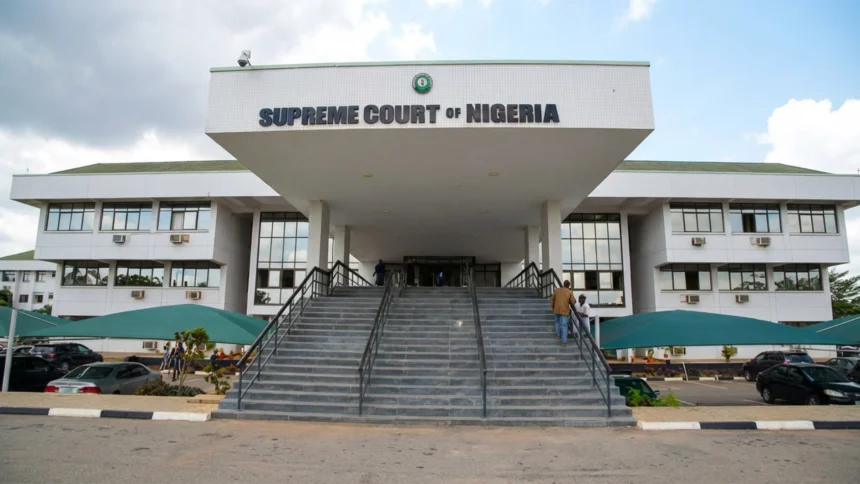
The Supreme Court of Nigeria will deliver judgment today in two major political cases involving the African Democratic Congress (ADC) and the Peoples Democratic Party (PDP). The decisions may reshape opposition politics ahead of the 2027 elections.
At the centre of both cases is a key issue: how far courts can вмеш (intervene) in internal party affairs, and which faction has legitimate leadership
The ADC case involves former Senate President David Mark.
Mark is asking the Supreme Court to overturn earlier rulings that allowed a lawsuit challenging the party’s leadership to proceed.
His lawyer, Jibrin Okutepa (SAN), argues that courts should not interfere in internal party matters. He says a previous Supreme Court decision already supports this position.
However, Nafiu Gombe’s lawyer, Robert Emukpero (SAN), disagrees. He insists the case is valid and that lower courts acted correctly.
The Court of Appeal earlier ruled against Mark. It said his appeal was premature. It also ordered the case to return to trial court. The court directed all sides to maintain the current status.
After that ruling, the Independent National Electoral Commission (INEC) withdrew recognition of the Mark-led leadership. INEC said it would wait for a final court decision.
The PDP case focuses on a disputed national convention held in Ibadan, Oyo State.
A faction led by Taminu Turaki wants the Supreme Court to restore the convention’s legitimacy. Their lawyer, Paul Erokoro (SAN), argues that the convention followed party rules and should stand.
Opponents, including Sule Lamido, argue otherwise. They say the party disobeyed a valid court order by holding the convention.
Lamido had earlier obtained a court order stopping the convention. The order required the party to allow him participate in the chairmanship race before any election.
Despite this, the party went ahead with the convention. Both the trial court and the Court of Appeal later ruled that the action violated the court order.
The Court of Appeal then nullified the convention. It also rejected claims that the issue was purely an internal party matter.
The Supreme Court’s decisions could settle long-standing debates about political party autonomy in Nigeria.
The rulings may also determine which factions control both the ADC and PDP.
Political observers say the outcome could reshape opposition politics ahead of the 2027 general elections.