
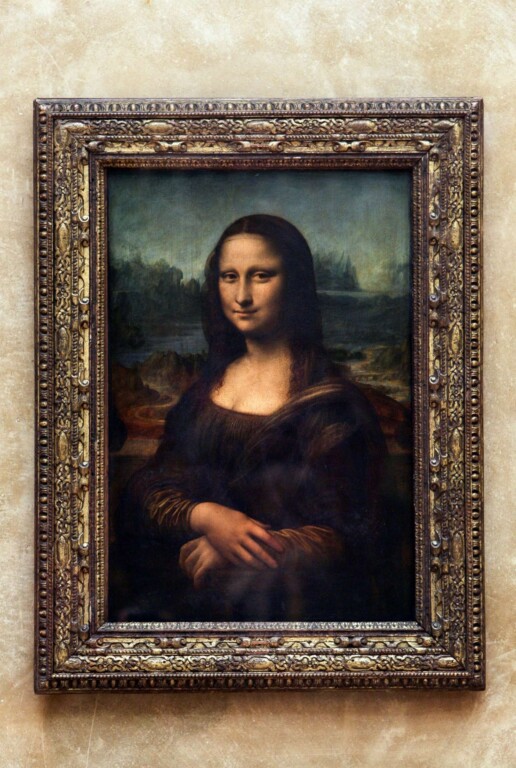
Mona Lisa remains one of the most recognized paintings in the world today attracting millions of people to the Louvre Museum just to catch a glimpse of the famous portrait and its mysterious smile.
Italian artist Leonardo da Vinci painted the artwork between 1503 and 1519. Most historians believe the woman in the portrait was Lisa del Giocondo, a noblewoman from Florence.
The painting stood out from other portraits of its time. Many wealthy women in Renaissance paintings wore expensive clothes and jewelry to display their status. Mona Lisa appeared simple and calm instead. Da Vinci focused attention on her face and expression rather than luxury.
He also painted her in a different pose. Instead of showing her stiffly from the side, he turned her slightly toward the viewer. She looks directly at the audience with a soft smile that continues to spark debate centuries later.
Da Vinci used a painting method called sfumato, which blended light and shadow smoothly. The technique gave the portrait a realistic and almost lifelike appearance. The background also fades gently into the distance, creating depth and mystery.
For centuries, the Mona Lisa belonged to French royalty. After the French Revolution, officials placed it in the Louvre, where it became one of the museum’s prized works.
At one point, French leader Napoleon Bonaparte even kept the painting in his bedroom before it returned to the museum.
Although artists admired the painting, the public did not see it as a global icon during the early 1900s. Everything changed after a shocking theft in 1911.
On August 21, 1911, Vincenzo Peruggia stole the Mona Lisa from the Louvre in what later became one of the most famous art crimes in history.
Peruggia had once worked at the museum. Wearing an old employee uniform, he entered the Louvre without attracting attention. He hid inside a storage closet overnight.
The next morning, he walked into the room where the Mona Lisa hung. Since the museum was quiet and nearly empty, he removed the painting from the wall, took it out of its frame, wrapped it in cloth, and carried it away.
His escape surprised many people because it seemed incredibly easy. At one point, he struggled with a locked door, but a plumber helped him open it because he assumed Peruggia worked there.
Museum workers did not notice the missing painting immediately. Staff members often removed artworks for cleaning or photography, so nobody raised concern at first.
The theft only came to light after an artist visited the gallery and noticed the empty space on the wall.
Once news spread, newspapers around the world covered the story. Police questioned several famous figures, including French poet Guillaume Apollinaire and Spanish artist Pablo Picasso.
Investigators eventually cleared both men.
Meanwhile, Peruggia hid the painting inside his Paris apartment for more than two years.
In 1913, he tried to sell the artwork to an art dealer in Florence, Italy. Instead of buying it, the dealer contacted police. Authorities arrested Peruggia in his hotel room, and officials recovered the painting safely.
The Louvre welcomed the Mona Lisa back in 1914.
Before the theft, many people knew little about the painting outside the art world. The robbery changed everything.
Newspapers printed the portrait across front pages worldwide. Suddenly, millions of people recognized the Mona Lisa. The mystery surrounding the crime increased public fascination with the artwork.
Many historians now believe the theft itself helped transform the painting into a worldwide cultural symbol.
The Mona Lisa faced several attacks after returning to the Louvre.
In 1956, a visitor threw a rock at the painting and damaged a small area near Mona Lisa’s left elbow. During an exhibition in Tokyo in 1974, another person sprayed red paint at the protective case during a protest. In 2009, a visitor threw a teacup at the glass after French authorities reportedly denied her citizenship request.
Museum officials increased security after each incident.
Today, the painting sits inside a climate-controlled glass case designed to protect it from damage and theft. Bulletproof glass shields the artwork from attacks, while strict crowd control limits how long visitors can stand near it.
Most people now spend less than a minute viewing the masterpiece before moving along.
More than 500 years after da Vinci painted it, the Mona Lisa continues to attract attention from around the globe. Its fame comes not only from artistic brilliance, but also from mystery, controversy, and one unforgettable robbery.
The small portrait survived theft, vandalism, war, and endless public fascination. Yet the woman’s famous smile still keeps people guessing, just as it did centuries ago.