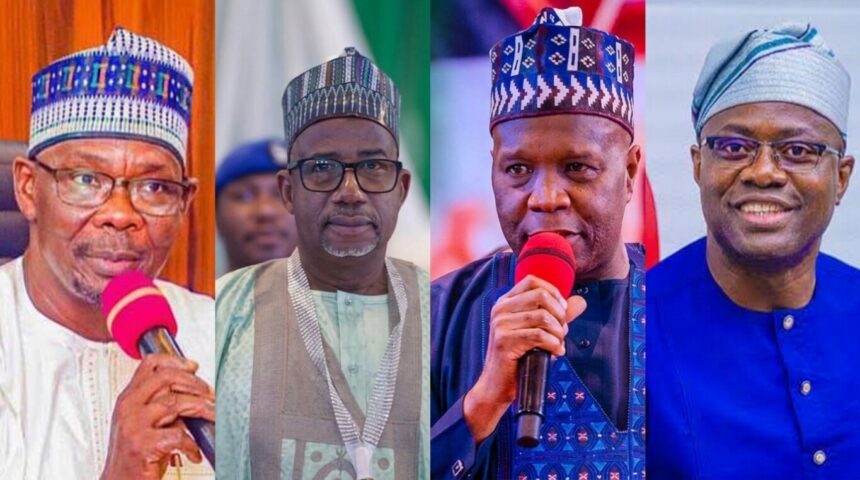
As preparations for Nigeria’s 2027 general elections gather momentum, some outgoing state governors are positioning themselves for new political roles, with senatorial seats and higher national offices emerging as potential destinations.
Among the governors linked to fresh political ambitions are Oyo State Governor Seyi Makinde, Nasarawa State Governor Abdullahi Sule, Gombe State Governor Muhammadu Inuwa Yahaya and Bauchi State Governor Bala Mohammed.
Their reported and declared ambitions reflect a recurring feature of Nigerian politics, where governors approaching the end of their constitutionally permitted tenures often seek elective positions that would allow them to remain active in national and state politics.
However, the status of each governor’s ambition differs, ranging from reported interest in higher office to an announced party nomination or a stated plan to contest a senatorial seat.
Seyi Makinde: Looking Beyond Oyo State
Oyo State Governor Seyi Makinde has been linked to broader political calculations ahead of the 2027 elections, including speculation about a possible presidential ambition or another major national elective position.
Makinde, a member of the Peoples Democratic Party (PDP), has remained an influential figure within the party and Nigeria’s opposition politics.
His political activities have attracted attention as discussions continue over the future of the PDP, possible opposition cooperation and the search for candidates for the 2027 presidential election.
A potential national ambition would represent a shift from state-level governance to a wider political contest. However, the precise office Makinde intends to pursue has not been established by the information available here, and reports of presidential interest should not be treated as a formal declaration without confirmation from the governor.
His next political move will be significant to discussions about the PDP’s leadership and the broader opposition landscape ahead of the elections.
Abdullahi Sule: Nasarawa North Senatorial Seat
Nasarawa State Governor Abdullahi Sule has acknowledged pressure from political stakeholders, supporters and people from his senatorial district to contest the Nasarawa North seat in the Senate after completing his tenure as governor.
In March 2026, Sule said the appeals from people who had worked with him and other stakeholders had prompted him to reconsider his earlier position that he would not seek another elective office after leaving Government House. <Cite refs={[“turn301070search2″,”turn301070search5”]}/>
The governor subsequently moved towards the senatorial contest, with a delegation of political stakeholders submitting his nomination form for the race under the All Progressives Congress (APC) in May 2026. <Cite refs={[“turn301070search18”]}/>
A transition from the executive arm of government to the legislature would give Sule an opportunity to continue participating in public affairs at the federal level after serving two terms as governor.
His case also illustrates how outgoing governors can draw on their political networks and relationships with stakeholders when pursuing new elective offices.
Muhammadu Inuwa Yahaya: Gombe North Senatorial Seat
Gombe State Governor Muhammadu Inuwa Yahaya is the APC candidate for the Gombe North Senatorial District in the 2027 general elections, according to the party’s published candidate profile.
Yahaya, who has served as governor since May 2019 and secured re-election in 2023, is preparing to move from state executive leadership to the National Assembly.
His senatorial ambition places him in the contest for federal legislative representation of Gombe North, where he would seek to represent the district after completing his tenure as governor.
The move would mark a transition from overseeing state administration to participating in national lawmaking and representing constituents at the federal level.
His candidacy also adds another dimension to the political calculations surrounding succession and the distribution of political influence in Gombe State ahead of 2027.
Bala Mohammed: From Bauchi Government House to the Senate
Bauchi State Governor Bala Mohammed has confirmed his intention to contest the Bauchi South Senatorial District seat in the 2027 elections under the Allied Peoples Movement (APM).
Mohammed formally defected from the PDP to the APM in May 2026 alongside political associates and other party members. At the time, he described the move as a strategic decision following consultations with his supporters and political allies.
The governor subsequently clarified that his focus remained on the Bauchi South senatorial contest, dismissing reports that he was being considered as a running mate to former President Goodluck Jonathan.
His decision to pursue a Senate seat under a different party platform represents a major political realignment ahead of the elections.
If elected, Mohammed would move from leading the Bauchi State Government to representing the district in the National Assembly, where senators participate in federal legislation, oversight and constituency representation.
What the Governors’ Ambitions Mean for 2027
The political trajectories of Makinde, Sule, Yahaya and Mohammed illustrate different paths available to outgoing governors as they approach the end of their constitutionally permitted two terms.
While Makinde is pursuing the presidency, the other three governors are linked to senatorial contests, although their political circumstances and the stages of their candidacies differ.
Their moves also raise important questions about political succession, the future of their respective parties and the role former governors may play in national politics after leaving office.
For voters, the central issues will include the candidates’ records in public office, their legislative or executive priorities and the extent to which their proposals address the needs of the constituencies they seek to represent.
Ultimately, the 2027 elections will determine whether these outgoing governors can translate their experience in state government into new elective mandates. Their ambitions demonstrate that the end of a governorship tenure does not necessarily mark the end of a politician’s electoral career.