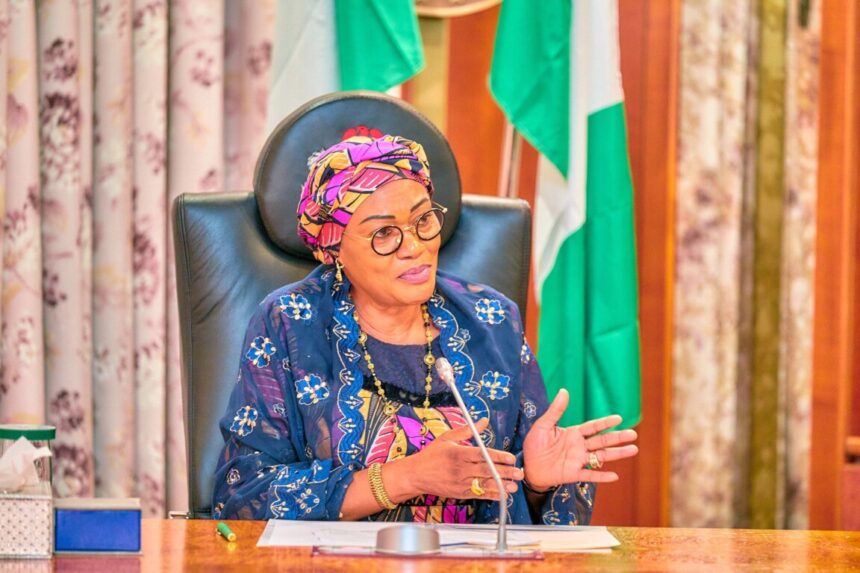
Nigeria’s First Lady, Senator Oluremi Tinubu, has launched the National Community Food Bank Programme for the North-West region in Hadejia, Jigawa State, describing the initiative as a sustainable response to food insecurity and malnutrition among vulnerable households across the country.
Speaking at the launch, the First Lady said the programme was designed to provide long-term support for vulnerable families while complementing the Renewed Hope Agenda of President Bola Ahmed Tinubu in the areas of food security, healthcare and social welfare.
“This initiative aligns with the Renewed Hope Agenda of His Excellency, President Bola Ahmed Tinubu, particularly in advancing food security, improving healthcare outcomes, and building a stronger and more prosperous Nigeria,” she said.
Senator Tinubu noted that the programme seeks to improve access to nutritious food for vulnerable groups, including children, pregnant women and nursing mothers, while strengthening community-based support systems.
The First Lady also commended Governor Umar Namadi for his administration’s efforts to improve the welfare of Jigawa residents. During her visit, she commissioned several projects in Hadejia, including the Senator Oluremi Tinubu Road, President Bola Ahmed Tinubu Road, Oluremi Tinubu Clinic and Dialysis Centre, and the President Bola Ahmed Tinubu Academy.
She expressed confidence in Jigawa State’s ability to successfully implement the programme, citing encouraging results recorded in Borno State, where 560 beneficiaries had already been enrolled and 468 vulnerable children, pregnant women and lactating mothers reached within two months of implementation.
According to her, the achievements recorded in Borno provide a strong foundation for expanding the initiative nationwide. She therefore called on individuals, organisations, institutions and development partners across the North-West to support the programme and ensure its success.
Responding, Governor Umar Namadi reaffirmed the commitment of North-West governors to promoting food security and improving nutritional outcomes for vulnerable households across the region.
He described the National Community Food Bank Programme as a timely intervention that complements government’s responsibility to protect citizens’ welfare through improved access to adequate food and nutrition.
Governor Namadi assured the First Lady that governors in the region would provide the necessary leadership and support to guarantee the successful implementation of the programme.
Highlighting Jigawa State’s achievements in nutrition and child welfare, the governor said the state’s home-grown MASAKI Nutrition Programme, currently operating in 300 communities across the 30 state constituencies, had screened about 245,000 children in 2024 and more than 382,000 children in 2025.
He disclosed that the initiative increased the number of children recovering from moderate acute malnutrition from about 19,000 to more than 43,000 within the same period.
The governor further stated that local government councils across the region would be mobilised to work closely with state agencies and community structures to ensure that the Community Food Bank Programme becomes a reliable platform for food assistance, nutrition protection and social support.
The National Community Food Bank Programme is expected to serve as a key intervention in addressing hunger and malnutrition among vulnerable populations while strengthening community resilience and improving public health outcomes across the North-West region.