
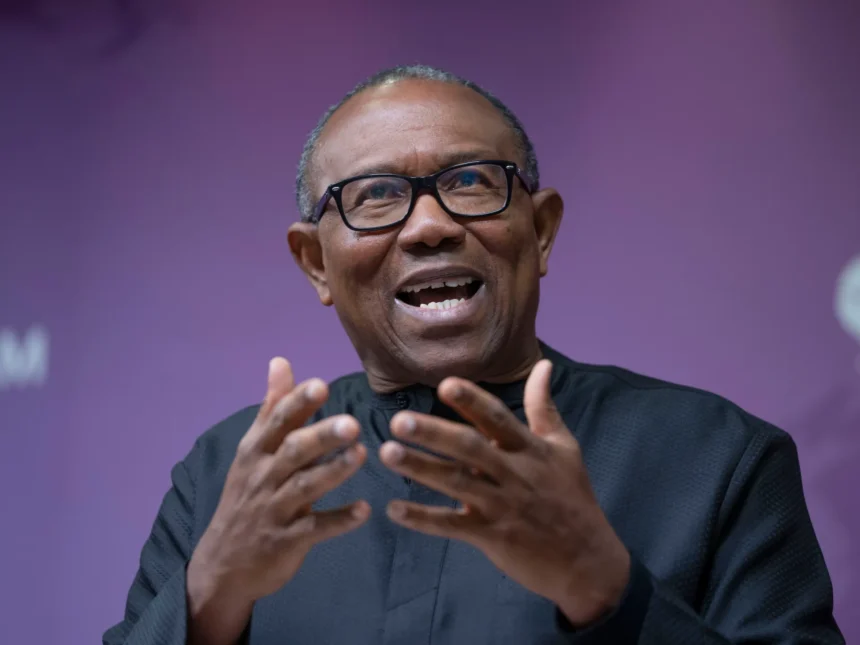
Former Anambra State Governor Peter Obi has urged Nigerians to reject politicians who promote violence during elections, calling for a free, fair and credible electoral process ahead of the 2027 general elections.
Obi made the call on Tuesday, August 18, 2026, in Abuja while speaking at the National Peace Accord signing ceremony organised by the National Peace Committee in collaboration with The Kukah Centre.
The former governor said political campaigns should focus on issues affecting Nigerians rather than violence, threats and personal attacks. He also challenged political candidates to demonstrate the qualities of responsible leadership throughout the electoral process.
According to Obi, candidates seeking public office should not need to sign a peace accord before deciding to conduct themselves peacefully.
Obi said no Nigerian should lose their life because of a political contest, stressing that human life must remain more important than political ambition.
He also urged Nigerians to remember those who died during the recent Osun State governorship election, using the incident to highlight the human cost of electoral violence.
For Obi, political leaders have a responsibility to prevent election-related deaths and ensure that competition for public office does not turn into a threat to the lives and safety of citizens.
His message was direct: political ambition should never come before human life.
Voters Should Reject Politicians Who Break Their Promises
When asked what should happen to politicians who violate the Peace Accord, Obi said Nigerians should refuse to vote for them.
His position places responsibility not only on political parties and candidates but also on voters, who ultimately have the power to determine who receives political office.
The ballot box, in this sense, becomes a tool for accountability.
Rather than relying only on legal or institutional sanctions, Obi argued that voters can punish politicians who promote violence by denying them electoral support.
This also means voters would have to pay close attention to how candidates behave before and during campaigns, rather than judging them only by their promises.
Obi Identifies the Electoral Process as His Biggest Concern
Asked about his biggest concern ahead of the 2027 elections, Obi pointed to the electoral process itself.
He said Nigerians must have the freedom to choose their leaders and stressed the importance of ensuring that voters’ choices are properly reflected in election results.
Explaining why he continues to participate in the electoral process despite the challenges surrounding Nigerian elections, Obi said: “Because I want to change the process, I have to go through it.”
The statement reflects his continued focus on electoral participation and efforts to influence how Nigeria’s political system operates.
Why the Peace Accord Matters
The National Peace Committee has promoted peaceful elections in Nigeria for years, encouraging political parties and candidates to reject violence, respect democratic rules and engage in dialogue.
The Peace Accord is intended to reduce political tension before, during and after elections.
However, signing an agreement is only the beginning.
For the accord to have a meaningful impact, political parties, candidates and their supporters must also respect the commitments they make and ensure that their actions match their public promises.
This becomes particularly important as political activity increases ahead of the 2027 elections.
Nigeria Moves Into a More Active Election Cycle
The Independent National Electoral Commission has already released its timetable for the 2027 general elections.
According to the timetable referenced in the statement, the presidential and National Assembly elections are scheduled for January 16, 2027, while the governorship and State Houses of Assembly elections are scheduled for February 6, 2027.
The campaign period is also approaching. Presidential and National Assembly campaigns are scheduled to begin on August 19, 2026, marking a significant step into the more active phase of the election cycle.
With political parties preparing their structures and candidates seeking support across the country, concerns over the conduct of campaigns are likely to remain central to the political conversation.
Security Remains a Major Election Concern
Political violence has affected Nigerian elections in the past, making the conduct of political parties, candidates and their supporters particularly important ahead of 2027.
While the electoral commission has a responsibility to organise credible elections, security agencies also play an important role in protecting voters, electoral officials and election materials.
Political parties and their supporters, however, remain central to preventing violence.
A peaceful election cannot depend entirely on security personnel. Candidates must avoid inflammatory rhetoric, supporters must reject violence and voters must be able to participate without fear.
Obi’s message gives Nigerian voters an important role in the political process.
His argument is that voters should judge politicians not only by what they say during campaigns but also by how they behave.
Candidates who promote peaceful politics should receive public support, while politicians who encourage violence should face rejection at the polls.
That approach places electoral accountability directly in the hands of citizens.
It also reinforces the idea that elections are not simply about choosing leaders but about deciding what kind of political behaviour society is willing to reward.
The Test Ahead of 2027
Nigeria is moving closer to another major electoral contest, with political parties preparing their campaigns and candidates positioning themselves for the 2027 polls.
The coming months will therefore provide an important test of whether political actors can compete without resorting to threats, intimidation or violence.
For Obi, the choice should be straightforward: political disagreements should be settled through democratic competition, while voters should be free to choose their leaders without fear.
As the 2027 election cycle gathers momentum, the success of that principle will depend not only on candidates and institutions but also on the millions of Nigerians who will ultimately cast their votes.
The message from Obi is clear: political power should be won through the ballot, not through violence, and Nigerians should use their votes to hold politicians accountable for the choices they make.