
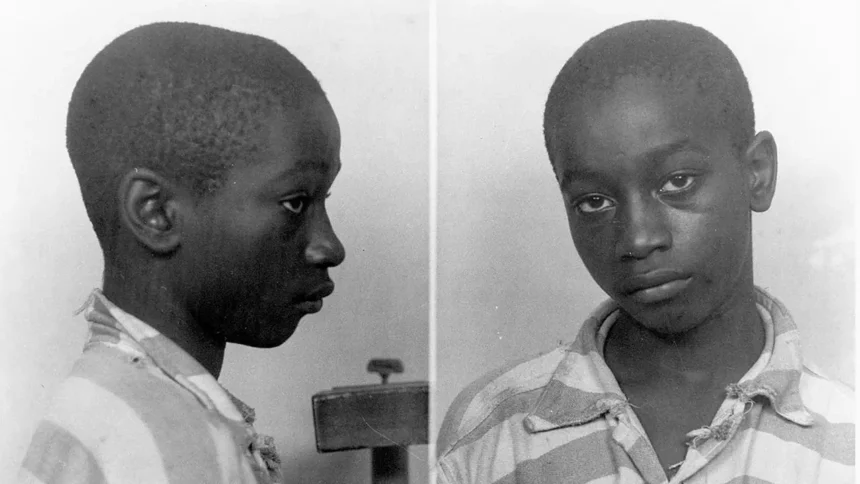
At just 14 years old, George Stinney Jr. became the youngest person executed in the United States during the 20th century.
Convicted in 1944 of killing two young white girls in South Carolina, he faced a trial that lasted only a few hours before an all-white jury found him guilty, seven decades later, a judge vacated his conviction, citing fundamental violations of his constitutional rights,
As the case of George Stinney Jr. remains one of the most disturbing chapters in American legal history, his story highlights the dangers of rushed proceedings, inadequate legal representation and a justice system shaped by racial inequality.
Who Was George Stinney Jr.?
George Junius Stinney Jr. was an African American boy who lived with his family in Alcolu, a small community in Clarendon County, South Carolina.
In 1944, he lived in a segregated society where racial discrimination affected nearly every aspect of daily life, including access to justice.Stinney was 14 when authorities arrested him in connection with the deaths of Betty June Binnicker, 11, and Mary Emma Thames, 7, who disappeared in March 1944.
Investigators later found the girls’ bodies in a ditch near the community. The authorities accused Stinney of killing them, setting in motion a legal process that would end his life within months.
The Murders and His Arrest
The two girls disappeared on March 23, 1944, after reportedly leaving their homes to look for flowers. Authorities discovered their bodies the following day.
Police subsequently arrested Stinney, who had reportedly seen the girls shortly before their disappearance.Investigators claimed that Stinney confessed to the killings. However, no written confession appeared in the surviving case record. The prosecution relied heavily on statements from police officers who said he admitted responsibility. The absence of a recorded confession and the limited documentation surrounding the interrogation later raised serious questions about how authorities obtained the alleged admission.
A Trial That Lasted Hours
Stinney’s trial took place on April 24, 1944, in Clarendon County, South Carolina. An all-white, all-male jury heard the case, while his court-appointed lawyer, Charles Plowden, offered little effective defence. The proceedings lasted approximately two and a half hours, and the jury reportedly reached its verdict after less than ten minutes of deliberation.The defence did not call witnesses to support Stinney’s alibi, and his lawyer did not meaningfully challenge the prosecution’s evidence. No appeal followed the conviction. These failures became central to the later court review, which found that Stinney did not receive the fair trial guaranteed by the Constitution.
The Evidence and Unanswered Questions
The prosecution’s case depended largely on the alleged confession and testimony from law-enforcement officers. Later reviews found no physical evidence directly connecting Stinney to the murders. Questions also emerged about the inconsistencies in the accounts of his alleged confession.Stinney’s family maintained that he was innocent. His sister, Amie Ruffner, later said she was with him around the time of the killings, but the original defence did not call her to testify. The surviving records do not provide a complete account of the investigation, and the absence of a full trial transcript makes it difficult to reconstruct every detail of the proceedings.
The Death Sentence and Execution
After the jury found Stinney guilty, Judge Philip H. Stoll sentenced him to death by electrocution. His family, churches and civil-rights advocates appealed to South Carolina Governor Olin D. Johnston for clemency, arguing that the state should not execute a child.Those appeals failed. On June 16, 1944, authorities executed George Stinney Jr. at the South Carolina State Penitentiary in Columbia. He was only 14 years old. His execution occurred less than three months after his arrest, making the case an enduring example of the extreme speed with which the justice system imposed the death penalty on a child.
The Fight to Reopen His Case
For decades, Stinney’s family and supporters continued to question the conviction. In the 2000s, efforts to review the case gained momentum, with legal researchers and members of his family examining the original proceedings and the evidence used against him.The Center for Civil Rights and Restorative Justice at Northeastern University School of Law became involved in the effort. Its work, alongside the family’s legal challenge, helped bring the case before a South Carolina court. The review focused not only on whether Stinney committed the crimes, but also on whether the original prosecution respected his constitutional rights.
Court Vacates His Conviction 70 Years Later
On December 16, 2014, South Carolina Circuit Judge Carmen Mullen vacated Stinney’s conviction through a post-conviction legal proceeding known as coram nobis. The judge found that the original trial involved fundamental constitutional violations, including inadequate legal representation and failures in due process.Judge Mullen’s ruling did not bring Stinney back to life or establish a new criminal trial. Instead, it formally set aside the 1944 judgment because the proceedings had been fundamentally flawed. The decision represented a significant legal acknowledgment that the state had failed to provide him with a fair trial.
Was George Stinney Jr. Exonerated?
Many civil-rights organisations and historical accounts describe the 2014 ruling as an exoneration. The Equal Justice Initiative, which documented the case, said the court recognised that Stinney had been denied due process. However, it is important to distinguish between vacating a conviction because of constitutional violations and proving factual innocence through a new trial or definitive evidence.Judge Mullen’s ruling did not declare, after a new trial, that Stinney could not have committed the murders. Instead, it found that the original conviction could not stand because the legal process had violated his rights. For that reason, the case is often described as a wrongful conviction or wrongful execution, while the precise legal meaning of the 2014 ruling remains important.
The Racial Context of the Case
Stinney’s prosecution took place during the era of racial segregation in the American South. Black Americans faced widespread discrimination, disenfranchisement and unequal treatment under the law. These conditions shaped the environment in which police investigated the case, prosecutors presented evidence and the jury reached its verdict.The all-white jury, the lack of meaningful defence and the speed of the trial have made Stinney’s case especially significant in discussions about racial injustice. His story illustrates how legal institutions can fail when prejudice and unequal access to representation undermine the safeguards designed to protect defendants.
George Stinney Jr.’s Legacy
George Stinney Jr.’s name has become associated with the fight against wrongful convictions, the protection of children in the justice system and opposition to the death penalty for juveniles. His case has appeared in books, documentaries, academic discussions and public debates about the history of capital punishment in the United States.His story also reminds the public that a court verdict is not always the final word on justice. The 2014 ruling came 70 years after his execution, but it demonstrated that courts can revisit past cases and acknowledge serious failures. Stinney’s legacy continues to encourage demands for fair trials, competent legal representation and accountability.
Why His Story Still Matters Today
The case of George Stinney Jr. remains relevant because it raises questions that modern justice systems must continue to confront: How should courts protect children accused of serious crimes? What safeguards should apply during police interrogations? How can courts prevent racial bias from influencing verdicts? And what happens when an innocent person—or someone denied a fair trial—receives an irreversible punishment?Stinney’s story does not offer an easy answer to those questions. Instead, it serves as a warning about the consequences of abandoning due process. His life and death remain a reminder that justice requires more than a verdict; it requires a fair, transparent and reliable process.