
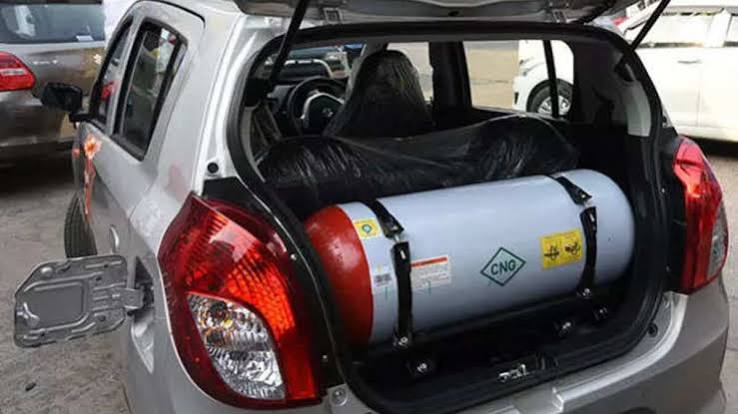
States across Nigeria are adopting different measures to reduce transportation costs as the Federal Government pushes for cheaper fares through the Compressed Natural Gas initiative ahead of October 1.
The move follows President Bola Ahmed Tinubu’s directive for states to work with transport unions and commercial operators to ensure that savings from cheaper energy are passed on to commuters.
The Presidency said more than 120,000 vehicles have so far been converted to CNG, while over 400 certified conversion centres and more than 90 refuelling stations are operating across the country. However, transport operators in several states say inadequate infrastructure, conversion costs and long queues at existing stations remain major obstacles.
In Lagos, motorists using CNG have continued to experience long queues at some refuelling stations, with commercial drivers reporting hours spent waiting to purchase the fuel.
The National President of the National Association of Road Transport Owners, Yusuf Othman, said the shortage of refuelling stations was costing operators valuable time and money. He, however, expressed optimism that additional stations being developed would eventually ease the pressure.
While some states are relying on CNG-powered buses, others have introduced subsidised or free transport services to cushion the impact of high transportation costs.
In Kaduna State, the government said its free CNG bus service, launched in July 2025 following the deployment of 100 buses, operates across eight routes with about 200 bus stops.
The state said the service is available to students, civil servants, traders, artisans and other residents, with the government directing that the programme continue indefinitely.
Plateau State has also maintained a subsidised transport programme, with government buses reportedly charging N200 for journeys covering between 18 and 20 kilometres within Jos.
However, transport operators in Plateau said the Federal Government’s CNG programme had yet to produce significant benefits for them, citing the absence of adequate refuelling infrastructure.
In Gombe State, operators said CNG could help reduce transportation costs but warned that inadequate infrastructure remained a challenge, particularly for long-distance journeys.
The state is reportedly considering the establishment of about 30 CNG substations, potentially providing facilities at local government headquarters. Operators also raised concerns over the cost of converting vehicles, estimated at between N750,000 and N800,000.
Other states are at different stages of implementation.
In Jigawa and Zamfara, transport operators complained about the limited availability of CNG stations and conversion facilities. Zamfara is planning facilities in Gusau and other parts of the state.
Kwara has two major CNG refuelling stations in Ilorin, although only about 100 commercial vehicles belonging to transport union members have reportedly been converted.
In Borno State, concerns about safety and the cost of gas have slowed adoption among some operators. Meanwhile, Maiduguri already has hundreds of government-owned electric vehicles providing transportation at fares ranging from N50 to N100.
Benue State is conducting an awareness campaign ahead of wider CNG adoption, while Nasarawa is planning to establish bi-fuel conversion centres across its three senatorial zones.
Edo State is also preparing to deploy more than 50 CNG buses in October, while Kano State says it is working with the Federal Government to introduce CNG-powered buses for urban and interstate transportation. Kano has also procured 500 electric tricycles as part of efforts to reduce transport costs.
In Rivers State, the government plans to return palliative buses to the roads from October, including buses that will provide free transportation for some commuters and civil servants.
The Federal Government has also continued to invest in CNG infrastructure and financing arrangements aimed at helping motorists spread the cost of vehicle conversion.
According to the State House, CNG and alternative-energy transport schemes have already produced significant fare reductions in some areas. It cited examples including Borno, where fares on some routes are reportedly between N50 and N100 compared with N300 to N600 charged by commercial operators, as well as reductions recorded in Oyo, Adamawa and Enugu.
Despite these examples, the nationwide reduction of transport fares will depend on more than cheaper fuel. Operators say conversion costs, access to refuelling stations, maintenance expenses, spare parts, financing, road conditions and other operational costs continue to influence fares.
With October 1 approaching, states are under increasing pressure to expand CNG infrastructure and alternative transport schemes.
The central challenge remains ensuring that cheaper energy translates into affordable and reliable transportation for commuters across the country, rather than remaining limited to areas with government-subsidised services or adequate CNG infrastructure.