
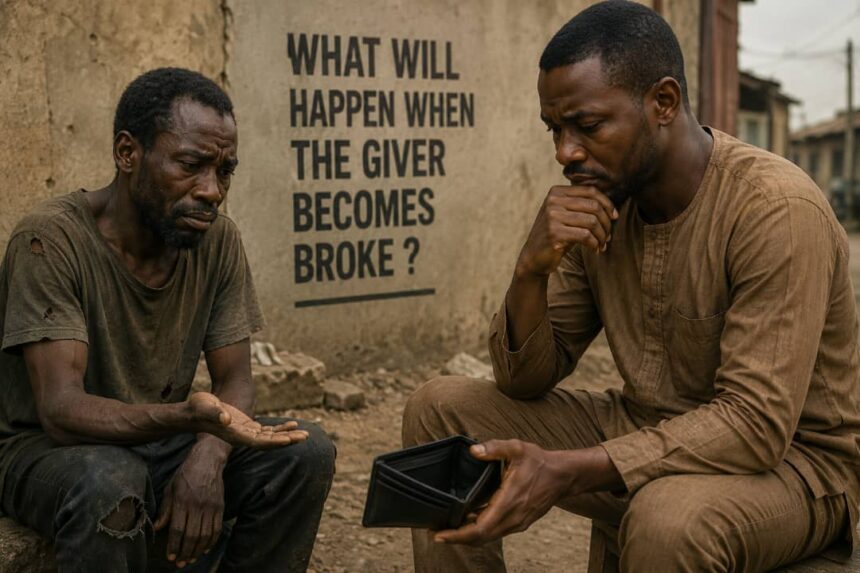
Life teaches some of its most important lessons when circumstances change. One of those lessons is the need to understand that the person who is always giving today may not always have the ability to give tomorrow.
A person can be generous, supportive and dependable for years. They may pay other people’s bills, provide food, help relatives, support friends, finance businesses, solve family problems and stand by people during difficult moments. Over time, everyone may become accustomed to seeing that person as the “giver.”
But what happens when the giver becomes broke?
What happens when the person everyone calls for help suddenly needs help themselves?
This is where relationships, expectations and human character are often tested.
The Giver Is Also Human
One of the biggest mistakes people make is assuming that a generous person has unlimited resources.
A person may be earning well today, but that does not mean they cannot experience financial difficulties tomorrow. Businesses can fail. Jobs can be lost. Salaries can be delayed. Unexpected responsibilities can arise. Investments can collapse, and personal circumstances can change.
The fact that someone helped you when they were financially comfortable does not mean they will always remain financially comfortable.
The giver is also human.
They have needs, responsibilities, dreams and emergencies of their own. Sometimes, they give so much to others that they neglect their own financial security.
When the Giver Can No Longer Give
The real test often begins when the giver says, “I cannot afford it this time.”
Some people will understand. Others may become angry, disappointed or distant.
People who were once constantly calling may suddenly stop calling. Friends who used to celebrate the giver may disappear. Some relatives may accuse the person of changing, becoming selfish or refusing to help.
This can be painful because it forces the giver to confront an uncomfortable question:
“Were these people genuinely connected to me, or were they connected to what I could provide?”
Financial hardship can therefore reveal the true nature of relationships.
Never Build Your Identity Around What You Give
Being generous is a good quality, but generosity should not become your entire identity.
A person should not feel valuable only because they can pay someone’s school fees, provide money for food, solve emergencies or finance other people’s needs.
Your worth is greater than your bank balance.
If people respect you only when you have money, then their respect is conditional. When the money disappears, their attitude may disappear with it.
That is why it is important to build relationships based on character, loyalty, trust, respect and genuine affection rather than financial usefulness.
Learn To Be Your Own Person
One of life’s important lessons is to be yourself.
Do not spend your life trying to impress people by living beyond your means, buying things you cannot comfortably afford or constantly proving that you are capable of helping everyone.
You do not need to demonstrate your generosity every time someone asks.
Sometimes, saying “No” is not selfishness. It is financial responsibility.
Sometimes, refusing to fund something is not a sign that you do not care. It simply means you understand your limits.
And sometimes, the healthiest thing you can do is stop trying to impress people who will never be satisfied.
Do Not Give Away Your Future To Solve Everyone’s Present
Generosity without boundaries can become destructive.
If you use all your savings to solve everybody else’s problems, what happens when you eventually face your own emergency?
If you constantly sacrifice your financial future to rescue others, you may eventually become the person who needs rescuing.
There is nothing wrong with helping people. But assistance should be balanced with personal responsibility.
Before giving, ask yourself:
Can I afford this?
Will this affect my basic needs?
Am I helping this person become independent, or am I simply creating dependency?
Would giving this money put my own future at risk?
These questions do not make you heartless. They make you responsible.
When You Become Broke, Do Not Become Bitter
Another important lesson is that financial hardship should not destroy your character.
If you once helped people and they disappeared when you needed them, learn from the experience without allowing bitterness to consume you.
Not everyone will reciprocate what you do for them.
Give because you genuinely want to help, not because you are keeping a mental record of who owes you.
At the same time, learn to recognize relationships that exist primarily because of what you provide.
There is a difference between generosity and being used.
Save For The Days You Cannot Predict
One of the strongest lessons from the experience of the “giver” is the importance of financial preparation.
Build savings.
Develop multiple sources of income where possible.
Invest carefully.
Avoid unnecessary debt.
Have emergency funds.
Learn financial discipline.
Generosity becomes more sustainable when it is supported by financial planning.
You should not have to choose between helping someone today and being able to survive tomorrow.
The People Who Stay Matter
When the money disappears, pay attention to who remains.
The friend who checks on you without asking for anything is valuable.
The relative who encourages you when you cannot contribute is valuable.
The person who understands your situation without humiliating you is valuable.
The person who reminds you that your worth is not determined by your financial situation is valuable.
These are the relationships worth protecting.
Because when everything is going well, many people can stand beside you. When things become difficult, the number usually becomes smaller.
You Do Not Have To Impress Everybody
Life becomes easier when you stop trying to impress everyone.
You do not need to prove that you are rich.
You do not need to show people that you can solve every problem.
You do not need to maintain an image that your financial reality cannot support.
And you certainly do not need to destroy your own peace just to maintain someone else’s perception of you.
Live according to your means.
Help when you can.
Decline when you cannot.
Build yourself quietly.
Protect your future.
Let people misunderstand you if necessary.
The Greatest Lesson
Perhaps the biggest lesson is this:
The giver must also learn how to receive.
There is dignity in accepting help when you need it. There is no shame in saying, “I am struggling.” There is no weakness in admitting that you cannot do what you once did.
Life moves in seasons.
There are seasons when you have more than enough and seasons when you have barely enough. There are moments when you carry others and moments when you need someone to carry you.
Never assume that your current position will remain permanent.
If you have money today, use it wisely.
If you can help people today, help responsibly.
If you are struggling today, do not lose hope.
And above all, never measure your value by how many people you can financially satisfy.
Because one day, the giver may become broke.
When that day comes, what will remain should not be the money you gave away, but the character you built, the wisdom you gained, the relationships that proved genuine and the life you built for yourself.
Be generous, but have boundaries.
Be kind, but do not destroy yourself trying to please everyone.
Help people, but do not forget yourself.
And most importantly, be your own person. Your life is not a performance designed to impress the world.