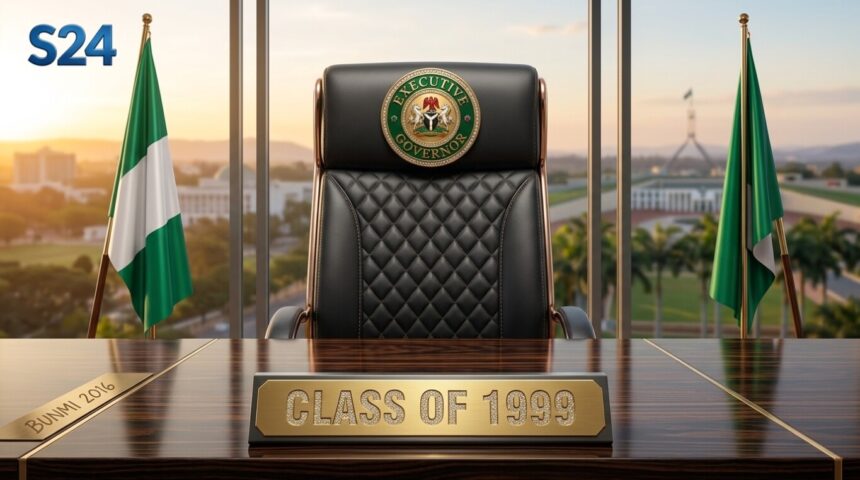
Twenty-seven years after Nigeria returned to democratic rule in 1999, the political journeys of the governors who took office at the dawn of the Fourth Republic reflect the changing character of the country’s democracy.
The 36 governors, elected across Nigeria’s states, came from different political backgrounds but became collectively associated with the “Class of ’99”. Since leaving office, some have risen to national leadership, serving as president, senators, ministers and party leaders, while others have withdrawn from active politics. Several have also died, and some have faced corruption convictions.
At the centre of this political evolution is President Bola Ahmed Tinubu, who governed Lagos State from 1999 to 2007 before emerging as one of the country’s most influential political figures.
Tinubu helped build the opposition coalition that produced the All Progressives Congress (APC) in 2013. He subsequently won the 2023 presidential election, becoming the most prominent member of the Class of ’99 to reach the presidency.
Another member of the class, Umaru Musa Yar’Adua, governed Katsina State for eight years before becoming president in 2007. Ill health cut short his tenure, and he died in office on May 5, 2010.
Other members of the group, including Diepreye Alamieyeseigha of Bayelsa, Mala Kachalla of Borno, Mohammed Lawal of Kwara, Adebayo Adefarati of Ondo, Lam Adesina of Oyo, Abdulkadir Kure of Niger, Abubakar Audu of Kogi, Abubakar Habu Hashidu of Gombe, Chinwoke Mbadinuju of Anambra and Bukar Abba Ibrahim of Yobe, have also died.
Akume: From Benue Government House to National Leadership
George Akume is among the former governors who have maintained prominent positions in Nigerian politics.
After governing Benue State from 1999 to 2007, Akume represented Benue North-West in the Senate for three consecutive terms between 2007 and 2019.
He later served as Minister of Special Duties and Intergovernmental Affairs under former President Muhammadu Buhari before being appointed Secretary to the Government of the Federation by President Tinubu in 2023.
His political journey illustrates how former state governors have continued to influence national administration long after leaving their respective government houses.
Orji Kalu Moves From Abia to the Senate
Orji Uzor Kalu governed Abia State from 1999 to 2007 before moving into national politics.
He contested the 2007 presidential election under the Progressive Peoples Alliance but did not win. After spending time outside elective politics, he returned to the Senate in 2019 as the representative of Abia North.
Kalu served as Chief Whip of the Senate from 2019 to 2023 and secured re-election in 2023. He has remained active in the National Assembly, holding committee leadership responsibilities.
Kwankwaso Maintains Influence in Kano Politics
Rabiu Musa Kwankwaso has remained one of the most recognisable political figures to emerge from the Class of ’99.
After his first tenure as Kano State governor ended in 2003, he served as Minister of Defence under President Olusegun Obasanjo. He subsequently returned to Kano politics and won a second term as governor in 2011.
Kwankwaso later represented Kano Central in the Senate and established the Kwankwasiyya political movement, whose supporters are widely identified by their red caps.
In 2023, he contested the presidency under the New Nigeria Peoples Party (NNPP), finishing fourth in the election. He has remained an influential figure in Kano politics and national opposition discussions.
Makarfi and Adamu: From State Leadership to Party Politics
Ahmed Mohammed Makarfi governed Kaduna State from 1999 to 2007 before serving two terms in the Senate.
He later became chairman of the Peoples Democratic Party’s Caretaker Committee during a major internal crisis. His political career has kept him connected to the party despite leaving elective office.
Abdullahi Adamu, the first civilian governor of Nasarawa State, also moved from state leadership to the Senate, representing Nasarawa West for three terms.
In 2022, he became national chairman of the APC but left the position in 2023. He subsequently announced his retirement from active politics, although he has continued to receive political visitors and maintain connections within the political establishment.
Former Governors Who Stepped Away From Frontline Politics
Not all members of the Class of ’99 pursued long careers in elective office.
Achike Udenwa governed Imo State from 1999 to 2007 and later served as Minister of Commerce and Industry under the late President Umaru Musa Yar’Adua. He has largely remained outside frontline politics since leaving the federal cabinet.
Chimaroke Nnamani, who governed Enugu State during the same period, later served in the Senate from 2019 to 2023 before returning to his medical practice.
Boni Haruna, former governor of Adamawa State, subsequently served as Minister of State for Youth Development. He has since maintained a relatively quiet public profile.
Former Bauchi State governor Ahmadu Adamu Mu’azu returned to business and professional practice after his tenure. He later became national chairman of the PDP and served as Nigeria’s ambassador to Australia.
Similarly, former Rivers State governor Peter Odili has concentrated much of his post-office career on medical education, healthcare and philanthropy. He established PAMO University of Medical Sciences in Port Harcourt and has continued to maintain influence in Rivers State politics.
South-West Governors and the Rise of the APC
The South-West produced several influential members of the Class of ’99, including Olusegun Osoba of Ogun State, Bisi Akande of Osun State and Niyi Adebayo of Ekiti State.
Osoba and Akande became prominent elder statesmen in the political coalition that eventually produced the APC. Adebayo later served as Minister of Industry, Trade and Investment under President Buhari.
Their political journeys demonstrate how the Alliance for Democracy and subsequent opposition alliances contributed to the formation of a national political platform that challenged the PDP’s dominance.
Lucky Igbinedion, who governed Edo State from 1999 to 2007, has gradually become less visible in frontline politics. He has maintained interests in business, hospitality and education, including his role within the Igbinedion University community.
Donald Duke’s Presidential Ambitions
Donald Duke governed Cross River State from 1999 to 2007 and later pursued national political ambitions.
He contested the presidency in 2007 under the PDP but lost to Yar’Adua. In 2019, he emerged as the presidential candidate of the Social Democratic Party before becoming involved in further political activities.
Outside partisan politics, Duke has maintained interests in tourism, entertainment and private enterprise.
Some Former Governors Faced Legal Challenges
The post-office experiences of the Class of ’99 have not all been defined by political advancement or retirement.
Joshua Dariye, who governed Plateau State from 1999 to 2007, was convicted in a corruption case and sentenced to prison before receiving a presidential pardon.
Jolly Nyame, the former Taraba State governor, was similarly convicted in a corruption case and served a prison sentence before receiving a presidential pardon.
Both men later remained connected to political activities, illustrating how the careers of some former governors continued after their legal troubles.
Other members, including Ahmed Sani Yerima of Zamfara and Adamu Aliero of Kebbi, moved from state government houses into the Senate and other national political roles.
Aliero also served as Minister of the Federal Capital Territory and has remained active in Kebbi politics.
A Generation That Shaped Nigeria’s Fourth Republic
The experiences of the Class of ’99 reveal the different ways political influence can endure in Nigeria’s democracy.
Some former governors have reached the highest national offices, while others have become political advisers, party leaders, businesspeople and philanthropists. Several have withdrawn from public life, and others have passed away.
Their political affiliations have also changed over the years. Politicians who began their careers under the PDP, the Alliance for Democracy and other parties later moved into the APC and different opposition platforms.
Twenty-seven years after the transition to civilian rule, the Class of ’99 remains an important reference point in understanding Nigeria’s Fourth Republic. Its members helped shape the institutions, alliances and political networks that continue to influence the country’s governance and electoral contests.