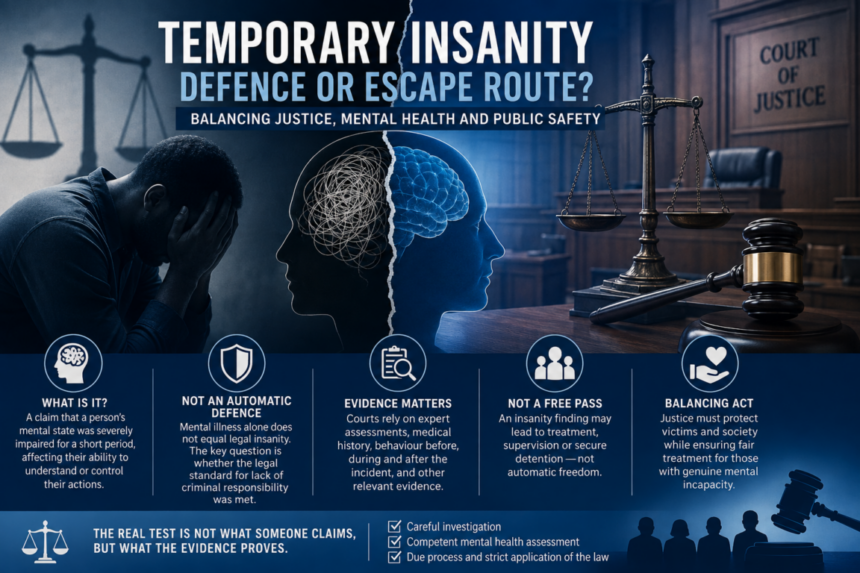
When an accused person claims temporary insanity after committing a serious offence, the courtroom faces a difficult question: was the person genuinely incapable of understanding their actions, or is mental illness being used as a way to escape criminal responsibility?
The idea of temporary insanity as a defence in criminal cases has long generated debate about the balance between justice, mental health and public safety.
For victims and their families, an insanity claim can sometimes feel like an attempt to avoid punishment. For mental-health professionals and legal experts, however, genuine mental incapacity can be a serious condition that affects a person’s ability to understand or control their actions.
The controversy lies in determining where the line should be drawn.
What Is Temporary Insanity?
“Temporary insanity” is commonly used to describe a situation in which a person’s mental state is believed to have become severely impaired for a limited period.
It is important, however, to distinguish the popular expression from the legal insanity defence, because the exact legal requirements differ from one jurisdiction to another.
The central issue in an insanity defence is generally not simply whether an accused person has a mental-health condition. The question is whether the person’s mental state at the time of the alleged offence met the legal standard for lack of criminal responsibility.
This distinction matters because having a mental illness does not automatically mean that someone is legally insane or exempt from criminal responsibility.
Could an Insanity Claim Help Someone Escape Punishment?
This is at the heart of the controversy.
Critics of insanity defences argue that they could potentially be exploited by offenders who want to avoid the consequences of their actions.
Their concern is that an accused person could claim that they were mentally unstable at the time of a crime, particularly when there is little independent evidence about what was happening in their mind.
Unlike a broken bone or other obvious physical injury, mental illness may not always be immediately visible.
An accused person might therefore attempt to portray themselves as confused, psychologically disturbed or unable to remember what happened.
This raises an uncomfortable question:
What if someone pretends to be mentally ill simply because they believe it could help them in court?
A Claim Alone Should Not Be Enough
The existence of an insanity defence does not mean that an accused person can simply declare themselves temporarily insane and walk out of court.
A credible claim requires proper legal and, where relevant, psychiatric assessment. The court must consider the evidence and apply the applicable legal test.
This can involve examining the accused person’s mental state and circumstances surrounding the alleged offence.
Evidence concerning their behaviour before, during and after the incident may also become relevant to understanding their state of mind.
The purpose of such examination is to distinguish a genuine mental-health crisis from an unsupported claim.
Mental Illness Is Not Automatically a Defence
One of the biggest misconceptions surrounding insanity defences is the assumption that anyone with a mental-health condition can avoid criminal responsibility.
That is not the case.
A person may live with a mental-health disorder and still understand the nature and consequences of their actions.
The relevant legal question is generally much narrower: did the person’s mental condition affect their capacity in the specific way required by the applicable law at the time of the offence?
This is why a diagnosis alone does not necessarily establish legal insanity.
Why the Defence Exists
There is, however, a compelling reason for the law to recognise mental incapacity.
Criminal punishment is based partly on the idea that people can understand their actions and make choices.
If someone was genuinely incapable of understanding what they were doing or appreciating the wrongfulness of their conduct because of a severe mental disorder, treating that person exactly like someone who deliberately planned and understood a crime raises difficult questions about fairness and justice.
The insanity defence therefore exists, in jurisdictions that recognise it, to address exceptional circumstances involving severe mental incapacity.
It is not necessarily intended to provide a free pass.
An Insanity Finding Does Not Always Mean Freedom
Another misconception is that a successful insanity defence automatically means an accused person is released and allowed to return home.
Depending on the jurisdiction and the circumstances, a person found legally not responsible because of mental incapacity may instead face psychiatric treatment, supervision, secure detention or other legal measures.
The outcome therefore depends heavily on the applicable law.
The objective may be to protect both the individual and society while addressing the underlying mental-health problem.
The Challenge of Proving Mental State
One of the most difficult aspects of these cases is establishing what was happening inside a person’s mind at the time of an offence.
Mental states cannot simply be photographed or measured in the same way as a physical injury.
This is why evidence can be crucial.
Medical history, psychiatric assessments, witness accounts and the person’s behaviour surrounding the incident may all help establish whether there was evidence of a genuine mental disturbance.
However, no single piece of evidence should automatically determine the outcome.
Could Someone Fake Insanity?
The possibility of deception is one reason insanity claims attract public suspicion.
An accused person who understands the legal consequences of a crime might believe that appearing mentally unstable could improve their position.
But identifying deliberate deception is itself difficult.
Someone genuinely experiencing a psychiatric crisis may behave unpredictably, while someone attempting to fake symptoms may try to imitate what they believe mental illness looks like.
This is why courts cannot simply rely on appearances.
Professional assessment, evidence and the legal standard must guide the decision.
The Victim’s Perspective Matters Too
For victims and families, an insanity defence can be particularly painful.
After losing a loved one or suffering harm, hearing that the accused may not be held criminally responsible can create a perception that justice is being denied.
That concern deserves to be taken seriously.
At the same time, the justice system must avoid treating mental illness as evidence of criminality.
The challenge is to protect victims and society while ensuring that a person with genuine mental incapacity is assessed according to the law.
The Bigger Problem: Weak Mental Health Support
The debate over temporary insanity also exposes a broader issue: mental health support remains inadequate in many communities.
People experiencing severe psychological distress may not receive professional assistance until their condition becomes a crisis.
Stigma can discourage people from seeking help, while families may struggle to recognise serious warning signs or find appropriate services.
Greater investment in mental-health awareness, early intervention and accessible psychiatric care could help address some crises before they reach the criminal justice system.
Justice Must Balance Accountability and Mental Health
The question should not simply be whether an accused person can say, “I was temporarily insane.”
The more important question is whether there is credible evidence that the person’s mental state met the legal threshold for lack of criminal responsibility.
Accepting every claim without scrutiny could undermine public confidence in the justice system.
Rejecting every claim automatically could also produce injustice for people who genuinely lacked the mental capacity required to be held criminally responsible.
The solution lies in careful investigation, competent mental-health assessment, due process and strict application of the law.
Beyond the Label
“Temporary insanity” may sound like a simple explanation for extraordinary behaviour, but mental health and criminal responsibility are far more complicated.
A person can experience extreme psychological distress without being legally insane. Another person may experience a severe psychiatric episode that fundamentally affects their ability to understand reality.
Determining the difference is not a matter of public opinion.
It requires evidence.
Ultimately, an insanity defence should not become a convenient escape route for crime, but neither should genuine mental illness be ignored simply because society is understandably angry about an offence.
The real test is not whether someone claims temporary insanity. It is whether the evidence demonstrates that their mental state genuinely met the legal standard for criminal responsibility at the time of the offence.