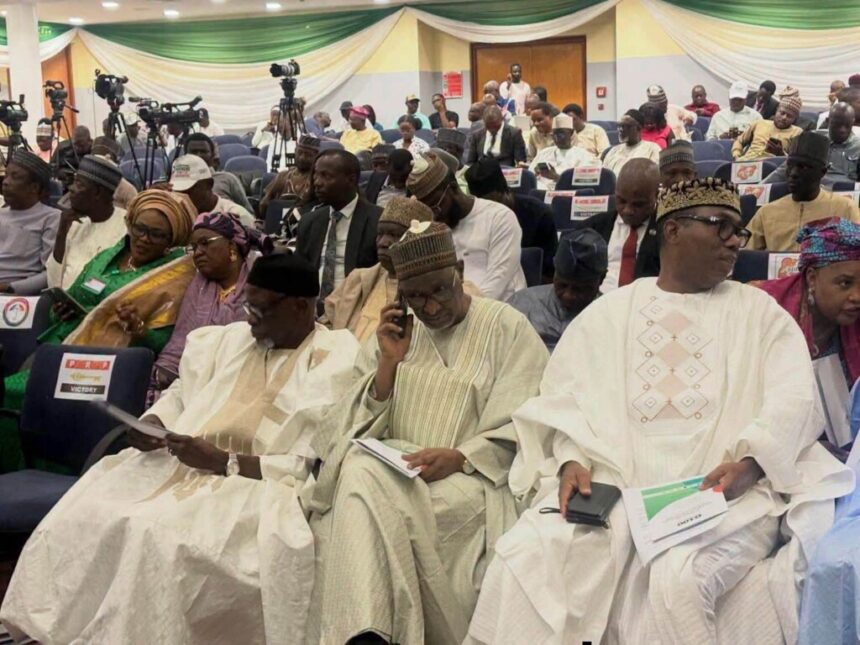
Six opposition political parties have agreed to begin structured negotiations aimed at forging a stronger alliance ahead of Nigeria’s 2027 general elections, including efforts to produce a consensus presidential candidate and develop a single-term transition charter.
The agreement was reached on Monday at the G100 First Summit of Party Leaders and Stakeholders in Abuja, where leaders of the African Democratic Congress (ADC), Allied Peoples Movement (APM), Nigerian Democratic Congress (NDC), Peoples Democratic Party (PDP), Peoples Redemption Party (PRP) and Social Democratic Party (SDP) met to discuss opposition cooperation.
Among the prominent figures at the summit were PRP National Chairman, Dr Hakeem Baba-Ahmed; APM National Chairman, Yusuf Dantalle; SDP National Chairman, Shehu Musa Gabam; NDC National Chairman, Cleopas Moses; former Niger State Governor, Babangida Aliyu; Minority Leader of the House of Representatives, Fredrick Agbedi; and former Cross River State Governor and PRP presidential candidate, Donald Duke.
In a communiqué issued at the end of the meeting, the parties said their national chairmen and principal leaders had agreed to “commit to a structured process of negotiation on the framework for opposition cooperation ahead of the 2027 general election.”
As part of the process, the parties will establish five working groups to prepare key documents within four weeks.
The documents will include a Roadmap to a Common Presidential Candidate, a National Covenant for Democratic Renewal, a Single-Term Transition Charter, a National Reform Programme and a Framework for Opposition Unity.
Each working group will have one representative from each participating party and will submit its report to the Central Leadership Committee for consideration at a second summit.
The parties also agreed to establish three standing coalition organs: the Central Leadership Committee, Publicity and Communication Committee, and Legal Committee.
The Central Leadership Committee will provide political direction and coordinate the cooperation process, while the Publicity and Communication Committee will be responsible for joint messaging and media engagement.
The Legal Committee will advise on legal and constitutional matters and vet agreements reached by the parties.
The communiqué stressed that the success of the proposed alliance would depend largely on the willingness of each party to determine how far it was prepared to go, identify its red lines and accept a framework considered fair by all participants.
Lessons From 2023
G100 facilitator, Salihu Lukman, said the initiative was designed to address the division that weakened the opposition during the 2023 presidential election.
According to him, opposition parties collectively secured about 13 million votes in 2023, while President Bola Ahmed Tinubu won with less than nine million votes.
He argued that the opposition failed to convert its numerical advantage into victory because its votes were divided among several presidential candidates.
Lukman pointed to the political cooperation that preceded the 2015 presidential election as an example of how opposition parties could agree on rules before determining who would emerge as their candidate.
“What they had was not affection. What they had was sequence. They agreed on the rules before they knew the outcome,” he said.
He said consultations with the six parties showed that opposition leaders understood the consequences of division but lacked a platform for negotiating their interests.
“What has been missing is not analysis. It is a table,” Lukman said.
He stressed that the summit was not asking any party to dissolve or demanding that any presidential candidate immediately withdraw from the race.
Rather, he said the objective was to create a process through which the parties could negotiate their interests and determine the basis for cooperation.
Lukman said the proposed coalition would work towards a “government of national competence” and a four-year national reset programme supported by an enforceable transition charter.
He warned that achieving unity would require politicians to sacrifice personal ambitions and accept outcomes that might not favour them.
“There is no version of this that costs nobody anything. Someone in this hall will have to accept an outcome he/she did not want. That is what unity is. It is not a communiqué. It is somebody’s disappointment, borne well,” he said.
According to Lukman, the ultimate objective is to provide Nigerians with a credible alternative government in 2027.
“Our only interest is the one stated in the doctrine we published on August 2: that a democracy is sustained not merely by holding elections, but by the credible possibility of an alternative government,” he said.
Agbedi Calls for Sacrifice
Minority Leader of the House of Representatives, Fredrick Agbedi, urged opposition leaders to subordinate individual ambitions to the broader objective of defeating the ruling All Progressives Congress (APC).
Agbedi said the House Minority Caucus partnered with the G100 to bring opposition parties together and create a platform capable of winning the 2027 election.
“On behalf of the Minority Caucus of the House of Representatives, we decided that we partner with the G100 to see how the opposition parties can come together, streamline our ambitions, and ensure that we take this government out,” he said.
He added that the objective was not simply to change government but to “salvage Nigeria.”
Agbedi said the caucus had no preferred opposition candidate and was not backing any particular politician.
“For us, as the G100 has said, there is no issue of preferred candidates, there is no issue of one we love more than the other, but that there is strength in unity,” he said.
He urged opposition parties to replicate the cooperation that enabled them to defeat the PDP in 2015.
Single Candidate Not Guaranteed
While several leaders supported the idea of a common opposition candidate, ADC National Vice Chairman, South-South, Usani Usani, cautioned against making a single presidential candidate the only measure of successful opposition cooperation.
“Assuming we are unable to project a single presidential candidate, should we presume that we are failing?” he asked.
Usani said opposition parties had different interests and political structures and should therefore consider broader strategic cooperation.
He argued that even if the parties failed to agree on one presidential candidate, they could coordinate their efforts in areas where individual parties were stronger.
He stressed that his position should not be interpreted as opposition to a single candidate.
“It is a matter of strategy, not because we do not support the evolution of a single candidate, but because we want to understand the possibility or impossibility of getting one at that point,” he said.
Usani also warned opposition parties against attacking one another instead of focusing on their common political opponent.
“For us, it is not only possible, but mandatory, because it is now or never,” he stated.
Parties Back Cooperation
APM National Chairman, Yusuf Dantalle, said opposition leaders must place national interest above personal and party ambitions.
Dantalle described the summit as an opportunity to restore what he called Nigerian integrity and return power to the people.
“The Allied Peoples Movement will stand by anything that has to do with the Nigeria project. We need this country to give back power to the people and make it better for all of us, so that we can be proud of Nigeria again,” he said.
The PDP representative, Babangida Aliyu, also commended the G100 for creating a platform for opposition parties to negotiate their interests.
Aliyu said personal ambitions and financial interests had previously undermined political cooperation.
He argued that the immediate task was not to select a candidate but to establish a framework that could guide subsequent decisions.
He also called for the opposition unity process to extend to the state and local government levels.
‘We’re on a Rescue Mission’
SDP National Chairman, Shehu Musa Gabam, described the initiative as a “rescue mission” aimed at bringing opposition parties together to offer Nigerians an alternative.
Gabam said the SDP demonstrated its commitment by attending the summit with its presidential and vice-presidential candidates as well as members of its National Working Committee.
He said the performance of opposition parties in the 2023 election showed that Nigerians were willing to support alternatives.
He urged political leaders to make sacrifices and subordinate personal ambitions to the broader national objective.
PRP National Chairman, Hakeem Baba-Ahmed, similarly warned that no opposition party should assume it could defeat the APC alone.
“We are not here because we are too weak. We are here because we believe the fight to get this government out of power and to put one of us or all of us in power is absolutely imperative in this country,” he said.
Baba-Ahmed also alleged that the participating parties were facing legal and political challenges aimed at weakening them.
“There is no party among the six that is here that is not facing an existential threat. None,” he said.
Former Cross River State Governor and PRP presidential candidate, Donald Duke, pledged to support whichever opposition candidate eventually emerges from the negotiations.
“We will support any political party that emerges in 2027,” Duke said.
ADC Seeks Broader Cooperation
NDC National Chairman, Cleopas Moses, said his party was fully committed to the opposition unity initiative.
Moses described the cooperation as necessary to address what he called the country’s current leadership challenges.
He said the NDC considered itself an integral part of the G100 initiative and commended the organisers for creating a platform for opposition parties to work together.
The ADC also declared its support for the initiative.
The party’s National Publicity Secretary, Bolaji Abdullahi, described the G100 objective as “noble” and said the ADC would do its best to support it.
However, Abdullahi cautioned that opposition cooperation should not be reduced to the production of a single presidential candidate.
“We believe that the objective is much broader than that,” he said.
According to him, opposition parties could cooperate on issues such as electoral integrity, presenting a united front against the ruling party and agreeing on policy positions.
He also noted that ideological differences could affect the possibility of producing a common presidential candidate.
Experts Differ on Single Candidate
Political science expert, Prof. Atah Pine of the Department of Political Science, Benue State University, said the opposition parties could struggle to produce a single presidential candidate.
Pine said some major opposition politicians appeared determined to pursue their individual presidential ambitions.
He suggested that the parties could instead assess their respective political strengths across the country and develop arrangements for supporting one another in areas where they had stronger structures.
“What I see them doing is to weigh their comparative strengths across the federation and work out an arrangement whereby they will complement each other’s strengths,” he said.
Pine described the possible arrangement as a “quasi-alliance framework” in which parties could support one another in states or constituencies where individual parties had greater political strength.
However, Prof. Saleh Dauda of the Department of Political Science, University of Abuja, said producing a single opposition candidate was feasible, although difficult.
Dauda said a united opposition candidate could pose a serious challenge to the ruling party if the political actors were willing to overcome their individual ambitions.
“It is feasible, but with some challenges. If they can come together and field a single candidate, they are likely to pose a serious challenge to the ruling party,” he said.
He identified the willingness of major politicians to sacrifice their presidential ambitions for a common candidate as one of the biggest obstacles.
Prof. Hassan Saliu, a Professor of Political Science and International Relations at the University of Ilorin and immediate past President of the Nigerian Political Science Association, also described the proposed alliance as potentially significant ahead of 2027.
However, Saliu warned that personal ambitions and ideological differences could undermine the coalition.
He urged the opposition to learn from Nigeria’s political history, particularly the cooperation that preceded the 2015 presidential election.
The proposed four-week negotiation period could therefore become a crucial test of whether Nigeria’s opposition parties can move beyond individual ambitions and establish a durable electoral alliance.
For now, the parties have agreed on the process. The bigger political question is whether they can agree on the candidate, policies and power-sharing arrangements needed to make the proposed coalition a viable alternative in 2027.