
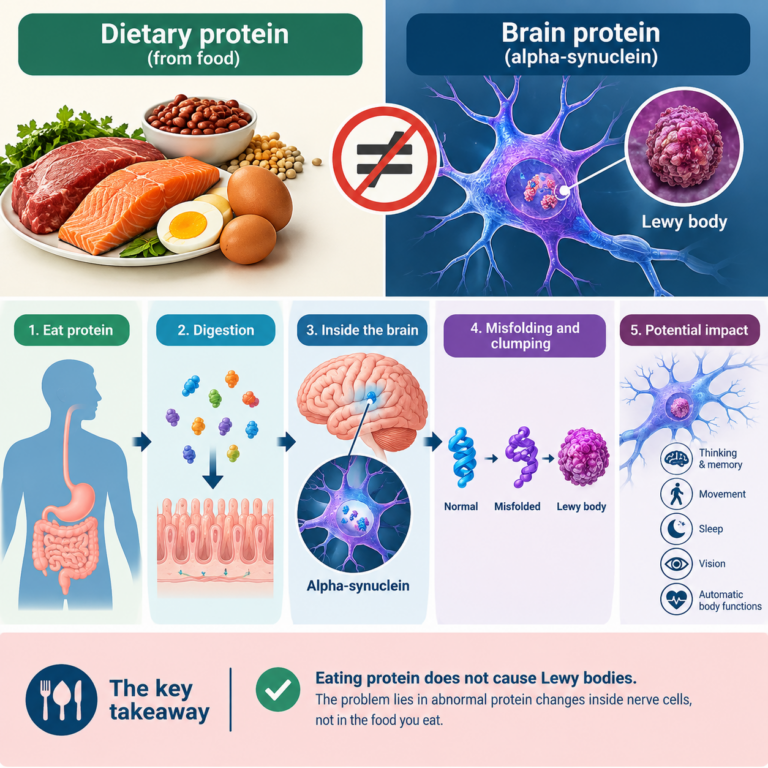
The word “protein” can make Lewy bodies sound like something caused by food, especially because the condition involves abnormal protein deposits inside nerve cells. But the protein in a meal is not the same as the abnormal protein accumulation associated with Lewy body diseases, and current evidence does not show that eating meat, fish, eggs, beans or other protein-rich foods causes Lewy bodies.
The confusion largely comes from alpha-synuclein, a protein naturally found inside nerve cells where it plays important roles, particularly around the connections through which brain cells communicate. In Lewy body diseases, alpha-synuclein can become abnormally accumulated and form clumps inside neurons, eventually contributing to the structures known as Lewy bodies.
When a person eats protein, the digestive system breaks dietary proteins down into smaller components that the body can absorb and use for building tissues, repairing cells and carrying out other biological functions.
Those dietary proteins do not simply travel from a meal into the brain and become Lewy bodies.
Instead, Lewy bodies are associated with changes involving proteins already present within nerve cells, particularly alpha-synuclein. This distinction is important because the word protein describes a huge range of molecules with very different structures and functions.
There is also a scientific nuance worth noting: alpha-synuclein itself can be found in some animal tissues, including meat, but researchers have not established that consuming dietary alpha-synuclein causes Lewy body disease in humans. One research review has explored the theoretical possibility of dietary alpha-synuclein contributing to disease processes, but it describes this as a question requiring further investigation rather than an established cause.
When a Normal Brain Protein Changes Shape
Alpha-synuclein normally exists in nerve cells and performs useful biological functions, but researchers believe that in Lewy body diseases the protein can undergo abnormal changes and form aggregates.
This process is often described as misfolding, meaning that a protein adopts an abnormal structure that can alter how it behaves.
Protein shape is important because it influences how molecules interact with one another. When alpha-synuclein becomes abnormal, it can begin accumulating rather than remaining in its normal cellular state.
The resulting buildup can interfere with the normal functioning of nerve cells, although researchers are still working to understand exactly how different forms of alpha-synuclein contribute to neurological damage.
How Misfolded Proteins Form Lewy Bodies
As abnormal alpha-synuclein accumulates, it can clump together inside neurons, forming the protein deposits known as Lewy bodies.
These deposits are not simply harmless collections of protein. Their presence is associated with changes in the function and survival of affected nerve cells, and Lewy bodies are a defining feature of conditions such as dementia with Lewy bodies and Parkinson’s disease dementia.
The exact sequence of events remains an active area of research, including questions about whether the Lewy bodies themselves are the main cause of cellular damage or whether other forms of abnormal alpha-synuclein play an important role.
Why the Brain May Struggle to Clear the Buildup
Cells have sophisticated systems for breaking down, recycling and removing damaged or unnecessary proteins. These processes help maintain the internal environment of nerve cells.
When protein-handling and clearance systems do not work properly, abnormal proteins may persist and accumulate.
Researchers are examining several biological processes that could contribute to this problem, including cellular waste disposal, mitochondrial dysfunction, inflammation and other forms of cellular stress.
Mitochondria are particularly important because they help cells produce energy, while nerve cells have high energy demands. Problems affecting these systems may therefore place additional stress on neurons.
Ageing and Genetics Also Matter
There is no single known cause of Lewy body diseases.
Age is the greatest known risk factor for Lewy body dementia, with the condition generally developing after age 50, while genetic factors can also influence individual risk. However, most cases are not explained by a single inherited genetic change, and having a family history does not mean that someone will definitely develop the disease.
Researchers are also examining other biological and environmental factors, including sleep-related conditions, inflammation and changes in the way cells process proteins.
This means Lewy body disease is better understood as the result of complex biological processes rather than one simple trigger.
When Lewy Bodies Begin to Affect the Brain
Lewy body diseases can affect several areas of brain function, so symptoms can vary considerably from one person to another.
They may include changes in thinking and attention, movement problems, sleep disturbances, visual hallucinations and changes in automatic body functions such as blood pressure regulation.
Lewy body dementia includes dementia with Lewy bodies and Parkinson’s disease dementia. Both conditions involve abnormal alpha-synuclein, although the timing and pattern of symptoms can differ.
For some people, changes in thinking, attention or perception may become noticeable early, while others develop movement-related symptoms first. This overlap with Parkinson’s disease and other neurological conditions can make diagnosis complicated.
So, Should People Avoid Protein?
For most people, there is no reason to avoid dietary protein simply because of concerns about Lewy bodies.
Protein remains an essential nutrient that supports muscles, tissues and many biological processes. Adequate protein can also be particularly important as people age because maintaining muscle strength and physical function becomes increasingly important.
The important distinction is between dietary protein and abnormal protein accumulation inside nerve cells.
Current evidence does not establish eating protein-rich foods as a cause of Lewy body disease. The biological problem researchers are investigating involves alpha-synuclein and what happens to it inside cells.
What Scientists Still Do Not Know
Researchers are still trying to understand why alpha-synuclein becomes abnormal in some people, why certain brain cells are particularly vulnerable and how the body’s protein-clearance systems respond to the buildup.
They are also studying whether different forms of alpha-synuclein have different effects on neurons and how factors such as genetics, ageing, inflammation and cellular stress interact.
That research is important because understanding how abnormal alpha-synuclein develops could eventually improve approaches to diagnosis, treatment and prevention.
For now, the key distinction is straightforward: the protein in a meal is not the same thing as the abnormal protein accumulation associated with Lewy bodies.
Eating chicken, fish, eggs, beans or other protein-rich foods does not, based on current evidence, mean that a person is putting Lewy bodies into the brain or causing them to form.