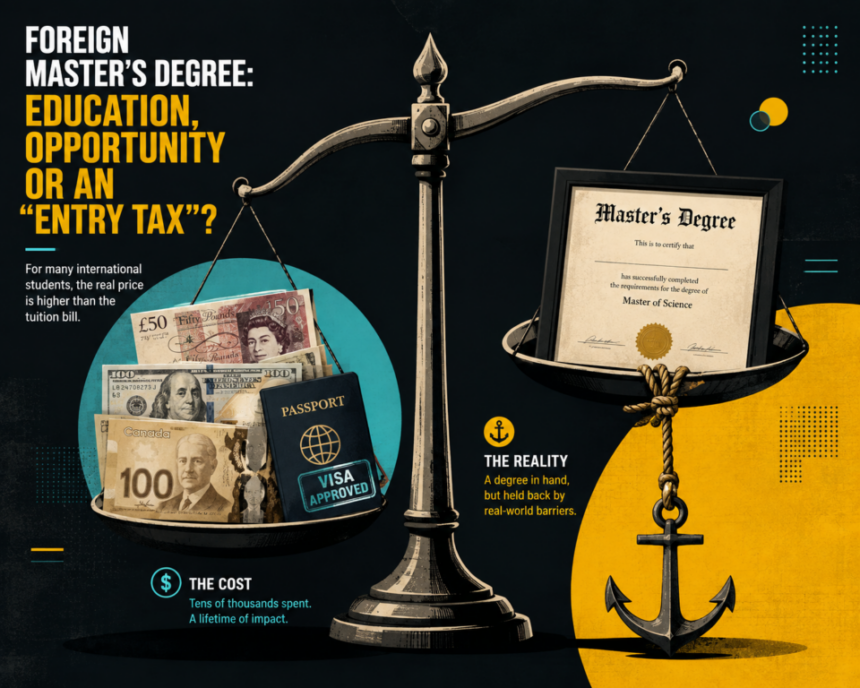
Every year, hundreds of thousands of ambitious professionals across Africa, Asia, and Latin America make life-altering sacrifices by liquidating family assets, take on high-interest loans, and spend tens of thousands of dollars, pounds, or euros to secure a spot in postgraduate programs across Western nations.
The underlying belief is universal: a foreign degree is a golden ticket to global economic mobility, but, stepping into university lecture halls in cities from London and Toronto to Melbourne and Frankfurt often brings a quiet, unsettling realization.
A viral reflection by an international graduate highlighted a scene that plays out globally. Studying in a specialized master’s program, she realized that out of an entire lecture theater, almost no local students were present. The seats were occupied almost exclusively by international students from developing nations.
It raises a fundamental question that few candidates ask before making the financial leap: If these degrees are designed to supply high-skilled talent to local industries, why are local domestic students largely absent from the classrooms?
Education or an “Entry Tax”?
The reality facing many international graduates is that higher education in major Western destinations has evolved into a lucrative export industry. With domestic tuition rates often capped or subsidized by governments, international students—who pay up to three to four times more—effectively subsidize university balance sheets and local economies.
Universities actively design and market programs tailored to international aspirations, featuring attractive, globally minded titles: International Business Analytics, Global Health Leadership, or Advanced Logistics Management. To the applicant back home, the degree promises a career leap. To the host country’s educational sector, it represents high-margin revenue.
The true shock, however, often arrives during job hunts in host countries:
-
The First-Degree Rule: Recruiters in countries like Canada, the UK, Australia, and the US frequently evaluate candidates based on their multi-year undergraduate foundation rather than a one-year specialized master’s.
-
The Local Experience Barrier: A distinction on a foreign master’s certificate rarely eliminates recruiter unfamiliarity with overseas universities or the absence of local work history.
-
Visa Barriers: Many employers hesitate to hire international graduates due to complex sponsorship laws, salary thresholds, or the temporary nature of post-study work visas.
The Pivot for Survival
Faced with the rigid demands of foreign job markets, international graduates frequently adapt out of necessity:
-
Lawyers transition into social care or administrative roles.
-
Engineers move into basic IT support or site inspection.
-
Finance graduates take on entry-level logistics or customer service.
While these are honest professions, they rarely align with the expectations set by a $30,000 to $50,000 price tag—before factoring in high living costs, visa fees, and mandatory health surcharges.
For the majority, the master’s degree functions less as an academic milestone and more as an “entry tax”—the tuition paid to legally buy access, time, and a post-study work window in a stronger economy.
Addressing the Root Cause
The global debate surrounding international student caps, work permit rules, and immigration quotas often misses the point. Millions do not take immense financial risks simply out of a love for Western classrooms; they leave because of systemic economic instability, currency devaluation, and lack of meritocratic growth at home.
As long as economic gaps persist, host nations will continue to repackage immigration pathways under new names, and ambitious youths will continue to buy them. The long-term solution lies not in chasing the next foreign visa route, but in building domestic institutions and economies capable of offering genuine opportunities at home.