
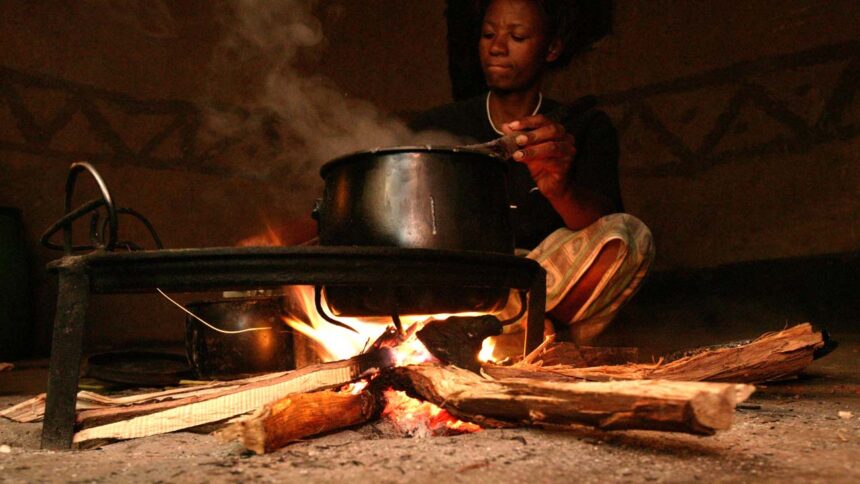
The sharp rise in the price of cooking gas across Nigeria is forcing many households to abandon Liquefied Petroleum Gas (LPG) and return to traditional cooking fuels such as charcoal and firewood, raising concerns about health, environmental sustainability and the country’s clean-energy goals.
The Nigerian Association of Liquefied Petroleum Gas Marketers (NALPGAM) recently warned that continued increases in LPG prices could spark widespread public dissatisfaction if urgent measures are not taken. According to the association, marketers are battling rising depot prices, supply constraints, logistics challenges and increasing operational costs.
NALPGAM disclosed that marketers currently pay between N25.2 million and N26.2 million for 20 metric tonnes of LPG, depending on location. The development has significantly increased the cost of supplying cooking gas to consumers nationwide.
The association noted that the soaring cost of LPG has placed a heavy burden on households, food vendors and small businesses that depend on cooking gas for daily activities. It warned that many Nigerians could be forced to abandon cleaner cooking fuel options and revert to charcoal and firewood if prices continue to rise beyond their reach.
Across several states, residents told Daily Trust that they are already adjusting their cooking habits due to the high cost of gas.
In Kaduna State, Maimuna Sani, a mother of two, said she now reserves cooking gas for preparing breakfast on school days while relying on charcoal for most other meals.
“Charcoal is more economical than gas. With just N200 worth of charcoal, you can prepare a meal,” she said.
Another resident, Badamasi Isa Adamu, explained that his family alternates between gas and charcoal depending on available income. He said gas is now mainly used for boiling water in the mornings while charcoal handles most cooking needs.
Similar concerns were expressed in Kano, where the price of cooking gas has reportedly increased from about N1,100 per kilogram to between N1,500 and N1,550 within weeks.
Aisha Suleiman, a mother of five, said she abandoned gas after struggling to afford refills.
“We used to buy gas at N1,100 per kilogram, but now it is too expensive. I switched to charcoal,” she said.
Charcoal sellers in Kano have also reported increased patronage as more households seek cheaper alternatives.
In Rivers and Bayelsa states, many residents are turning to charcoal stoves as gas and kerosene become increasingly unaffordable. Victory Elechi, a resident of Port Harcourt, said charcoal stoves have become the most practical option for her family.
“Two of my neighbours have also purchased charcoal stoves. It is the cheapest means to cook at the moment,” she said.
In Borno State, housewife Aisha Abubakar said she abandoned gas after the cost of a 12.5kg cylinder rose from N18,000 to N20,600 within one week. She subsequently purchased a charcoal stove and a bag of charcoal as a more affordable solution.
Gas retailers in Gombe State have also reported declining patronage as consumers reduce purchases or combine gas usage with charcoal and firewood to manage expenses.
While many Nigerians are moving toward charcoal and firewood, some Lagos residents are exploring alternative cooking technologies such as power stoves and green gel fuel.
Kemi Adeniran, a power stove user, said the technology has reduced her cooking expenses significantly.
“The power stove has reduced my cooking costs by about 70 per cent,” she said, adding that it offers a more affordable alternative amid rising gas prices.
However, energy experts have warned that the growing return to traditional cooking fuels could have serious consequences.
Professor Dayo Ayoade, an energy law expert at the University of Lagos, described the situation as part of Nigeria’s broader energy paradox, where abundant energy resources do not translate into affordable access for citizens.
He attributed the rising prices to both global and local factors, including international supply disruptions linked to tensions in the Middle East and domestic supply chain challenges.
According to him, increased dependence on charcoal and firewood poses significant health risks, particularly for women and children who spend more time around cooking areas.
He warned that exposure to smoke from traditional fuels has long been associated with respiratory illnesses, carbon monoxide poisoning and increased risks of lung cancer.
Beyond health concerns, Ayoade noted that greater reliance on firewood and charcoal could accelerate deforestation, biodiversity loss and environmental degradation while undermining efforts to combat climate change.
He urged the federal government to stabilise LPG prices through improved production, transportation and storage infrastructure while promoting affordable clean cooking technologies.
As cooking gas prices continue to climb, many Nigerians are increasingly faced with a difficult choice between cleaner energy and affordability, a reality that threatens years of progress in promoting safe and sustainable cooking practices across the country.