
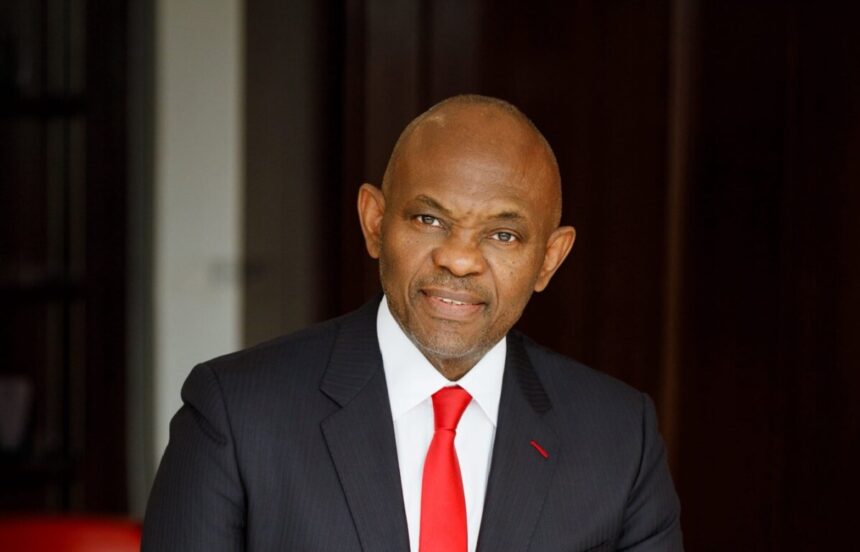
Tony Onyemaechi Elumelu, CFR, is a Nigerian economist, entrepreneur, investor, banker, and philanthropist, ranks among Africa’s most influential business leaders.
Many people know him for transforming the United Bank for Africa (UBA) into a leading pan-African financial institution. Through Heirs Holdings and the Tony Elumelu Foundation, he promotes entrepreneurship, economic development, and private-sector growth across Africa.
Elumelu also introduced Africapitalism, an economic philosophy that encourages long-term private investment, focuses on creating economic prosperity while delivering lasting social impact across the continent.
Tony Elumelu was born on 22 March 1963 in Jos, Plateau State, Nigeria. His family comes from Onicha-Ukwu in Aniocha North Local Government Area of Delta State. He grew up with four siblings, including former House of Representatives Minority Leader Ndudi Elumelu.
Elumelu studied Economics at Ambrose Alli University, where he earned a bachelor’s degree. He later completed a master’s degree in Economics at the University of Lagos.
After graduating, he began his career during the National Youth Service Corps (NYSC) at Union Bank. He later worked as a copier machine salesman. Those early experiences strengthened his determination to succeed in business.
A major turning point came in 1997 when Elumelu led a group of investors to acquire the struggling Crystal Bank. The institution later became Standard Trust Bank. Within a few years, the bank returned to profitability.
In 2005, he spearheaded one of Africa’s biggest banking mergers. Standard Trust Bank acquired United Bank for Africa (UBA). Under his leadership, UBA expanded into a pan-African bank with operations in more than 20 African countries. It also established offices in London, Paris, New York, and Dubai.
Following his retirement as Group Managing Director in 2010, Elumelu founded Heirs Holdings. The investment company focuses on banking, energy, power, healthcare, hospitality, real estate, technology, and financial services.
He also chairs Transcorp Plc. The company ranks among Nigeria’s largest publicly listed conglomerates. Its investments span electricity generation, hospitality, agriculture, and energy.
In 2010, Elumelu launched the Tony Elumelu Foundation. He pledged $100 million to train, mentor, and fund African entrepreneurs. The foundation has empowered thousands of young business owners across all 54 African countries. It remains one of Africa’s largest privately funded entrepreneurship programmes.
Tony Elumelu married Dr. Awele Vivian Elumelu, a medical doctor and business executive, in 1993. They have seven children, including a set of triplets. Despite his public profile, the family maintains a relatively private life.
His mother, Chief (Mrs.) Suzanne Elumelu, greatly influenced his life and career. She worked as a successful entrepreneur and restaurateur in Delta State. As a young boy, Elumelu helped at her restaurant and learned valuable lessons about business and leadership. After losing her husband, she raised her children with a strong focus on education, hard work, resilience, and generosity. Elumelu often credits her as his first business mentor. Her values later inspired his passion for entrepreneurship and youth empowerment across Africa.
His late father-in-law, Chief Israel Chinwuba Ogbue, also built a distinguished career in banking. He joined the UBA Board as a non-executive director in 2005. He later served as Chairman of the Board from 2011 to 2013.
Tony Elumelu has received many honours for his contributions to business and philanthropy. TIME Magazine named him one of the world’s 100 Most Influential People in 2020. Nigeria also honoured him with the MFR, CON, and CFR national awards.
His leadership helped reshape African banking. His advocacy for Africapitalism continues to influence discussions about sustainable economic development across the continent.
Like many prominent business leaders, Elumelu has faced public controversies. In early 2026, false claims spread on social media alleging that he had divorced his wife, Dr. Awele Elumelu. UBA Group rejected the reports and described them as false, defamatory, and malicious.
Police later arrested several bloggers and content creators over the publication of the claims. The arrests sparked public debate. Some civil rights advocates argued that defamation disputes should remain civil matters instead of criminal cases.
Despite the controversy, Elumelu continues to focus on business, entrepreneurship, and philanthropy. His journey from a young salesman to one of Africa’s leading entrepreneurs has inspired millions.
Today, he remains a leading advocate for youth empowerment, private-sector investment, and economic development across Africa.