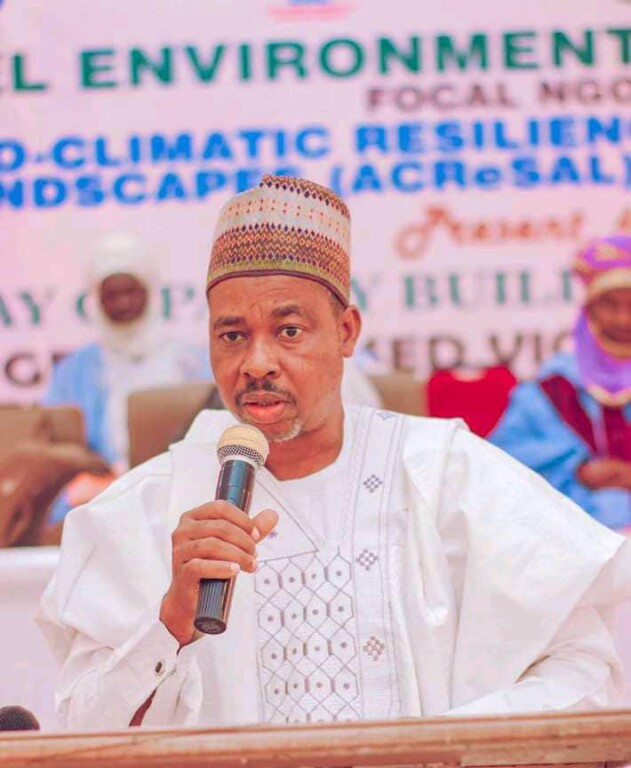
Professor Abdulkadir Saleh of the Department of Political Science, Gombe State University (GSU), has warned that growing voter apathy in Nigeria is being driven by declining public confidence, insecurity, unemployment, poverty and repeated political promises that fail to translate into meaningful improvements in citizens’ lives.
Saleh made the remarks during a public lecture organised by the Muslim Students’ Society of Nigeria (MSSN), Gombe State University chapter, at the New Multi-Purpose Hall of the university in Gombe.
The political scientist said many Nigerians are becoming increasingly disappointed with the political system because they have seen little improvement in their living conditions despite repeated promises by political leaders.
According to him, poor living standards, insecurity, rising unemployment and poverty have contributed significantly to a loss of hope among Nigerians, particularly young people who are struggling to find meaningful employment and opportunities.
He argued that Nigeria, despite having a population of more than 200 million people and abundant natural resources, has continued to face serious development challenges.
Saleh expressed concern over the country’s inability to develop sufficient industrial capacity, pointing to the long-standing challenges in the petroleum sector and the need for functional refineries and industries capable of creating jobs and reducing dependence on imported products.
He said the lack of industries and investment opportunities was contributing to youth unemployment, while the difficult economic environment could also discourage foreign investors from bringing capital into the country.
The professor also criticised what he described as the declining attention given to agriculture, arguing that Nigeria could create millions of jobs if agricultural production was properly mechanised and supported with infrastructure.
Using Gombe State as an example, he pointed to the Balanga and Dadin Kowa dams, saying that proper utilisation of the facilities could support large-scale agricultural production and create employment opportunities for millions of young people.
According to him, investment in irrigation, mechanised farming, agro-processing and related industries could transform agriculture from subsistence activity into a major source of employment and economic growth.
Beyond economic challenges, Saleh identified what he described as the weakness of the opposition as another factor contributing to voter apathy.
He argued that many citizens no longer believe that voting can produce meaningful change, while political divisions and the use of financial inducements have weakened opposition efforts to effectively challenge incumbent governments.
The professor said the situation could become a major concern ahead of the 2027 general elections if political parties and candidates fail to restore confidence among voters.
He noted that the low level of enthusiasm witnessed during the 2023 elections could resurface in 2027 if citizens continue to perceive elections as a cycle of promises without accountability.
Saleh urged Nigerians to approach the 2027 elections differently by making their choices based on issues, competence and the ability of candidates to provide solutions to the country’s challenges rather than ethnicity, religion or other primordial considerations.
He said voters should carefully examine the records and programmes of candidates before deciding who deserves their support.
According to him, security should be one of the major issues that candidates must address during the election campaign.
He called on voters to ask candidates specific questions about how they intend to tackle insecurity and protect citizens if elected.
He also urged Nigerians to demand clear plans on infrastructure development, employment creation, poverty reduction and general economic development.
On employment, Saleh said political candidates should explain what practical measures they would take to create jobs for Nigeria’s growing youth population rather than relying on general campaign promises.
He similarly called for detailed plans on poverty reduction, stressing that candidates should be challenged to explain how their proposed policies would improve the living conditions of ordinary Nigerians.
The professor also identified the development of Nigeria’s refining capacity as an important issue that should feature prominently in the 2027 political debate.
He argued that increasing the number and capacity of functional refineries could reduce pressure on the country’s foreign exchange, retain more value within the economy and create additional opportunities for government revenue and employment.
Saleh further called for the organisation of public debates, town-hall meetings and media engagements where presidential and other political candidates would be required to directly answer questions from Nigerians.
He said such platforms would allow citizens to compare candidates based on their ideas, competence and proposed solutions rather than relying solely on campaign rallies, slogans and political propaganda.
The political scientist also emphasised the importance of prayer and supplication, saying Nigerians should continue to seek divine intervention while also demanding responsible leadership and accountability from those entrusted with political power.
Reflecting on Nigeria’s leadership challenges, Saleh argued that a focused government should be able to make significant progress within five years if it has the right leadership, clear policies and the political will to implement them.
He therefore urged Nigerians to pay closer attention to leadership quality when making electoral choices in 2027.
According to him, repeated disappointment with successive administrations has created a dangerous cycle in which citizens blame previous governments for the country’s problems, only to become disappointed when a new administration fails to meet expectations.
Saleh said this cycle must be broken by ensuring that Nigerians elect leaders based on competence, integrity, capacity and clearly defined development programmes.
He maintained that the increasing voter apathy should not be interpreted simply as political disinterest, but as a reflection of citizens’ frustration with the political system.
The professor warned that if political leaders continue to make unfulfilled promises while living conditions deteriorate, more Nigerians may decide to withdraw from the electoral process.
He therefore called on political parties, civil society organisations, the media and voters to make the 2027 elections more issue-driven and focused on solutions to Nigeria’s most pressing challenges.
Saleh said Nigerians should demand answers on security, infrastructure, employment, poverty, agriculture, industrialisation, refineries and general economic development before deciding who to support.
He stressed that the responsibility for changing the country’s political trajectory does not rest entirely with politicians, urging citizens to actively participate in the democratic process and hold elected officials accountable.
The lecture was organised by the MSSN Gombe State University chapter as part of its engagement with students and the wider community on national development and political participation.