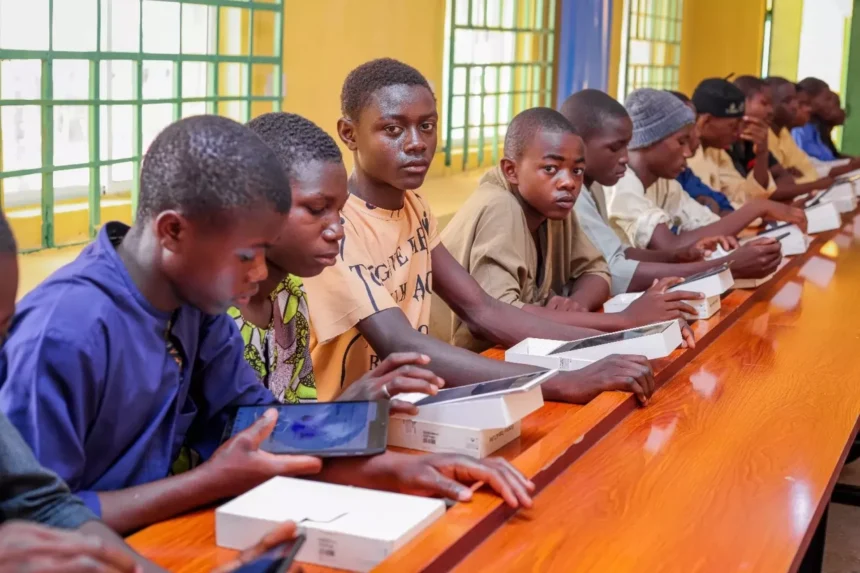
The word “Almajiri” often evokes images of barefoot children begging on the streets of northern Nigeria. For many, it has become synonymous with poverty, exclusion and illiteracy.
But education experts and Islamic scholars argue that such assumptions overlook an important reality: many Almajirai possess advanced literacy and extensive knowledge within the Islamic intellectual tradition, even if they lack formal Western education.
A growing conversation among academics and public commentators is challenging Nigerians to rethink what literacy truly means and whether the country’s understanding of education has become too narrow.
The debate gained renewed attention following a widely shared commentary titled “Before You Call an Almajiri Illiterate,” which argues that many Almajirai are far from illiterate.
The author notes that numerous students within the traditional Qur’anic education system memorise the entire Qur’an—comprising 6,236 verses—with remarkable precision.
Beyond memorisation, many also study classical Arabic, including grammar (Nahwu), morphology (Sarf), rhetoric (Balaghah), jurisprudence (Fiqh), theology (Aqidah), Hadith, Qur’anic exegesis (Tafsir) and Islamic ethics.
Supporters of the argument say mastering these disciplines requires years of rigorous study, analytical thinking and intellectual discipline.
According to the United Nations Educational, Scientific and Cultural Organization (UNESCO), literacy extends beyond simply reading and writing. It involves the ability to identify, understand, interpret, create and communicate using written materials in different contexts.
By that definition, many traditional Islamic students are literate in Arabic, even if they cannot read or write English.
Experts argue that the inability to communicate in English should not automatically be interpreted as a lack of education or intelligence.
Throughout history, civilizations have preserved knowledge in many languages, including Arabic, Greek, Latin, Persian, Sanskrit and Chinese, long before English became the world’s dominant language of commerce and academia.
Islamic civilization has played a significant role in preserving and advancing knowledge across numerous disciplines.
During the Islamic Golden Age, scholars made major contributions to mathematics, astronomy, medicine, chemistry, engineering, philosophy and law.
Classical Islamic education traditionally combines religious studies with logic, ethics, legal reasoning and language sciences.
Students often develop exceptional memorisation skills while studying complex legal principles governing inheritance, commerce, contracts, family law and conflict resolution.
Supporters argue that dismissing such scholarship simply because it is not delivered in English reflects a misunderstanding of education itself.
While defending the intellectual value of traditional Islamic education, many scholars agree that the Almajiri education system requires significant reform.
Nigeria is home to one of the world’s largest populations of out-of-school children. According to UNICEF, millions of Nigerian children remain outside formal education, with northern Nigeria accounting for a significant proportion.
Education experts have consistently advocated integrating Qur’anic education with modern subjects such as:
- Mathematics
- Science
- Technology
- Engineering
- Medicine
- Economics
- Computer studies
- Digital literacy
- Entrepreneurship
They argue that combining traditional and modern education would better prepare students for contemporary economic realities without undermining Islamic scholarship.
Rather than choosing between religious and secular education, advocates believe the future lies in combining both.
They envision graduates who possess strong Islamic scholarship alongside professional expertise.
Such a model could produce:
- Qur’an memorizers who become medical doctors.
- Islamic scholars who specialise in artificial intelligence.
- Arabic linguists who develop language technologies.
- Jurists with expertise in constitutional law and international relations.
- Engineers grounded in both scientific knowledge and ethical values.
Supporters say this approach would preserve Nigeria’s rich Islamic educational heritage while expanding opportunities for young learners.
The commentary also urges Nigerians to avoid judging Almajirai based on clothing, poverty or social circumstances.
Observers note that many students enrolled in traditional Qur’anic schools come from economically disadvantaged backgrounds, making it easy for society to confuse poverty with ignorance.
Educational researchers argue that socioeconomic hardship should not be mistaken for intellectual inability.
Many Almajirai demonstrate remarkable memory, discipline and analytical reasoning developed through years of intensive study.
As debates continue over education reform, the discussion highlights a broader national question: What does it truly mean to be educated?
Many experts believe education should be viewed as the acquisition of knowledge, critical thinking, ethical values and practical skills, regardless of the language or institution through which it is obtained.
At the same time, they stress that expanding access to quality formal education remains essential for improving employment opportunities, reducing poverty and supporting national development.
The growing consensus among education advocates is that Nigeria does not need to replace one educational tradition with another. Instead, it needs a system that values both.
For many observers, the challenge is not whether Almajirai are capable of learning—it is ensuring they receive the broad-based education needed to thrive in a rapidly changing world while preserving the rich intellectual traditions they already possess.
As the national conversation evolves, one message continues to resonate: literacy is larger than language, education is broader than any single curriculum, and knowledge should be recognised wherever it is found.