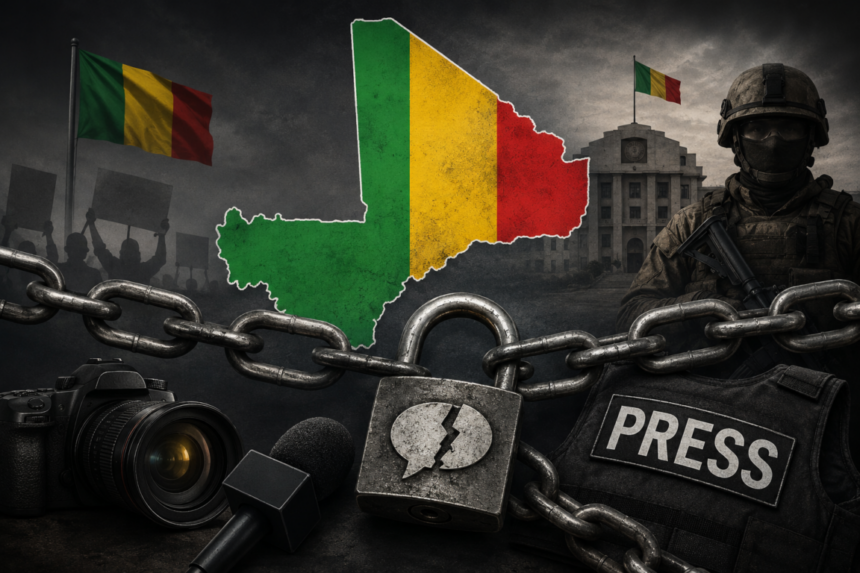
The International Press Institute (IPI) has raised concerns over the growing use of cybercrime laws by Mali’s military authorities to target journalists and restrict critical reporting.
The warning follows the imprisonment and prosecution of several Malian journalists over their reports, public comments and criticism of the authorities.
IPI Africa Programme Lead, Nompilo Simanje, said the development reflects a wider trend across Africa, where cybercrime laws are increasingly being used against journalists.
“The escalating weaponisation of cybercrime provisions to target journalists is a deeply alarming trend that continues to intensify across Africa, including in Mali, Zambia and Nigeria, among others,” Simanje said in a statement published on the IPI website on Thursday.
She called on African governments to review cybercrime laws that could threaten freedom of expression.
“This trend shows the urgent need to repeal these provisions and ensure that cybercrime legislation is aligned with regional and international standards on freedom of expression,” she said.
Journalists Increasingly Face Prosecution
The warning comes amid a series of cases involving journalists in Mali.
IPI said journalist and editor of 22 Septembre, Chahana Takiou, was sentenced on August 3 to 12 months in prison, with six months suspended. He was also fined for allegedly undermining the credibility of the state through the judicial system.
According to the institute, authorities arrested Takiou in June after he criticised the use of cybercrime laws against journalists during remarks at the Pan-African Media Forum in Bamako.
Another journalist, Abdrahamane Keita of Le Témoin, was detained on June 9 over comments he made during a live media programme about the security situation in northern Mali.
IPI said authorities charged Keita with undermining national unity and the credibility of the state, as well as disseminating false and misleading information.
His trial, initially scheduled for August 17, has been postponed to August 31.
The institute also reported that the trial of radio and television commentator Mohamed Youssouf Bathily, popularly known as Ras Bath, began on August 10.
Bathily faces charges of criminal association and undermining the credibility of the state through information and communication technologies.
IPI said authorities arrested him in March 2023 following public comments about the death in custody of former Prime Minister Soumeylou Boubèye Maïga.
The institute described Bathily’s prolonged detention and repeated prosecutions as an example of how criminal and cybercrime-related laws are being used against critical voices and journalists.
IPI Calls for Release of Journalists
Simanje urged the Malian authorities to release journalists imprisoned in connection with their professional work.
“We call on authorities in Mali to release all journalists imprisoned in connection with their work, and to end the misuse of criminal and cybercrime provisions to suppress critical reporting,” she said.
IPI said Mali amended its Penal Code in December 2024, incorporating provisions previously contained in the country’s 2019 cybercrime law.
The institute said the government also established a specialised cybercrime unit, the Pôle national de lutte contre la cybercriminalité, to enforce offences involving digital and telecommunications technologies.
According to IPI, several critical journalists have since been arrested and imprisoned under the amended Penal Code.
The president of Maison de la Presse, Mali’s national umbrella organisation for press defence groups, Dante Bandiangou, called for legislation that protects journalists in the course of their work.
“We want a healthy media environment with legislation that protects journalists in the exercise of their profession,” Bandiangou told IPI.
He said the growth of digital technology should support rather than restrict press freedom.
“The expansion of digital technology must be an opportunity and not an obstacle to the thriving of press freedom,” he added.
IPI said it had previously documented the growing crackdown on independent reporting in Mali, Burkina Faso and Niger amid the wider security crisis in the Sahel.