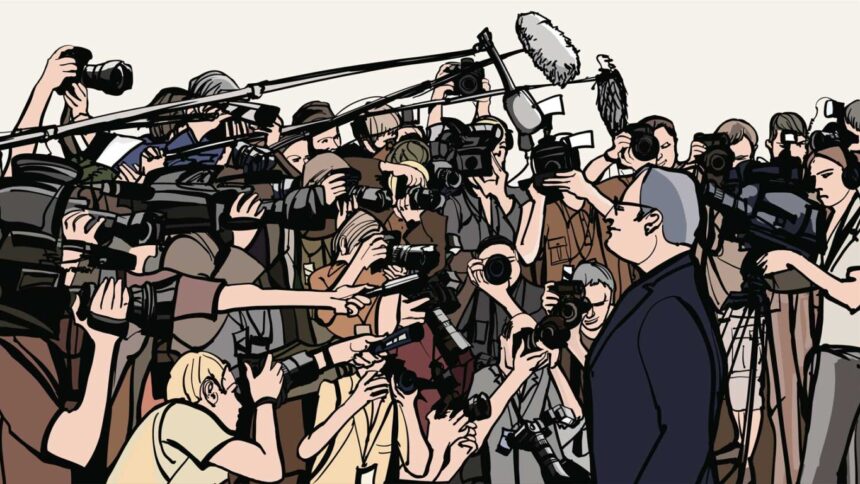
As Nigeria steadily approaches the 2027 general elections, the country’s journalists face one of the most consequential assignments since the return to democratic rule in 1999.
The task ahead is larger than reporting campaign rallies, political defections, or party primaries. It is about safeguarding truth in an increasingly complex environment shaped by insecurity, digital misinformation, artificial intelligence, political polarization, and competing ambitions for power.
The quality of information available to Nigerians between now and 2027 may significantly influence the quality of decisions made at the ballot box.
Many Nigerians view elections as events that begin when political parties unveil candidates or launch campaigns.
In reality, elections begin much earlier.
They begin when narratives are created, when public opinion is shaped, when information, misinformation, and disinformation start competing for attention.
The Independent National Electoral Commission (INEC) reported over 93.4 million registered voters ahead of the 2023 general elections, making Nigeria one of the world’s largest democratic electorates.
INEC’s preliminary register stood at 93,522,272 voters, while the final register contained 93,469,008 eligible voters. (INEC Nigeria)
This means that even small shifts in public perception can have enormous electoral consequences.
For journalists, the responsibility is clear: citizens must be equipped with verified facts rather than manipulated narratives.
The AI Challenge
The 2027 election cycle may become Nigeria’s first major election heavily influenced by artificial intelligence.
Across the world, AI-generated images, cloned voices, manipulated videos, and synthetic content are increasingly blurring the line between fact and fiction.
A fabricated video can travel across social media platforms within minutes, reaching millions before fact-checkers can respond.
The challenge for journalists is no longer simply asking whether a story is important.
The first question increasingly becomes: Is it authentic?
Nigeria’s 2023 general elections demonstrated how quickly misinformation can influence public perception and political discourse.
Throughout the election cycle, fact-checking organisations including Africa Check, Dubawa, FactCheckHub, and members of the Nigeria Fact-Checkers’ Coalition were forced to respond to a flood of false election results, manipulated videos, forged statements, misleading images, and coordinated disinformation campaigns circulating across social media platforms.
Researchers and election observers documented how fabricated election announcements, doctored campaign materials, and false narratives were deliberately deployed to influence voters, undermine confidence in institutions, and deepen political divisions.
The lesson for journalists ahead of 2027 is clear: speed can no longer outweigh accuracy. Verification must come before amplification.
A single fake result sheet, manipulated video clip, forged statement, or AI-generated recording can travel farther in one hour than a correction can travel in one week, making verification, digital literacy, and newsroom discipline among the most important democratic responsibilities of journalism in the 2027 elections.
Newsrooms must therefore invest in digital verification tools, fact-checking systems, forensic verification skills, and AI literacy if they are to remain credible sources of information.
In an era where content can be manufactured instantly, verification becomes journalism’s most valuable currency.
Also, Nigeria’s security landscape remains one of the defining issues likely to shape voter sentiment heading into 2027.
Across various regions, communities continue to confront terrorism, banditry, kidnapping, communal violence, farmer-herder conflicts, and organized criminality.
The Lake Chad Basin provides a powerful example of how security challenges intersect with governance, climate pressures, displacement, and development.
According to UNDP conflict analyses, countries within the basin continue to grapple with insecurity, displacement, criminality, and fragility, while regional stabilization efforts have attracted hundreds of millions of dollars in international support.
Reports indicate that millions of people across the Lake Chad region have been displaced or remain dependent on humanitarian assistance due to conflict and environmental pressures.
In this environment, journalists must strike a delicate balance. The media must expose failures, hold authorities accountable, give voice to affected communities.
However, the media must also avoid sensationalism that amplifies fear, glorifies violence, or unintentionally serves the propaganda objectives of criminal groups.
Journalism Must Follow the Money
One of the most underreported dimensions of elections is campaign financing. Political influence often follows financial influence.
Journalists should be asking difficult questions:
– Who is funding campaigns?
– How much money is being spent?
– What interests are attached to that funding?
– What obligations may emerge after elections?
Transparency in campaign financing is not merely a political issue. It is a governance issue.
Citizens deserve to understand not only who is seeking power but also who is financing the pursuit of that power.
Nigerian political reporting has historically devoted substantial attention to personalities.
Names dominate headlines. Political drama dominates conversations. Yet citizens ultimately live with policies, not personalities.
Journalists must increasingly focus on measurable questions:
– How will jobs be created?
– How will inflation be addressed?
– What is the security strategy?
– What is the education plan?
– What reforms are proposed for healthcare?
Issue-based journalism strengthens democracy because it allows voters to compare ideas rather than merely compare political brands.
Trust Is Journalism’s Greatest Asset
The greatest danger facing journalism during election cycles is not censorship, it is the loss of public trust.
Once journalists are perceived as political actors rather than independent observers, their credibility begins to erode.
This is why journalists must maintain professional distance from candidates, parties, and power blocs.
A journalist does not need to be neutral between truth and falsehood.
A journalist must, however, remain loyal to evidence.
Credibility remains the foundation upon which public trust is built.
The future of election reporting may be increasingly local.
While national politics dominates headlines, voters often make decisions based on realities closest to them:
– The condition of roads.
– Availability of electricity.
– Cost of food.
– Quality of schools.
– Access to healthcare.
– Personal security.
The most impactful election stories may not emerge from Abuja alone.
They may emerge from villages, local government areas, marketplaces, farms, schools, and communities across the country.
Community journalism helps bridge the gap between national policy and everyday experience.
Governance Journalism Must Continue After Elections
One of Nigeria’s recurring democratic weaknesses is that scrutiny often declines after elections are concluded. Yet governance begins after votes are counted.
Journalists must continue asking:
– Was the promise fulfilled?
– Was the budget implemented?
– Was the project completed?
– Did citizens benefit?
Accountability journalism ensures that campaign promises do not disappear once political office is secured.
The Road to 2027
Nigeria’s broadcast landscape is already preparing for the challenges ahead. In 2026, regulatory attention intensified around misinformation, presenter neutrality, and election-related content as the country moves closer to another national electoral cycle.
This development reflects a reality confronting journalists globally: information has become a strategic battleground.
As 2027 approaches, the role of journalism will not be measured by how loudly it speaks, but by how accurately it informs.
The future belongs to journalists who verify before publishing, investigate before amplifying, and hold power accountable without becoming part of power.
Because in every democracy, informed citizens remain the strongest defense against poor governance.
And in 2027, the most powerful political force may not be a political party, a candidate, or a campaign.
It may be the quality of information available to the Nigerian voter.