
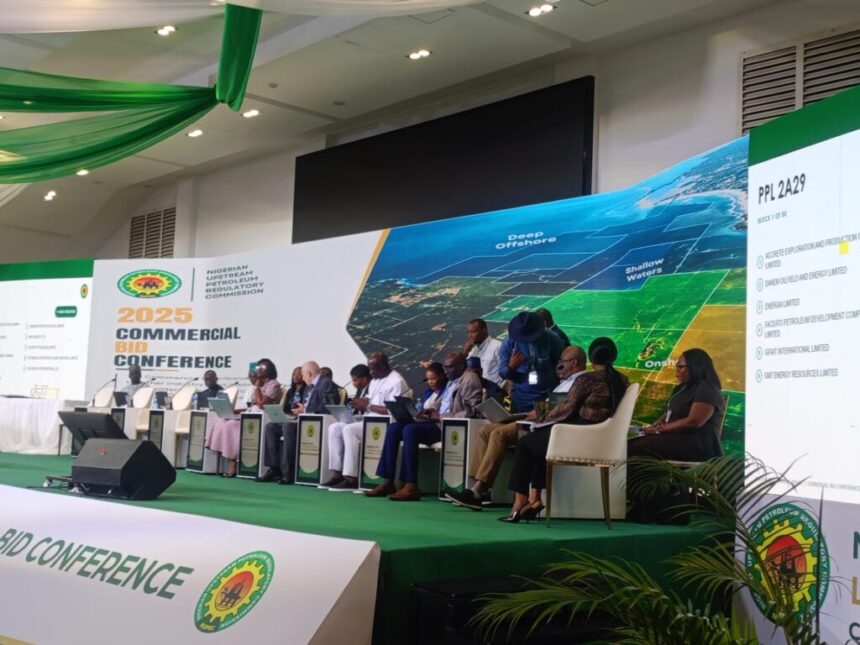
The NUPRC 2025 Commercial Bid Conference is the final stage of Nigeria’s oil and gas licensing process, where qualified companies submit commercial bids for available oil and gas blocks.
The Nigerian Upstream Petroleum Regulatory Commission (NUPRC) evaluates each submission through a transparent scoring system before announcing successful bidders.
The NUPRC 2025 Commercial Bid Conference attracted 143 pre-qualified companies that submitted 200 technical and commercial bids for 37 oil and gas blocks. The process is designed to select investors with the financial capacity, technical expertise, and commitment needed to develop Nigeria’s petroleum resources.
How Does the NUPRC Select Winners?
The NUPRC does not simply choose the highest bidder. Instead, it uses a weighted scoring system.
Officials assess every company using three main criteria:
- Signature bonus.
- Work programme commitment.
- Performance security.
The commission combines these scores with each company’s technical evaluation. It then selects the highest-ranked bidders.
This process rewards companies that can invest and develop the assets. It also discourages speculative bidding.
The outcome of the NUPRC 2025 Commercial Bid Conference is expected to strengthen Nigeria’s upstream sector by attracting new investments, increasing crude oil reserves, and supporting future production growth.
Why Is the Conference Important?
The conference plays a major role in Nigeria’s energy sector. It helps the government attract credible investors and increase oil production.
Officials expect the licensing round to attract about $10 billion in investments.
The awarded assets could also add 500 million barrels to Nigeria’s crude reserves. In addition, they could increase production by 300,000 barrels per day within three years.
These projects would move Nigeria closer to its goal of producing 3 million barrels of oil per day by 2030.
How Does the Process Promote Transparency?
The NUPRC designed the licensing round to promote transparency.
The Nigeria Extractive Industries Transparency Initiative (NEITI) monitored key stages of the process. It observed both the bid opening and the commercial evaluation.
The commission also followed the Petroleum Industry Act (PIA) 2021. The law introduced reforms that strengthen accountability and attract investment.
What Happens After the Conference?
Winning a bid does not guarantee an oil licence.
Successful companies must meet several conditions within 90 days. They must pay the signature bonus and first-year rent. They must also provide performance guarantees and sign the required agreements.
Companies that fail to meet these conditions lose the assets. The NUPRC may then offer the blocks to reserve bidders.
The commission calls this policy “drill or drop.” It expects companies to develop the assets instead of holding them without investment.