

As President Bola Tinubu, former Vice-President Atiku Abubakar and the Peter Obi–Rabiu Kwankwaso ticket prepare for the January 16, 2027 presidential election, northern Nigeria is emerging as a decisive battleground, with more than 54 million registered voters across the region’s 19 states.
The contest is expected to test Tinubu’s ability to retain the northern support that contributed significantly to his victory in 2023, as opposition candidates seek to exploit economic hardship, insecurity and shifting political alliances.
The ruling All Progressives Congress (APC) inaugurated its Presidential Campaign Council on October 14, drawing members from its ranks and opposition figures supporting Tinubu’s re-election bid.
Five days earlier, the African Democratic Congress (ADC) inaugurated its campaign council for Atiku, while the Nigeria Democratic Congress (NDC), which is fielding the Obi–Kwankwaso ticket, scheduled the inauguration of its campaign council for October 20.
Beyond campaign ceremonies, endorsements and political defections, the central question is whether Tinubu can reconstruct the coalition that helped him secure the presidency in 2023.
Why the North Matters
Data cited from the Independent National Electoral Commission (INEC) put Nigeria’s registered voters at 103,428,715 in October 2026, up from 93,469,008 in 2023.
The 19 northern states account for approximately 54.28 million registered voters, while the wider northern region, including the Federal Capital Territory, has more than 56 million.
The figures underline the region’s electoral importance, particularly the North-West, which has more than 25 million registered voters.
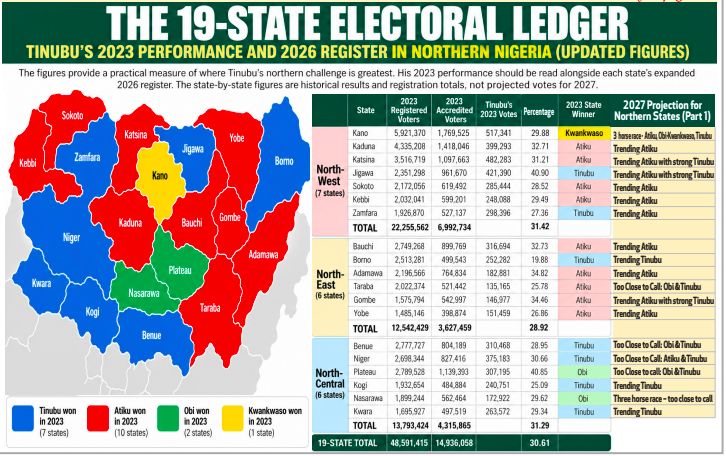
In the 2023 presidential election, Tinubu secured 5,507,784 votes across the 19 northern states, representing approximately 62.6 per cent of his national total of 8,794,726 votes.
Despite winning only seven of the 19 northern states, Tinubu polled more votes across the region than Atiku, who won nine states, while Peter Obi won two and Rabiu Kwankwaso secured Kano.
The outcome demonstrated that the number of states won does not necessarily determine a candidate’s overall electoral strength.
However, the political environment has changed considerably since 2023, with new alliances, defections and competing presidential ambitions reshaping the electoral landscape.
North-West Emerges as a Major Battleground
The North-West, comprising Kano, Kaduna, Katsina, Jigawa, Zamfara, Sokoto and Kebbi, is expected to be central to the presidential contest.
Tinubu secured his largest northern vote total from the zone in 2023, but his performance varied significantly across the seven states.
Kano presents one of the most consequential tests. Kwankwaso received 997,279 votes in the state in 2023, while Tinubu polled 517,341, Atiku secured 131,716 and Obi obtained 28,513.
The subsequent defection of Kano State Governor Abba Kabir Yusuf from the New Nigeria Peoples Party to the APC has altered the state’s political calculations.
Yusuf’s movement to the ruling party, alongside several lawmakers, has strengthened the APC’s institutional position. However, whether Kwankwasiyya supporters will follow the governor or remain loyal to Kwankwaso remains a key question.
With Kwankwaso now running alongside Obi on the NDC platform, Kano could become a major battleground between the ruling party and the opposition alliance.
Kaduna, Katsina and Sokoto are also expected to attract significant attention because of their competitive results in 2023.
In Katsina, Atiku defeated Tinubu by just 6,762 votes, while the margin in Sokoto was only 3,235 votes in Atiku’s favour.
These narrow margins suggest that changes in voter turnout, party mobilisation and local political alliances could influence the outcome in both states.
Atiku’s Opportunity in the North-East
The North-East presents another significant challenge for the APC.
Atiku won five of the zone’s six states in 2023, leaving Borno as the only state secured by Tinubu.
Adamawa, Atiku’s home state, remains an important opposition stronghold, while Bauchi and Gombe recorded substantial margins in his favour during the previous election.
However, the APC retains political structures across the region, including the influence of Vice-President Kashim Shettima and several incumbent governors.
Borno, where Tinubu won in 2023, will be particularly important because of Shettima’s position in the administration and the political influence of Governor Babagana Zulum.
The region’s security situation, displacement, agricultural challenges and economic conditions are also expected to shape voters’ assessments of the government.
In Taraba and Yobe, changing political alignments could make the contest more competitive than the previous results alone might suggest.
North-Central Could Produce Decisive Margins
The North-Central region, comprising Benue, Plateau, Nasarawa, Niger, Kogi and Kwara, presents a different electoral calculation.
Tinubu won four of the six states in 2023, while Obi secured Plateau and Nasarawa.
Benue was particularly competitive, with Tinubu defeating Obi by just 2,096 votes.
The narrow margin illustrates how small shifts in voter preferences could change the outcome in closely contested states.
Political realignments have also altered the region’s landscape, with some influential opposition figures and elected officials moving towards the APC.
Nevertheless, insecurity, displacement, agricultural disruption and concerns about political representation remain important issues that could influence voting behaviour.
Economic Hardship and Insecurity Could Shape Voting
Beyond political alliances, the cost of living and security challenges are expected to feature prominently in the 2027 campaign.
For many voters across northern Nigeria, the election will provide an opportunity to assess the administration’s performance on food prices, employment, agriculture, public services and insecurity.
Tinubu’s supporters are expected to defend the government’s economic reforms and argue that their long-term benefits require continuity.
Opposition candidates, meanwhile, are likely to emphasise the immediate impact of economic pressures on households and question whether the administration has delivered sufficient improvements in living standards.
In communities affected by banditry, kidnapping and displacement, the ability to travel safely, farm and conduct business could prove particularly influential.
The effectiveness of government security operations and the restoration of livelihoods may therefore matter as much as endorsements by prominent political figures.
Opposition Unity Remains a Major Question
The emerging competition also raises questions about whether the opposition can translate public dissatisfaction into a consolidated electoral advantage.
Atiku brings extensive political experience and established support across northern Nigeria, while Obi retains a substantial following among voters seeking an alternative to the established political parties.
Kwankwaso’s grassroots organisation in Kano and neighbouring areas could strengthen the NDC ticket, although combining the supporters of two politicians does not automatically guarantee a corresponding increase in votes.
The APC could benefit if opposition parties divide voters who might otherwise support a single challenger.
However, the extent of that advantage will depend on the candidates’ ability to mobilise supporters, attract undecided voters and secure strong turnout across competitive states.
The National Electoral Calculation
Although northern Nigeria is central to the contest, the outcome will also depend on voting patterns across the South-West, South-East and South-South.
Tinubu will seek to consolidate his support in the South-West while improving his performance in states where he lost in 2023.
Obi will face the challenge of maintaining his strong support in the South-East, while Atiku and his running mate, Rotimi Amaechi, will seek to build support across regions where political alignments have shifted.
The constitutional requirements for winning the presidency also mean that no candidate can rely solely on dominance in one geopolitical zone.
Under Section 134 of the 1999 Constitution, as amended, a presidential candidate must secure the required majority of votes cast and at least 25 per cent of votes in no fewer than two-thirds of the states of the federation and the Federal Capital Territory, as constitutionally applicable.
Consequently, winning the North alone will not guarantee victory, but a significant loss of support across the region could make it more difficult for any candidate to assemble a winning national coalition.
With the election approaching, the political calculations remain uncertain. Voter registration figures indicate the size of the electoral opportunity, but they do not establish turnout or predict how voters will cast their ballots.
Ultimately, Tinubu’s re-election prospects will depend on the strength of his political organisation, his administration’s record and the ability of his opponents to build an effective alternative.
The North helped shape the outcome of the 2023 presidential election. In 2027, its voters could once again play a decisive role in determining who occupies the presidency for the next four years.