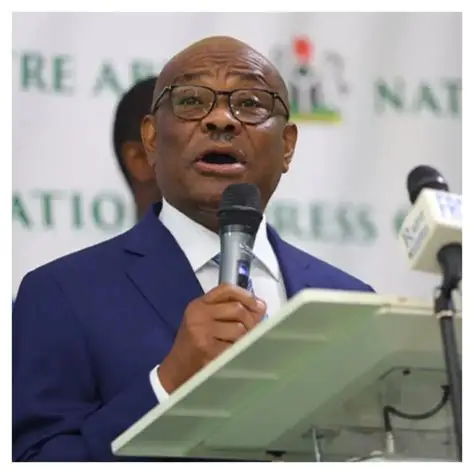
The recognition of the Rainbow Coalition championed by Minister of the Federal Capital Territory (FCT), Nyesom Wike, as part of President Bola Ahmed Tinubu’s 2027 Presidential Campaign Council has altered political calculations in several states, raising concerns within the ruling All Progressives Congress (APC) over its candidates’ electoral prospects.
The coalition, which seeks to mobilise support for Tinubu’s re-election while backing candidates from other political parties, particularly the Peoples Democratic Party (PDP), for governorship and legislative positions, has emerged as a potential force in the evolving political realignments ahead of the 2027 general elections.
Before the launch of the presidential campaign council in Abuja last week, APC governors led by Imo State Governor Hope Uzodimma reportedly opposed the arrangement, insisting they would campaign only for APC candidates.
However, Wike’s inclusion in the council has strengthened perceptions that the coalition enjoys support from the presidency, encouraging opposition politicians, particularly those within the PDP, to revive their political structures and consolidate their electoral ambitions.
The FCT minister has consistently maintained that his support for Tinubu’s re-election does not translate into automatic support for every APC governor or candidate.
Adamawa PDP Resolves Internal Dispute
In Adamawa State, the Wike-backed faction of the PDP has continued its political activities following the resolution of an internal dispute over the party’s governorship candidacy.
The Independent National Electoral Commission’s (INEC) list of governorship candidates reportedly recognised Chief Maurice Michael Vonobolki as the PDP candidate, rather than Caleb Andrew, who had claimed the ticket on social media.
The party’s state secretary, Alhaji Shekarau Yerima, said the Wike factor would not weaken the PDP, insisting that the party had complied with electoral guidelines and its constitution.
He described the PDP as a strong contender in the 2027 elections, citing its performance in the 2023 general elections and recent local government polls in the state.
Rainbow Coalition Exposes APC Divisions in Kwara
In Kwara State, the coalition has brought existing divisions within the ruling APC into sharper focus, particularly over Governor AbdulRahman AbdulRazaq’s succession plan.
The political realignment involves aggrieved APC chieftains under the Otoge Progressives (TOP), members of the G15 group of governorship aspirants and politicians associated with former Senate President Bukola Saraki.
Although the groups have different political interests, their opposition to the governor’s preferred succession arrangement could complicate the APC’s electoral calculations.
The coalition gained prominence on August 26 when Senator Saliu Mustapha unveiled its state chapter in Ilorin. Mustapha, who defected from the APC to the PDP, also declared his intention to challenge AbdulRazaq for the Kwara Central senatorial seat.
Wike recently accused the governor of contributing to the coalition’s growth by ignoring the grievances of the G15, warning that AbdulRazaq could face a significant political challenge.
The PDP’s publicity secretary, Olusegun Olushola Adewara, said the party had no objection to Tinubu’s re-election bid, stressing that its immediate political objective was to unseat AbdulRazaq.
Adewara added that the party was open to APC members joining the coalition, saying its priority was to win elections in the state.
Edo Coalition Remains Active After Orbih’s Death
In Edo State, the Rainbow Coalition remains active despite the death of its former leader, Chief Dan Orbih, according to the report.
Orbih spearheaded the coalition during the 2024 governorship election, in which Governor Monday Okpebholo defeated the PDP candidate, Barrister Asue Ighodalo.
The PDP’s state secretary, Hilary Otsu, said the coalition remained active in Edo and was mobilising support for Tinubu’s re-election.
He maintained that the arrangement would not undermine PDP candidates in state elections, arguing that voters understood the distinction between presidential and legislative contests.
“Edo State voters are very discerning. So, our message in Edo is very clear: Vote for BAT in the presidential ballot. For Senate, Reps and Assembly, vote for PDP only,” Otsu said.
Wike, Fubara Renew Reconciliation Talks in Rivers
In Rivers State, Wike has continued efforts to consolidate reconciliation between political leaders loyal to him and supporters of Governor Siminalayi Fubara.
Barely two weeks after their previous meeting, Wike on Sunday led a delegation of political stakeholders to meet Fubara at his private residence in Port Harcourt.
The delegation included members of the Rivers State House of Assembly, led by Speaker Martin Amaewhule, as well as the 23 local government council chairmen and other key political figures.
The meeting reportedly advanced ongoing reconciliation efforts, with the Rainbow Coalition providing a political framework for engagement between the rival camps.
The renewed discussions could prove significant for the political configuration of Rivers State as parties prepare for the 2027 elections.
Benue Coalition Draws Line Against Alia’s Second Term
In Benue State, the Rainbow Coalition’s plan to support Tinubu’s re-election without backing Governor Hyacinth Alia’s second-term ambition has exposed widening divisions over the state’s political succession.
The coalition’s national secretary, Austin Agada, said in Makurdi that the group would not support Alia unless he demonstrated commitment to its political interests.
Agada maintained that the coalition would work for Tinubu but would not automatically support the governor.
The position comes amid allegations by the Benue Alliance for Good Governance and Accountability (BAGA) that a proposed political arrangement involving Wike, Secretary to the Government of the Federation George Akume and former governor Samuel Ortom was intended to influence the 2027 governorship election.
BAGA alleged that the arrangement was designed to favour former Attorney-General of the Federation Mike Aondoakaa as Alia’s successor. The group rejected attempts by political leaders outside the state to determine the next governor, insisting that the electorate should decide.
Agada also said Alia had not engaged the coalition.
“Benue is not Rivers, and we will not allow Wike from Rivers State to choose a governor for us in Benue State,” the group said.
Meanwhile, PDP publicity secretary Bright Antyo said the party’s leadership would communicate its position on the implications of Wike’s support for Tinubu for the party’s candidates.
Coalition Gains Ground in Nasarawa
In Nasarawa State, PDP candidates contesting governorship and legislative positions secured their tickets from the faction loyal to Wike, according to the report.
The party’s governorship candidate, Emmanuel David Ombugadu, said at a recent stakeholders’ meeting that the state chapter would select its presidential candidate during the general elections in line with Wike’s directive.
Ombugadu, who contested the 2023 governorship election, is seeking to win the position under the PDP in 2027.
Another prominent candidate whose prospects could be affected by the arrangement is former Director-General of the National Orientation Agency, Mike Omeri, who is contesting the Nasarawa South senatorial seat on the PDP platform against APC candidate Abubakar Hassan Nalaraba.
Both the PDP and APC lost the presidential vote in Nasarawa State in 2023 to Peter Obi, who contested under the Labour Party.
Ombugadu’s position on the presidential ballot has continued to generate reactions among party stakeholders and political observers as preparations for the 2027 elections gather momentum.
Rainbow Coalition Could Challenge APC in Ondo
In Ondo State, the emergence of candidates associated with the Rainbow Coalition is raising questions about the APC’s control of its political structures.
Among those at the centre of the realignment are Matthew Oyerinmade, popularly known as MATO, the PDP candidate for Ondo South Senatorial District, and Idowu Mafimisebi, a former APC chieftain contesting the Ilaje/Ese-Odo Federal Constituency seat on the PDP platform.
Both candidates are associated with the coalition after failing to secure APC tickets for the 2027 elections.
Oyerinmade said the arrangement offered him an opportunity to pursue his senatorial ambition while maintaining his support for Tinubu, adding that his backing for the president predated his departure from the APC.
He argued that the coalition’s strategy of mobilising presidential votes for Tinubu while pursuing legislative victories was compatible with his political ambitions.
Mafimisebi’s camp is also relying on grassroots support rather than party affiliation alone.
His aide, Kayode Bidemi, said the campaign was mobilising supporters despite the APC’s influence in the state, arguing that voters would make decisions based on their preferred candidates rather than party symbols.
Political analyst Lasisi Iwu of the Department of Political Science at Adekunle Ajasin University, Akungba-Akoko, said the development could pose a challenge to APC candidates.
According to him, influential political stakeholders sympathetic to coalition-backed candidates could withhold support from APC candidates, withdraw from their campaigns or redirect their political influence towards preferred candidates within the Wike-led coalition.
2027 Political Realignments Intensify
The developments across Adamawa, Kwara, Edo, Rivers, Benue, Nasarawa and Ondo illustrate how the Rainbow Coalition could reshape political alliances ahead of the 2027 general elections.
By separating support for the presidency from support for individual state and legislative candidates, the arrangement creates room for politicians from different parties to cooperate on one electoral contest while competing in others.
For the APC, the emerging coalition presents a potential challenge where influential party members and grassroots networks align with opposition candidates. For the PDP, it offers an opportunity to strengthen its candidates in states where internal divisions within the ruling party could influence electoral outcomes.
However, the coalition’s ultimate impact will depend on its ability to sustain cooperation among politicians with competing interests, resolve internal disputes and translate political endorsements into votes.
As the 2027 elections approach, the central question is whether Wike’s strategy can deliver a presidential victory for Tinubu while enabling coalition-backed candidates from other parties to secure governorship and legislative seats.