
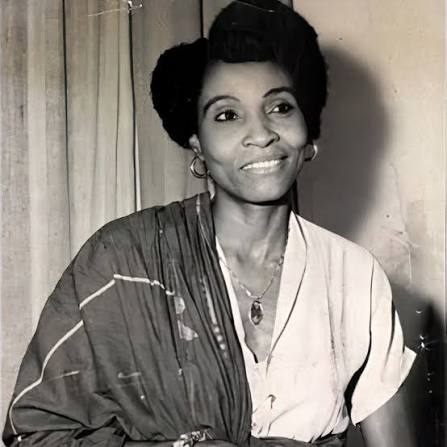
Long before gender equality became a global movement, Margaret Ekpo championed the rights of Nigerian women, challenged colonial authorities, organized women at the grassroots, and demanded equal opportunities.
Today, many regard Margaret Ekpo as one of Nigeria’s pioneering feminists, a nationalist, and one of the country’s first female politicians. Her courage transformed communities and inspired generations of women to pursue leadership.
Margaret Ekpo was born on 27 July 1914 in Creek Town, now in Cross River State. She came from a family with both Igbo and Efik heritage, giving her a rich cultural background.
After completing her early education, she worked as a teacher, married Dr. John Udo Ekpo In 1938, and later settled in Aba.
A new chapter began in 1946 when she travelled to Ireland to study Domestic Science at what is now the Dublin Institute of Technology. Upon returning home, she opened a Domestic Science and Sewing Institute in Aba. The school equipped women with practical skills that improved their income and independence.
Margaret Ekpo entered politics during the colonial era. Her husband could not attend political meetings because civil service rules restricted his participation. She attended the meetings instead.
At one gathering, she noticed she was the only woman in the room. Rather than remain silent, she spoke up. That experience convinced her that Nigerian women needed stronger representation in public affairs.
Soon after, she joined the National Council of Nigeria and the Cameroons. Through the party, she campaigned for women’s inclusion in politics and supported Nigeria’s struggle for independence.
Believing in the power of unity, Margaret Ekpo founded the Aba Market Women’s Association. The group brought together thousands of women from different ethnic backgrounds.
Through the association, members defended their economic interests, resisted unfair colonial policies, and encouraged women to participate in politics. Their efforts turned market women into a powerful political force.
By 1955, women in Aba outnumbered men on the voters’ register. That achievement reflected Margaret Ekpo’s commitment to civic participation and women’s empowerment.
She consistently encouraged women to vote, seek public office, and influence decisions affecting their communities.
Standing Against Colonial Injustice
Margaret Ekpo also challenged colonial oppression. During the 1950s, she joined Chief Funmilayo Ransome Kuti in protesting the killing of striking coal miners at the Enugu Colliery.
Their campaign drew national attention to colonial injustice and strengthened Nigeria’s independence movement. Her activism showed that women’s rights and national freedom were closely connected.
Breaking Barriers in Government
Her leadership opened new opportunities for women in governance. In 1959, the National Council of Nigeria and the Cameroons nominated her to the Eastern Region House of Chiefs.
Two years later, voters elected her to the Eastern Regional House of Assembly. As one of Nigeria’s first female parliamentarians, she advocated better roads, improved transportation, and stronger economic opportunities for women, especially those living in rural communities.
Her success challenged stereotypes and inspired more women to participate in politics.
A Legacy That Endures
The Nigerian Civil War interrupted Margaret Ekpo’s political career. During the conflict, Biafran authorities detained her for several years. Even after that difficult period, Nigerians continued to celebrate her remarkable contributions.
In 2001, authorities renamed Calabar Airport as Margaret Ekpo International Airport to honour her legacy. She also received national honours, including the Commander of the Order of the Federal Republic and the Officer of the Order of the Niger.
Margaret Ekpo died on 21 September 2006 at the age of 92. Her legacy continues to inspire women, leaders, and activists across Nigeria.
An Inspiration for Future Generations
Margaret Ekpo was far more than a politician. She believed women deserved equal opportunities to shape Nigeria’s future.
Her determination challenged social norms. Her activism empowered thousands of women. Her leadership expanded political participation across the country.
Today, her story remains relevant as Nigeria continues to pursue greater gender equality. Margaret Ekpo proved that one courageous voice can inspire lasting national change.