Nigeria is often described as the “Giant of Africa” because of its abundant natural resources, vibrant population, and enormous economic potential.
Yet, despite being Africa’s largest oil producer, with vast and fertile land and home to one of the continent’s biggest economies, millions of Nigerians continue to live in abject poverty.
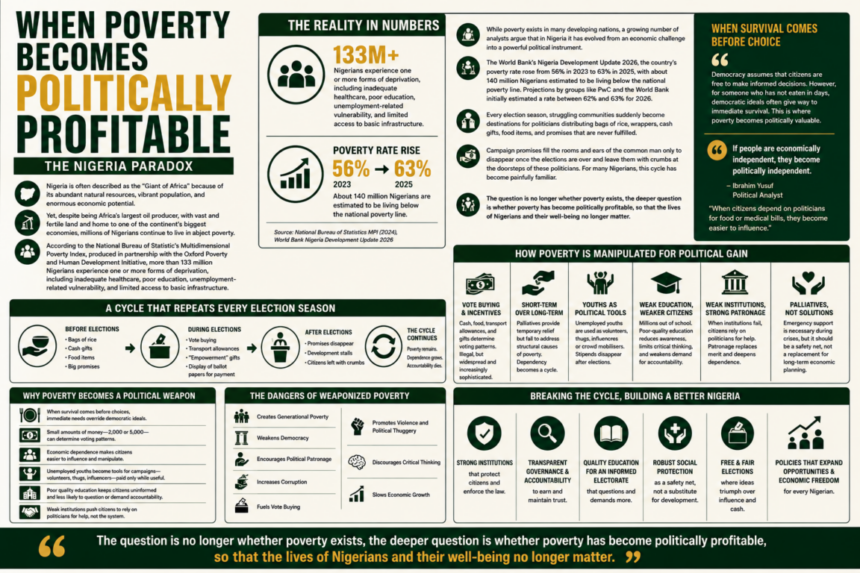
According to the National Bureau of Statistic’s Multidimensional Poverty Index, produced in partnership with the Oxford Poverty and Human Development Initiative, more than 133 million Nigerians experience one or more forms of deprivation, including inadequate healthcare, poor education, unemployment-related vulnerability, and limited access to basic infrastructure.
While poverty exists in many developing nations, a growing number of analysts argue that in Nigeria it has evolved from an economic challenge into a powerful political instrument.
The World Bank’s Nigeria Development Update 2026, the country’s poverty rate rose from 56% in 2023 to 63% in 2025, with about 140 million Nigerians estimated to be living below the national poverty line. Projections by groups like PwC and the World Bank initially estimated a rate between 62% and 63% for 2026.
Every election season, struggling communities suddenly become destinations for politicians distributing bags of rice, wrappers, cash gifts, food items, and promises that are never fulfilled.
Campaign promises fill the rooms and ears of the common man only to disappear once the elections are over and leave them with crumbs at the doorsteps of these politicians. For many Nigerians, this cycle has become painfully familiar.
The question is no longer whether poverty exists, the deeper question is whether poverty has become politically profitable, so that the lives of Nigerians and their well-being no longer matter.
When survival comes before choices, Democracy assumes that citizens are free to make informed decisions. However, for someone who has not eaten in days, democratic ideals often give way to immediate survival. This is where poverty becomes politically valuable.
In many communities across Nigeria, election campaigns focus less on long-term development and more on temporary relief. Small amounts of money, sometimes as little as 2,000 or 5,000 can determine voting patterns. For many families, that money buys food for several days.
If people are economically independent, they become politically independent, says a political analyst, Ibrahim Yusuf. “When citizens depend on politicians for food or medical bills, they become easier to influence.”
Vote buying has become one of Nigeria’s most viable electoral challenges, although the practice is illegal, election observers have repeatedly documented cases where voters receive cash, food items, or other incentives before or after casting ballots. The methods have become increasingly sophisticated.
Instead of openly exchanging money for votes, political agents often distribute transport allowances, empowerment packages, or appreciation gifts.
In some communities, voters reportedly display their marked ballot papers before receiving payment, this practice undermines democracy because elections become competitions of financial strength rather than ideas, competence, or leadership. For citizens struggling with hunger, resisting such offers can be incredibly difficult.
Many Nigerians argue that poverty persists because government interventions often prioritize short-term assistance over sustainable economic opportunities.
Rather than investing consistently in quality education, healthcare, industrialisation, agriculture, and job creation, successive administrations have frequently relied on palliative programmes.
These interventions may provide temporary relief during periods of economic hardship, but critics say they rarely address the structural causes of poverty. The result is a cycle of dependency.
Communities repeatedly wait for handouts from politicians to provide school fees, hospital bills, fertilizer or food supplies instead of receiving functional public services. Over time, elected officials become benefactors instead of public servants.
Nigeria has one of Africa’s youngest populations, yet millions of young minds remain unemployed or underemployed.
This creates another political advantage for those seeking power. Idle youths are often recruited as campaign volunteers, political thugs, social media influencers or crowd mobilisers.
Some receive daily stipends that disappear immediately after elections. Without stable employment opportunities, many young individuals see mobilizations as one of the few available sources of income. This deepens dependence on politicians while reducing incentives for long-term economic reforms.
Education, as the greatest equalizer, remains unequal and the most effective tool for breaking the cycle of poverty. Educated citizens are generally most likely to question government policies, demand accountability, and participate actively in governance.
Yet millions of Nigerian children remain out of school. Many public schools continue to face shortages of teachers, learning materials, classrooms, and basic facilities. Where education quality declines, political awareness often suffers. Experts argue that strengthening public education would produce a more informed electorate that evaluates candidates based on policies rather than immediate handouts.
Poverty becomes even more damaging when institutions meant to protect citizens fail: weak law enforcement, slow judicial processes, corruption, and poor public service delivery. Citizens who cannot rely on institutions often turn to influential politicians for assistance.
Needs hospital treatment, needs school Fees, needs employment; political connections become more important than merit. While such assistance may genuinely help individuals, it also reinforces patronage politics instead of strengthening public institutions that should serve everyone equally.
Government social intervention programmes have become increasingly rapid. Cash transfers, food distributions, student loans, agricultural support and fuel subsidy palliatives are designed to cushion economic hardship.
Economists such as Nobel Laureate Amartya Sen and Esther Duflo have long argued that while emergency social assistance is vital during crisis, lasting poverty reduction depends on sustained investments in human capital, strong public institutions, quality education, healthcare and economic opportunities.
Acknowledge that emergency assistance is necessary during a crisis. However, they caution that palliatives should never replace long-term economic planning. Their work emphasizes that social protection should serve as a safety net rather than a substitute for long-term development.
Weaponized poverty poses significant risk not only to individuals but also to democracy, economic development, national security, and social cohesion. When poverty is deliberately exploited or allowed to persist for political, economic, or social advantage, it creates a cycle that becomes increasingly difficult to break.
These cycles could be:
- Creating Generational Poverty
- Weakens Democracy
- Encourages political patronage
- Increases corruption
- Fuels vote buying
- Promotes violence and political thuggery
- Discourages critical thinking and
- Slows economic growth.
The danger of weaponized poverty lies in its ability to create a self- enforcing cycle. Poverty increases dependence on political patrons; that dependence can reduce accountability; weak accountability can lead to poor governance, and poor governance can make it harder to reduce poverty. Breaking this cycle requires more than economic growth alone. It depends on strong institutions, transparent governance, quality education, robust social protection, free and fair elections, and policies that expand opportunities so citizens can make political choices without economic coercion.