Nigeria has announced plans to strengthen agricultural infrastructure and modernise food production in a major drive to unlock the sector’s economic potential, attract investment and improve food security.
Vice President Kashim Shettima disclosed this on Thursday during a tour of farms and agricultural facilities in Ethiopia’s Oromia region as part of the Ethiopia–Nigeria Leadership Exchange.
Shettima said Nigeria intends to address supply chain gaps and logistical bottlenecks that have constrained agribusiness, while adopting modern farming practices to position the country as a major food producer in Africa.
He identified Ethiopia’s Oromia agricultural model as a template for transforming farming across the continent, citing the country’s progress in wheat and rice production as evidence of the benefits of sustained investment in agriculture.
According to the Vice President, Ethiopia has moved from importing about $1 billion worth of wheat annually to achieving self-sufficiency and producing surpluses for export to neighbouring countries, including Djibouti and Kenya.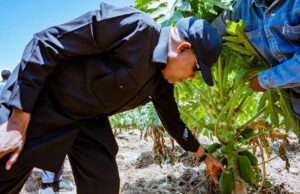
He also commended Ethiopia’s progress towards self-sufficiency in rice production, describing the country’s agricultural transformation as a model Nigeria and other African nations could emulate.
“We intend to embrace improved seeds, mechanization, and climate-smart agriculture,” Shettima said.
He stressed that Nigeria’s agricultural strategy would focus on expanding large-scale production, improving productivity and strengthening the systems required to move food from farms to markets.
Food Security Is National Sovereignty, Says Shettima
The Vice President warned that excessive dependence on imported food could undermine a nation’s independence and sovereignty.
“Food dependency compromises our sovereignty. Without independence in food production, a nation remains incomplete in its sovereignty,” he stated.
Shettima said Nigeria and Ethiopia had the agricultural resources and population strength to make significant contributions to Africa’s food security if they deepened cooperation in modern farming and large-scale food production.
He described Ethiopia’s transformation as evidence that African countries could overcome food deficits through investment, improved farming techniques and the effective use of available agricultural resources.
“I am overwhelmed with joy that the real economic renaissance of Africa is in the offing. Ethiopia has become the pathfinder, the front runner in us reclaiming our pride and our continent. We are mightily proud of them.
“Africa must learn to feed itself. Ethiopia is doing it and Nigeria is on course to do the same. Ethiopia is a success story worthy of emulation,” he said.
The Vice President urged African governments to adapt the Oromia model to their local conditions, noting that the region’s extensive arable land and diverse climatic zones had supported increased agricultural production and export-oriented growth.
Nigeria Targets 20 Billion Trees
Shettima also announced plans for Nigeria to launch a large-scale tree-planting campaign during the next rainy season, with a target of planting 20 billion trees.
He said the proposed initiative would draw lessons from Ethiopia’s Green Legacy Initiative, which combines environmental restoration with economic and livelihood benefits.
According to him, implementing the programme would require extensive planning, public mobilisation and sustained commitment.
“We will embark on a massive tree-planting campaign in the next rainy season. It requires a lot of planning, energy and drive, which Ethiopia was able to galvanize its population into doing. We intend to plant 20 billion trees,” he said.
The initiative, he explained, would support environmental restoration while creating employment opportunities and contributing to sustainable development.
Shettima added that cooperation between Nigeria and Ethiopia could have a significant impact on the continent, given their combined population of more than 400 million people.
He expressed optimism that Ethiopia’s agricultural achievements, alongside Nigeria’s efforts to modernise its own sector, could help strengthen food production across Africa.
Oromia Highlights Agricultural Gains
Earlier, the President of Oromia Regional State, Shimelis Abdisa, outlined the region’s agricultural achievements and the sector’s contribution to Ethiopia’s economy.
Abdisa said more than 200 crop varieties were cultivated across Ethiopia, while the country had expanded exports of agricultural products, including bananas, avocados and coffee.
He added that wheat production generates more than $3.1 billion annually for the country, noting that Ethiopian wheat remains competitive in international markets.
The Oromia president also announced a collaboration with the Dangote conglomerate to produce fertiliser for farmers in the region.
He said the region’s poultry industry had expanded significantly beyond its initial capacity of two million birds, with plans for further growth.
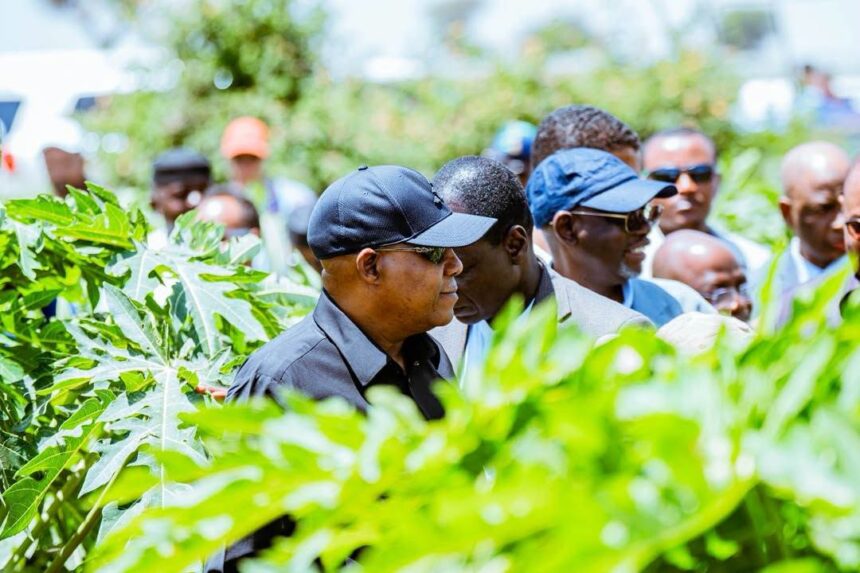
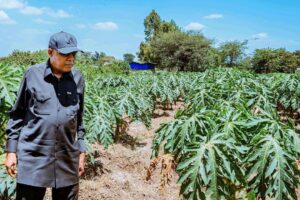
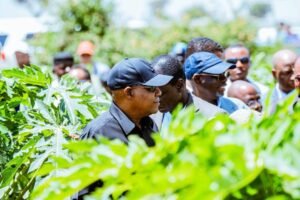
During the visit, Shettima toured wheat, banana and papaya farms, where he examined Ethiopia’s agricultural production systems and ongoing efforts to expand output.
The visit forms part of efforts to strengthen Nigeria–Ethiopia cooperation and explore practical approaches to agricultural modernisation, food self-sufficiency and sustainable economic growth.
Nigeria’s proposed infrastructure drive and adoption of modern farming technologies are expected to support the broader ambition of reducing food import dependence, strengthening agribusiness and improving the country’s contribution to Africa’s food supply.