


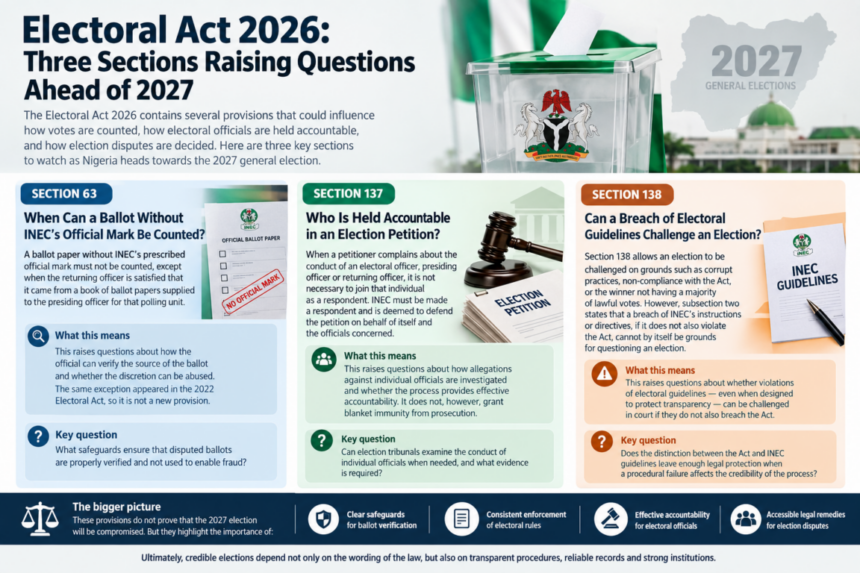
The provisions do not establish that the next election will be compromised. However, their wording raises questions about the safeguards available when electoral procedures are disputed, the accountability mechanisms that apply when officials are accused of irregularities, and the extent to which election petitioners can rely on breaches of electoral guidelines.
Understanding these sections requires looking beyond political predictions to examine what the law says, what it permits and where questions about its application remain.
Section 63: When Can a Ballot Without INEC’s Official Mark Be Counted?
The credibility of an election begins with confidence that the ballots being counted are legitimate. Section 63 of the Electoral Act 2026 addresses this issue by stating that a ballot paper without INEC’s prescribed official mark must not be counted, subject to an exception.
Under subsection two, a returning officer must count such a ballot if satisfied that it came from a book of ballot papers supplied to the presiding officer of the polling unit for that election.
This creates an important question about verification: what evidence should satisfy an election official that a ballot without the prescribed mark came from an authorised book?
The provision does not expressly permit the use of counterfeit ballots. Rather, it creates an exception based on the official’s assessment of a ballot’s origin. The concern is whether that assessment can be applied consistently and supported by verifiable evidence, particularly where candidates or polling agents dispute the decision.
There is also an important historical detail. The same exception appeared in Section 63 of the Electoral Act 2022. Its retention in the 2026 legislation means it is not a newly introduced provision, although its implications remain open to scrutiny.
The central issue, therefore, is not simply whether an exception exists, but whether the procedures for verifying disputed ballots are sufficiently clear to prevent abuse and resolve disagreements transparently.
Section 138: Can a Breach of Electoral Guidelines Challenge an Election?
Another question concerns the relationship between the Electoral Act and INEC’s instructions and directives.
Section 138(1) allows an election to be challenged on grounds including corrupt practices, non-compliance with the Act, or the returned candidate not having been elected by a majority of lawful votes. However, subsection two states that an act or omission contrary to an INEC instruction or directive, but not contrary to the Act itself, cannot on its own be grounds for questioning an election.
The distinction matters because election administration depends on both statutory requirements and operational guidelines. INEC’s rules help determine how procedures are carried out at polling units, during accreditation, while counting ballots and throughout result collation.
If an official violates a guideline, but the violation does not also amount to a breach of the Act, Section 138(2) may prevent that violation from independently serving as grounds to challenge the election.
This raises a difficult question: what happens when an electoral guideline is designed to protect transparency, but a breach of that guideline cannot independently invalidate an election?
The provision does not mean that every violation of an INEC directive is legally irrelevant. Where the conduct also violates the Electoral Act, or supports another recognised ground for a petition, the circumstances may be considered under the applicable law.
The issue is whether the distinction between statutory requirements and administrative directives leaves sufficient legal protection when a procedural failure affects confidence in the electoral process.
Section 137: Who Is Held Accountable in an Election Petition?
The third issue concerns the role of electoral officials in disputes over election results.
Section 137(3) provides that when a petitioner complains about the conduct of an electoral officer, presiding officer or returning officer, it is not necessary to join that individual as a respondent. Instead, INEC must be made a respondent and is deemed to defend the petition on behalf of itself and the officials concerned.
The provision establishes a procedure for handling election petitions. It does not, by itself, grant electoral officials blanket immunity from criminal prosecution or other forms of accountability.
Nevertheless, it raises questions about how allegations involving the conduct of individual officials are investigated and addressed during election litigation.
For instance, when a disputed result sheet, an alleged alteration or a questionable collation decision becomes central to a petition, how can the relevant facts be established? What evidence should be produced, and when might the testimony of the official involved be necessary?
These questions are particularly important because election disputes often depend on records, signatures, result sheets and explanations of how electoral decisions were made.
The fact that an official need not be individually joined as a respondent does not automatically prevent evidence about that official’s conduct from being examined. But the effectiveness of the process depends on the applicable evidentiary rules and how tribunals handle the issues before them.
The broader concern is whether the procedure provides an effective means of establishing responsibility while allowing election petitions to be resolved fairly and within the time limits prescribed by law.
What Do the Three Provisions Mean for 2027?
Taken together, Sections 63, 137 and 138 address different stages of the electoral process: ballot verification, the handling of allegations against election officials, and the legal grounds available for challenging an election.
None of these provisions, considered alone, establishes that the 2027 general election will be compromised. Nor does the existence of a legal exception automatically prove that it will be abused.
However, the wording of the law makes implementation and accountability especially important. A rule may appear clear on paper but still generate disputes if election officials apply it inconsistently, if evidence is poorly documented or if the available legal remedies do not adequately address the alleged irregularity.
For voters, the practical questions are straightforward. Can disputed ballots be verified? Can breaches of electoral procedures be properly documented and challenged? Can election tribunals examine the evidence needed to determine whether the law was followed?
These are questions that electoral authorities, lawmakers, political parties, legal practitioners and civil society organisations can examine before the next general election.
The National Assembly can consider whether the existing wording provides sufficient clarity. INEC can strengthen operational guidance, training and documentation procedures within its lawful powers. Courts and election tribunals, in turn, will interpret and apply the provisions in cases brought before them.
Ultimately, electoral credibility depends on more than the wording of legislation. It also requires transparent procedures, consistent enforcement, reliable records and accessible legal remedies when disputes arise.
As Nigeria approaches 2027, the important task is to ensure that the law provides clear safeguards for the ballot and a credible process for resolving allegations of electoral malpractice.