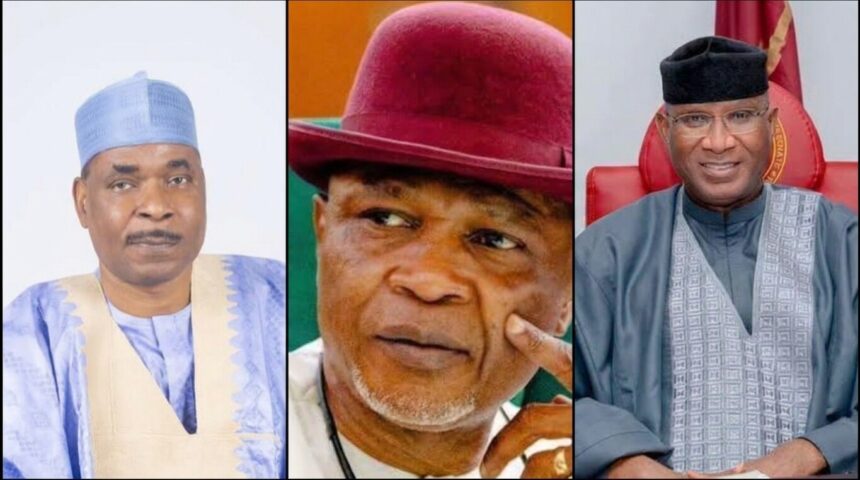
The Independent National Electoral Commission (INEC) has included several prominent politicians, including former Inspector-General of Police Mohammed Adamu, foDeputy Senate President Ovie Omo-Agege, former House of Representatives Minority Leader Kingsley Chinda and Senator Saliu Mustapha, on its final lists of candidates for the 2027 general elections.
Others whose candidacies have attracted attention amid uncertainty over party membership registers and nomination procedures include Senator Shehu Buba Umar and former Delta State House of Assembly Speaker Victor Ochei.
Their inclusion comes weeks after the Supreme Court restored key provisions of the Electoral Act 2026 governing political party membership registers and participation in primaries, raising questions about the eligibility of aspirants who defected to new parties after internal nomination disputes.
Supreme Court Judgment on Party Membership Registers
On September 24, 2026, the Supreme Court reversed a Court of Appeal decision that had invalidated disputed provisions of the Electoral Act 2026, restoring Sections 77(5)–(7) and 84(2) of the law.
Section 77 requires political parties to submit their membership registers to INEC at least 21 days before their primaries, congresses or conventions. Under the restored provisions, only members whose names appear on the submitted registers are eligible to participate in the relevant party exercises.
The controversy arose from a legal challenge by the Zenith Labour Party, which argued that the provisions imposed restrictions on the constitutional autonomy of political parties.
The Federal High Court dismissed the party’s suit in May, but the Court of Appeal struck down the disputed provisions in July. INEC subsequently approached the Supreme Court, which reversed the appellate court’s decision.
The judgment became politically significant because several aspirants had changed parties after losing primaries, failing to secure tickets or disagreeing with their former party leaderships.
While INEC Chairman, Professor Joash Amupitan, said the certified true copy of the judgment was being reviewed, the commission’s National Commissioner for Information and Voter Education, Mohammed Haruna, indicated that candidates who were not members of their parties when they contested for tickets could face difficulties participating in the elections.
The publication of the final candidates’ lists has therefore drawn attention to politicians whose movements between parties and nomination processes had generated questions about their eligibility.
Mohammed Adamu: From APC to SDP
Former Inspector-General of Police Mohammed Adamu is among the politicians whose candidacy attracted attention following the legal uncertainty surrounding the membership-register provisions.
Adamu initially pursued his governorship ambition in Nasarawa State under the All Progressives Congress (APC) before moving to the Social Democratic Party (SDP).
He subsequently emerged as the SDP’s governorship candidate through a substitution primary in September, following the withdrawal of the party’s previously listed nominee, Musa Angbazo.
An earlier INEC list had recognised Angbazo rather than Adamu, prompting the former police chief’s campaign organisation to insist that Adamu was the authentic candidate.
The disagreement placed the SDP’s substitution process under scrutiny and raised questions about the circumstances surrounding the replacement of the original nominee.
Adamu’s campaign maintained that the substitution was valid and that the Supreme Court judgment did not disqualify him or invalidate the party’s nomination process.
His appearance on INEC’s final list represents a significant development after the uncertainty surrounding the party’s ticket.
However, inclusion on the list should not be interpreted as a judicial determination of every possible legal challenge to his candidacy.
Kingsley Chinda: Rivers Governorship Contest
Kingsley Chinda’s emergence as the APC governorship candidate in Rivers State has also attracted attention because of the sequence of events surrounding his movement from the Peoples Democratic Party (PDP).
Chinda, a member of the House of Representatives and an ally of Federal Capital Territory Minister Nyesom Wike, emerged from the APC governorship primary held on May 21, 2026.
Reports on his political movement indicated that he registered with the APC on April 27, while his defection from the PDP was formally announced on June 2, after the primary had taken place.
The chronology prompted questions about whether he met the membership requirements for participating in the APC primary and whether his name appeared on the party’s membership register submitted to INEC within the statutory period.
The issue has implications for Rivers State’s political landscape, where the relationship between Wike, the APC-led Federal Government and Governor Siminalayi Fubara has remained a major factor in political alignments.
Chinda’s inclusion on INEC’s list means the commission has published him as the APC candidate for the governorship election. Any challenge to the process that produced his nomination would, however, depend on the relevant records and applicable legal proceedings.
Ovie Omo-Agege: Seeking Senate Return Through NDC
Former Deputy Senate President Ovie Omo-Agege is seeking to return to the Senate through the Nigeria Democratic Congress (NDC) after losing the APC senatorial primary for Delta Central in May.
The primary was won by incumbent Senator Ede Dafinone.
Omo-Agege resigned from the APC on May 22, 2026, and subsequently joined the NDC, which granted him a waiver to participate in its Delta Central senatorial primary. He secured the party’s ticket through a consensus arrangement.
His political transition raised questions about whether the NDC’s membership and nomination procedures complied with the requirements of the Electoral Act 2026.
The central issue concerned the timing of his entry into the party and the statutory requirement for political parties to submit their membership registers to INEC at least 21 days before their primaries.
Omo-Agege’s inclusion on the final list places him in the Delta Central senatorial contest under the NDC, following his departure from the APC.
His case highlights the legal and political difficulties that can arise when experienced politicians seek alternative platforms after losing internal party contests.
Shehu Buba: From APC Aspirant to PRP Governorship Candidate
Senator Shehu Buba Umar’s emergence as the Peoples Redemption Party (PRP) governorship candidate in Bauchi State followed a political break with the APC, the platform on which he initially pursued his ambition to become governor.
Buba, who represents Bauchi South in the Senate, declared his governorship ambition on the APC platform in April 2026. He called for a transparent primary that would allow party members to determine the candidate.
Following the APC nomination process, he moved to the PRP and emerged as its governorship candidate at a special delegates’ congress on May 25.
He subsequently announced that he had transferred his political structure to the PRP and obtained membership in his ward in Toro Local Government Area.
His movement from the ruling party to an opposition platform placed his candidacy within the broader debate over party membership registers and eligibility following the Supreme Court judgment.
The central question was whether his transition to the PRP and subsequent nomination complied with the statutory requirements governing party membership and participation in primaries.
The publication of Buba as the PRP governorship candidate, alongside Aliyu Tijjani Mohammed as his running mate, has provided greater certainty for the party ahead of the election.
Buba’s candidacy also introduces a serving senator with an established political base into the contest to succeed Governor Bala Mohammed.
The PRP has presented his candidacy as an alternative to the established political forces in Bauchi, with Buba highlighting security, agriculture, employment, education and healthcare as priorities.
Saliu Mustapha: Kwara Central Senate Race
Senator Saliu Mustapha’s political realignment in Kwara State has also drawn attention ahead of the 2027 elections.
Mustapha left the APC in August after losing the party’s governorship primary to Speaker of the Kwara State House of Assembly, Yakubu Danladi-Salihu, and failing to secure the APC senatorial ticket.
He subsequently joined the PDP and obtained its Kwara Central senatorial ticket through a substitution process.
INEC’s final list names Mustapha as the PDP candidate for Kwara Central, where he is expected to contest against the APC’s candidate, Governor AbdulRahman AbdulRazaq, who is seeking a Senate seat.
Mustapha’s departure from the APC has been linked to divisions within the party and the realignment of political groups, including stakeholders associated with the G-15 and the OTOGE bloc.
He has described his decision to leave the APC as a response to what he considers a departure from the party’s founding principles of internal democracy and collective participation.
His move to the PDP has also been presented as part of a broader political coalition rather than a purely individual decision.
The substitution through which he obtained the PDP ticket makes his candidacy relevant to the debate over membership registers and nomination procedures.
His inclusion on INEC’s final list places him in the Kwara Central contest under the PDP, although any separate legal challenge would have to be determined on its own merits.
Victor Ochei: NDC Ticket for Delta North
Former Speaker of the Delta State House of Assembly Victor Ochei is another politician whose movement to a new political platform has attracted attention.
Ochei left the APC and joined the NDC following the conclusion of the APC nomination process. He obtained the NDC ticket for Delta North senatorial district after the party approved a waiver allowing him to participate in its primary on May 28, 2026.
His route to the ticket raised questions similar to those surrounding Omo-Agege, particularly whether politicians who join a party after the relevant membership-register deadline can lawfully participate in its nomination process.
The cases illustrate the challenges political parties face when accommodating experienced politicians who change platforms after internal contests have concluded.
Although a party may grant a waiver under its internal arrangements, such a decision does not automatically resolve whether the nomination satisfies statutory requirements.
Ochei’s inclusion on INEC’s list means the commission has published him as the NDC candidate for Delta North. As with other candidates whose nomination processes have attracted scrutiny, his appearance on the list should be distinguished from a court ruling on the legality of the process.
What the Candidates Have in Common
The cases of Adamu, Chinda, Omo-Agege, Buba, Mustapha and Ochei demonstrate how party defections, disputed primaries and candidate substitutions have complicated preparations for the 2027 elections.
Although their political circumstances differ, their candidacies have attracted attention because of questions surrounding party membership, the timing of defections and compliance with nomination procedures.
The Supreme Court’s judgment has reinforced the importance of the statutory framework governing membership registers and party primaries. It has also placed greater emphasis on the records political parties maintain and submit to INEC.
For political parties, the dispute underscores the need to ensure that membership registers, nomination procedures and candidate substitutions comply with the Electoral Act.
For aspirants, it demonstrates that securing a party ticket may not, by itself, settle every legal question surrounding eligibility.
For INEC, the publication of candidates’ lists is an important stage in the electoral process, but any subsequent dispute must be addressed within the applicable legal framework.
Ultimately, the 2027 elections will test not only the strength of political alliances and candidates’ popularity but also the ability of parties and electoral institutions to comply with the law.
The inclusion of these politicians on INEC’s final lists marks an important development in their campaigns. It does not, on its own, establish that every aspect of their respective nomination processes is immune from legal challenge.