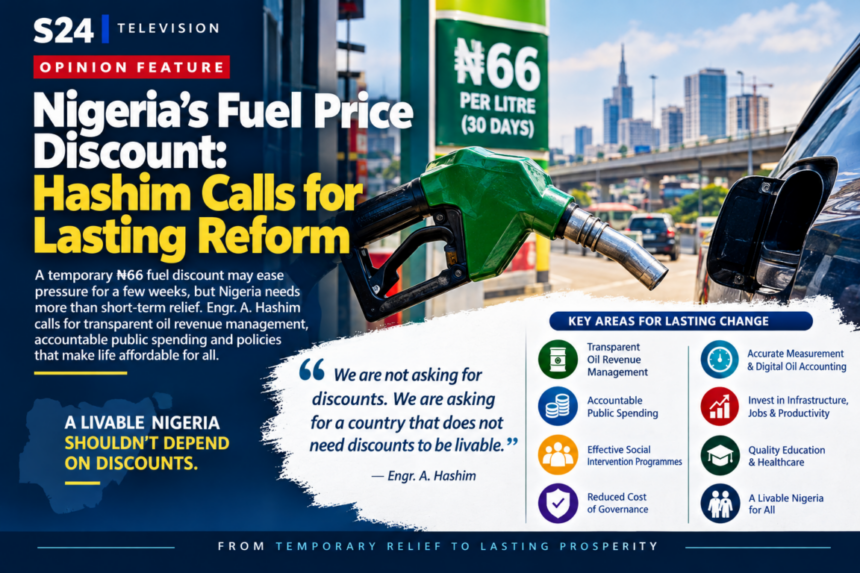
Nigeria’s recurring fuel price interventions have renewed an important question about the country’s economic direction: should citizens have to depend on temporary discounts and emergency relief to afford basic necessities, or should public policy focus on building an economy in which ordinary people can live with dignity without waiting for government concessions?
In an opinion article, Engr. A. Hashim argues that a proposed 30-day fuel discount of ₦66 per litre offers temporary relief but does not address the structural problems that continue to make life difficult for millions of Nigerians. His central argument is that the country needs more than short-term price reductions; it needs transparent public finances, accountable management of oil revenue and a deliberate commitment to making essential goods and services affordable.
Temporary Relief Cannot Replace Long-Term Reform
A discount at the pump may ease pressure on household budgets for a few weeks, particularly for workers, traders, transport operators and small businesses already struggling with rising operating costs. However, Hashim questions the logic of presenting such an intervention as a meaningful response to a crisis that extends far beyond the price of petrol.
For households facing higher food prices, rent, electricity bills, transportation costs and healthcare expenses, a temporary reduction in fuel prices may provide some breathing room without significantly changing their financial circumstances. Once the discount expires, the same pressures are likely to return unless broader economic conditions improve.
Hashim’s concern is therefore not simply whether Nigerians should welcome a ₦66-per-litre reduction, but whether the policy addresses the reasons citizens have become so dependent on government relief. In his view, a country should not continually rely on temporary concessions to make everyday living costs bearable when more durable economic solutions are needed.
Where Are the Benefits of Economic Sacrifice?
At the heart of Hashim’s argument is the question of what Nigerians have gained from the difficult economic adjustments and the savings government says have followed changes to fuel subsidy policy.
The removal of the petrol subsidy was defended by the Federal Government as a necessary step towards reducing public expenditure and freeing resources for investment in infrastructure, education, healthcare and other priorities. Yet, as citizens continue to contend with the rising cost of living, the debate has increasingly shifted towards how those savings are managed and whether their benefits are reaching ordinary people.
Hashim challenges the gap between the promise of economic reform and the lived experience of citizens. He questions public spending priorities, the cost of government administration, debt-servicing obligations and the effectiveness of social intervention programmes, arguing that Nigerians deserve clearer evidence of how public resources are being deployed.
His position is that the success of economic reform should not be measured only by government revenue or the reduction of a particular subsidy bill. It should also be assessed by whether households can afford food, workers can meet basic expenses, businesses can operate sustainably and public services deliver tangible improvements in people’s lives.
Without such outcomes, he argues, the burden of adjustment risks falling disproportionately on citizens while questions about public expenditure and accountability remain unresolved.
Social Intervention Must Deliver More Than Promises
Hashim also raises concerns about welfare transfers and other government support programmes, including the implementation of the initiative he refers to as HYAS. His argument places the focus on the difference between announcing relief measures and demonstrating that they work.
For social intervention to make a meaningful difference, citizens need to know who qualifies, how beneficiaries are selected, how funds are disbursed and what results the programmes achieve. Transparent reporting is particularly important when government presents such interventions as part of the response to economic hardship.
Where assistance is delayed, poorly communicated or difficult for eligible citizens to access, the public may struggle to see the connection between government spending and improvements in their circumstances. Hashim therefore calls for greater scrutiny of intervention programmes and the resources committed to them.
The wider point is that social protection should form part of a coherent economic strategy rather than serve as a temporary answer to problems that remain unresolved. Relief can be necessary during periods of hardship, but it cannot substitute for reliable public services, productive employment and policies that strengthen household purchasing power over time.
Oil Revenue and the Demand for Transparency
The article also directs attention to the management of Nigeria’s oil resources, particularly the measurement and accounting of production, revenue reporting and deductions made before funds are distributed to the Federation Account.
For Hashim, these questions are central to the wider debate about the country’s capacity to finance development and provide relief to its citizens. Nigeria depends heavily on petroleum revenue, making the accurate measurement of production and the transparent accounting of proceeds important to public confidence in the management of national resources.
He questions spending attributed to the Nigerian National Petroleum Company Limited (NNPC) and raises concerns about deductions made before revenue reaches the Federation Account. He also points to budget insertions and other spending decisions as areas requiring closer public scrutiny.
These are serious claims that require examination against official records, audited accounts and relevant financial disclosures. Their importance lies in the broader accountability question Hashim raises: how can Nigerians be expected to accept repeated economic sacrifices without sufficient clarity about the revenue the country earns, the deductions it makes and the priorities guiding public expenditure?
A credible response would require transparent reporting, independent scrutiny and clear explanations of major financial decisions. Publishing figures alone is not enough; citizens also need accessible information showing how those figures relate to government obligations, development spending and the delivery of public services.
The Cost of Government Must Be Examined
Hashim’s criticism extends beyond fuel pricing to the wider cost of running government. He questions whether public expenditure reflects the urgency of the hardship facing citizens and whether sufficient attention is being paid to reducing waste and improving the value Nigerians receive from public funds.
The issue is particularly significant when governments ask citizens to endure higher costs in the name of economic recovery. Public confidence depends partly on whether those making policy decisions demonstrate discipline, transparency and a willingness to subject their own spending choices to scrutiny.
For Hashim, the credibility of reform is weakened when citizens are repeatedly asked to make sacrifices while doubts persist about expenditure, revenue management and the implementation of announced policies. He argues that a more convincing approach would combine fiscal discipline with measurable improvements in living standards.
This would require more than announcing savings or unveiling new interventions. It would involve explaining how resources are allocated, publishing verifiable performance data and showing how economic decisions translate into better outcomes for the population.
Beyond the Politics of Discounts
A temporary fuel discount can offer immediate relief, and the value of that relief should not be dismissed by households that must stretch every naira. However, the timing, duration and communication of such an intervention can also raise questions about its place within a broader economic strategy, particularly when citizens are approaching another period of intense political activity.
Hashim views the proposed 30-day discount as an inadequate response to the scale of the problem. His concern is that short-term interventions may draw attention away from the more difficult work of building a system that makes essential goods and services affordable on a sustained basis.
The challenge for policymakers is to show how immediate assistance connects to lasting reform. If a discount is necessary, the government should explain its cost, funding, eligibility and expected impact, while setting out the longer-term measures intended to prevent the same hardship from recurring.
That approach would help distinguish a carefully designed intervention from a temporary gesture whose benefits disappear when the programme ends.
A Country Where Dignity Is Not a Luxury
By invoking the legacies of Nigerian leaders such as Obafemi Awolowo and Nnamdi Azikiwe, Hashim places the current economic debate within a broader question about national purpose: what kind of country should Nigeria aspire to become, and what obligations does the state owe its people?
His argument ultimately goes beyond petrol prices. It concerns the relationship between government and citizens, the management of national wealth and the meaning of economic progress in a country where many households continue to struggle with basic necessities.
A livable country, in this view, is one where access to food, transportation, healthcare, education and other essentials does not depend on periodic discounts or emergency government concessions. It is a country where public resources are managed transparently, social programmes deliver measurable results and economic reforms are judged by their effect on people’s daily lives.
The task is not necessarily to reject every temporary intervention. Rather, it is to ensure that relief measures complement a credible long-term plan instead of becoming a substitute for one. Nigerians need policies that protect vulnerable households today while creating the conditions for greater affordability, opportunity and security tomorrow.
Hashim’s closing appeal is therefore a challenge to the country’s political and economic leadership: give Nigerians a country that does not need discounts to be livable.
The question facing policymakers is whether temporary relief will remain the recurring response to economic hardship, or whether it will become part of a wider transformation that allows citizens to live with dignity without continually waiting for the next concession.