
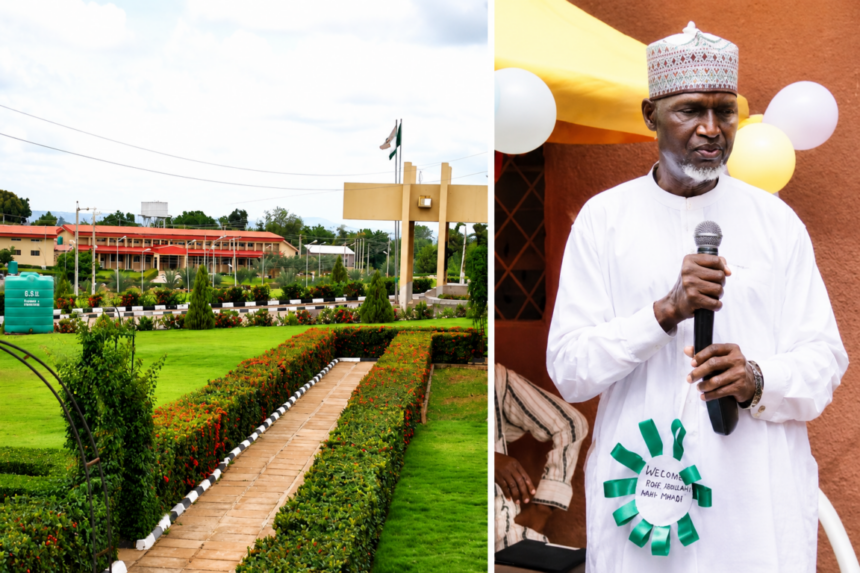
Professor Abdullahi Mahadi, the renowned historian, educationist and university administrator who died on December 16, 2022, left behind a legacy that extends beyond lecture halls and university administration.
A former Vice-Chancellor of Ahmadu Bello University, Mahadi also served as the pioneer Vice-Chancellor of Gombe State University and the pioneer Vice-Chancellor of the Gombe State University of Science and Technology, Kumo.
His career was remarkable not only because he led three universities, but because of the distinctive philosophy he brought to university administration: academic excellence, merit, discipline, inclusion, environmental preservation and service.
Mahadi died at the age of 77 in Gombe after a career spanning more than five decades in education and public service. He was buried at the Gombe Central Graveyard after funeral prayers at the Emir’s Palace in Gombe. (Daily Trust)
From the Classroom to University Leadership
Born in December 1945 in Kiva-Warabe, Gwoza Local Government Area of present-day Borno State, Mahadi began his education at Warrabe Primary School before attending Gwoza Central School, Government Craft School in Maiduguri and Mubi Teachers’ College.
His professional journey began in the classroom. He worked as an assistant headmaster at Gadamayo Primary School in Gwoza in 1967, became a headmaster the following year and later served as an Assistant Education Officer in the former North-Eastern Government.

Read More: GSU Hosts 2nd Research Fair, Showcases Innovation
He eventually proceeded to Ahmadu Bello University, Zaria, where he obtained degrees in History, including a PhD. In 1984, he joined the university as a senior lecturer in History and later became Director of the Northern History Research Scheme. (BioLegacy Foundation)
His rise through academia eventually took him to the highest administrative position at ABU. He served as the university’s ninth Vice-Chancellor from 1999 to 2004, according to records from the Federal Ministry of Education. (Federal Ministry of Education)
But perhaps his most enduring institutional legacy was created after he left Zaria.

Building Gombe State University From the Ground Up
In 2004, Mahadi was appointed the first and founding Vice-Chancellor of Gombe State University.
He arrived at an institution that was still developing its identity, structures, academic programmes and human resources. According to a Gombe State University publication commemorating his legacy, he immediately embarked on what it described as a systematic and dynamic restructuring of the university. (Gombe State University)
One of the principles that shaped his administration was merit.
The university’s account of his tenure says the recruitment of pioneer academic and non-academic staff was based on merit and academic qualifications. It also says Mahadi deliberately recruited academics from different backgrounds and countries, while establishing links with universities in countries including the United States, Israel and Sri Lanka.
The strategy was aimed at giving a relatively young state university an academic culture that was not limited by geography.
Rather than treating GSU simply as a local institution, Mahadi sought to give it an outward-looking character by building academic networks and attracting expertise.
That approach helped lay an important foundation for the university’s subsequent growth.
A University Built Around Discipline and Inclusion
Mahadi’s vision of a university was not restricted to buildings, lecture theatres and academic qualifications.
The GSU publication says he placed considerable emphasis on discipline and decency among students, while also paying attention to their welfare.
He was reportedly known for personally visiting classrooms and checking on students in the hostel.
The university also credits him with promoting inclusive education. During his tenure, people living with disabilities were encouraged to study at GSU, with special facilities provided to meet their learning needs. (Gombe State University)
This reflected a broader philosophy in which the university was expected to serve students regardless of their circumstances.
His administration also reportedly sponsored some students to pursue university education, reinforcing his belief that education should provide opportunities for those who might otherwise struggle to access it. (Gombe State University)
The Professor Who Turned Campus Green
Perhaps one of the most visible aspects of Mahadi’s legacy is one that has little to do with his academic discipline.
It is the environment.
Mahadi developed a reputation as an environmentalist and advocate of tree planting and conservation.
At Gombe State University, he paid particular attention to the natural environment, encouraging the planting of fruit-bearing trees, flowers and other vegetation across the campus.
The result was not simply an attractive university environment. His philosophy linked environmental protection with the welfare of students and staff and the quality of the learning environment. (Gombe State University)
His environmental work later expanded beyond the university through the Mahadi Foundation, which focused on environmental preservation, combating desertification and addressing the effects of global warming.
A 2016 Daily Trust report on his environmental intervention in Gombe said the foundation had planted at least 3,000 seedlings in public schools across the state, many of which had matured and contributed to greener learning environments. (Daily Trust)
Other accounts have attributed a much larger tree-planting effort to initiatives associated with Mahadi, including extensive planting across Gombe. Because figures vary by source and project scope, the broader point is clearer than any single number: tree planting and environmental management became a major part of his post-university public service.
From GSU to Another University
Mahadi’s contribution to higher education in Gombe did not end with his tenure at GSU.
He was later appointed pioneer Vice-Chancellor of the Gombe State University of Science and Technology, Kumo, in Akko Local Government Area.
The institution had yet to commence full operations when he was appointed, making the assignment another opportunity to contribute to institution-building from the foundation. Contemporary reports described him as the pioneer Vice-Chancellor of the proposed university. (Daily Trust)
This meant that Mahadi had the unusual distinction of serving as Vice-Chancellor of three universities: ABU, Gombe State University and Gombe State University of Science and Technology.
Scholarship Beyond Administration
Before and alongside his administrative career, Mahadi remained a scholar.
He authored or contributed to numerous publications and was associated with works on Nigerian history, society and economy. Daily Trust reported after his death that he had authored more than 47 books and journals and delivered more than 70 public lectures across Nigeria. (Daily Trust)
His academic background in history also influenced his understanding of society and education.
For Mahadi, the university was not merely a place for awarding degrees. It was an institution for producing knowledgeable citizens, developing critical thinking and contributing to society.
His influence was also felt through mentorship. A Gombe State University inaugural lecture published in 2022 records appreciation to Mahadi from an academic who described his persistent interest in the scholar’s academic progress and acknowledged his mentorship and support. (Gombe State University)
Recognition for Environmental Work
Mahadi’s environmental advocacy eventually attracted international recognition.
The Gombe State University publication on his legacy records that his International Institute of Islamic Research and Development received a 2017 environmental award associated with the Islamic Educational, Scientific and Cultural Organization, for work described as environmental management in the Islamic world. (Gombe State University)
His environmental work demonstrated an unusual combination of interests: history, education, institutional administration and ecological conservation.
He showed that university leadership could extend beyond academic administration into questions of community development and environmental sustainability.
A Legacy Visible Across Gombe

Today, one of the most visible institutional reminders of Mahadi’s contribution to Gombe State University is its main library, which bears his name.
The library reflects the university’s continued recognition of its founding Vice-Chancellor and his role in establishing the institution. (Wikipedia)
But perhaps the more important legacy is less tangible.
It is found in the academic culture he helped establish, the students he supported, the scholars he mentored, the institutional networks he created and the trees that changed the physical landscape of the university.
The GSU News Bulletin described him as the “groomer and pruner” of the university and credited him with laying its foundation and shaping its reputation. (Gombe State University)
That assessment is significant because Mahadi’s tenure came at the formative stage of the university. The decisions made during those early years helped establish standards that subsequent administrations inherited and developed.
A Model of Institution Building
Mahadi’s story provides an important lesson about what founding leadership can mean in higher education.
He did not inherit a mature university and simply administer it. At GSU, he helped establish the institution’s human resources, academic networks, culture, student welfare systems and physical environment.
His emphasis on merit-based recruitment, international academic connections, student welfare, inclusion and environmental sustainability gave the young university an identity beyond simply being a state-owned institution. (Gombe State University)
It would be difficult to attribute the later development or standing of Gombe State University to one individual alone. Universities evolve through successive administrations, faculty, students, governments and communities.
But it is equally difficult to discuss the early history and institutional foundation of GSU without recognising Mahadi’s central role.
The Green Legacy
Perhaps what makes Professor Abdullahi Mahadi particularly memorable is the contrast between his profession and one of his most visible passions.
He was a historian, but he planted for the future.
He was an educationist, but he believed learning required an enabling environment.
He was a university administrator, but his vision went beyond offices and academic programmes.
And he was an environmental advocate who understood that planting a tree was not merely about beautification; it was an investment in the future.
His life therefore offers a broader definition of legacy.
Buildings can age. Administrations change. Academic programmes evolve. But knowledge passed to students, institutions built on strong foundations and trees planted for generations can continue to speak long after their planter is gone.
Professor Abdullahi Mahadi died on December 16, 2022.
But in Gombe State University, his legacy remains visible—in its history, its institutions, its academic community and, perhaps most fittingly, in the green landscape that he helped create. (Daily Trust)