
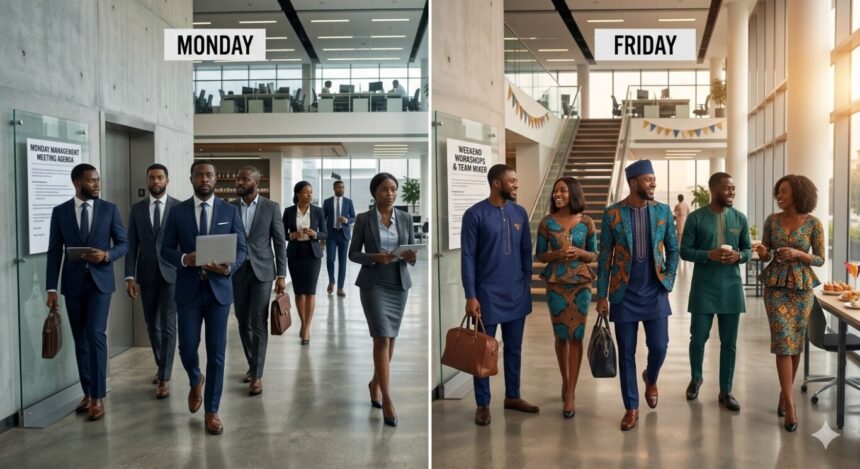
On Monday morning, the Nigerian office can look like a different country.
Shirts are neatly tucked in. Trousers are pressed. Blazers are buttoned. Skirts and corporate dresses dominate the corridors, while polished shoes announce that the weekend is officially over. Everyone looks ready for meetings, deadlines and another five day battle with traffic.
Then Friday arrives.
The transformation is almost unbelievable.
The corporate shirts disappear and senator wears come out. Ankara replaces formal dresses. Agbada, kaftans, lace, aso oke and other traditional outfits take over office corridors. Some workers trade their formal shoes for sneakers or more comfortable footwear. The atmosphere also seems lighter, as though the clothes themselves have announced that the weekend is only a few hours away.
But there is one question that deserves to be asked: Who actually decided that Friday is for native wear?
There is no national law, government circular or workplace authority that says Nigerians must wear native attire on Fridays. It is an unofficial dress culture that has become so familiar that many people simply accept it as part of working life. Nigerian media have described Friday traditional dressing as an “unspoken rule” and a workplace culture rather than a formal requirement.
Monday: Everybody Means Business
For many Nigerians, Monday dressing carries a message.
It says: I am back at work, and I am ready to be taken seriously.
Corporate dressing has long been associated with professionalism. In banks, government offices, law firms, corporate organisations and other formal workplaces, clothing can form part of the expected image of an employee.
The suit, shirt, tie, formal dress and polished shoes are not simply pieces of clothing. They represent a workplace culture built around order, discipline and presentation.
Monday therefore becomes the day to look the part.
After two days of sleeping late, attending social events, running errands or staying at home, workers return to an environment where appearance can matter almost as much as punctuality.
But by Friday, that seriousness begins to loosen.
Then Friday Comes
The change is not always announced, but everyone seems to understand it.
The corporate look gives way to native attire. The person who spent Monday to Thursday in shirts and trousers may arrive in a senator outfit. Another worker may choose Ankara, lace, kaftan or agbada.
And suddenly, the office feels different.
Friday native dressing has become so familiar in many Nigerian workplaces that someone who arrives in full corporate attire can even attract a playful question: “You no get native?”
But who created this rule?
So, Who Created Friday?
The answer is more complicated than “Nigerians.”
The modern idea of relaxing workplace dress on Fridays has roots outside Nigeria. In Hawaii, the campaign for workplace acceptance of the traditional aloha shirt gained momentum in the 1960s. The Hawaiian Fashion Guild promoted aloha attire as suitable workplace clothing, and Aloha Friday became established in 1966. The idea later helped inspire the wider international practice known as Casual Friday.
The original idea was not simply about looking fashionable. Climate, comfort and cultural identity were also part of the argument for allowing workers to wear clothing suited to Hawaii.
As the concept travelled, different countries and workplaces adapted it to their own cultures.
Nigeria appears to have done exactly that.
Instead of simply making Friday a jeans and T-shirt day, Nigerians gave the tradition a distinctly local flavour.
If the rest of the world had Casual Friday, Nigeria could have Native Friday.
Nigeria Gave Casual Friday Its Own Style
The Nigerian version is particularly interesting because “casual” does not always mean the same thing here.
A worker wearing a well tailored senator outfit may actually look more dressed up than someone wearing jeans and a T-shirt.
That is because native attire occupies an unusual position in Nigerian society. It can be casual, formal, traditional and fashionable at the same time.
A senator outfit can take someone from the office to a Friday prayer, a family gathering or an evening event without requiring a complete change of clothes.
An Ankara dress can be comfortable enough for work while still looking elegant enough for an after work outing.
For many Nigerians, therefore, Friday native wear is not simply about dressing down. It is also about dressing differently.
Pulse Nigeria has similarly linked Friday native dressing to cultural identity, comfort and the relaxed feeling associated with the end of the working week.
Friday Is Also About Culture
There is another reason Friday may have become particularly comfortable for traditional dressing in Nigeria.
For many Muslims, Friday is a significant day of congregational prayer. Traditional flowing outfits and caps are common choices for Jumu’ah prayers, particularly among Muslim communities.
Some accounts have also linked the practice to Muslim workers who would carry traditional clothes to work and change before Friday prayers. Over time, arriving at work already dressed in native attire could become more convenient.
But Friday native dressing is no longer limited to Muslims.
Christians and people of different backgrounds also participate in the tradition because it has developed into a broader workplace and cultural practice.
That is perhaps one of the most interesting things about it.
A practice that may have been strengthened by particular religious and cultural habits eventually became something many Nigerians could identify with.
Nobody Sent the Memo
The funniest part is that nobody really needed to.
There was no nationwide announcement saying:
“Effective immediately, all Nigerian workers shall wear native attire every Friday.”
Yet the message somehow spread.
In some offices, management encourages traditional wear. In others, employees simply adopted it themselves. Some organisations allow casual dressing on Fridays without specifically demanding native attire, while workers independently choose Ankara, senator, kaftan or other traditional clothing.
The practice has become so familiar that arriving in full corporate attire on a Friday can sometimes attract a simple question:
“You no get native?”
And that question says a lot.
It shows how workplace culture can create rules without formally writing them down.
Why Friday Feels Different
There is also a psychological difference between Monday and Friday.
Monday feels like a beginning.
Friday feels like an escape.
The clothes reflect that feeling.
On Monday, the worker dresses for the office. On Friday, the worker may feel as though they are dressing for everything that comes after the office.
The native outfit can be more comfortable. It can reflect personal taste. It can celebrate culture. It can also make it easier to move from work into the weekend without going home to change.
That may explain why the tradition has survived even as Nigerian workplaces become more modern and flexible.
And perhaps this is why Friday feels different before anyone even says “TGIF.”
Does Looking Corporate Make Someone More Professional?
The Monday versus Friday contrast raises a bigger question about Nigerian workplaces.
If someone can perform their duties efficiently in native attire on Friday, why does a suit or corporate dress carry a stronger association with professionalism on Monday?
Of course, some professions and workplaces need formal clothing for practical or institutional reasons. A dress code can also help organisations maintain a particular image.
But clothing does not automatically determine competence.
The same employee who answers emails, attends meetings, meets targets and solves problems in a corporate outfit on Monday can do exactly the same work in Ankara or senator wear on Friday.
Perhaps the real difference is not the worker.
It is the expectation attached to the clothes.
Monday tells Nigerians to look serious.
Friday gives them permission to breathe.
And somewhere between the two is a uniquely Nigerian workplace culture, one where nobody officially declared that Friday belongs to native wear, yet the tradition has become familiar enough for many people to accept it without question.
Maybe that is the real story of Monday vs Friday: four days of dressing for the job, followed by one day of dressing a little more like ourselves.
This keeps the version you liked while making the subheadings more conversational and connected to the central question, rather than sounding like generic article sections.