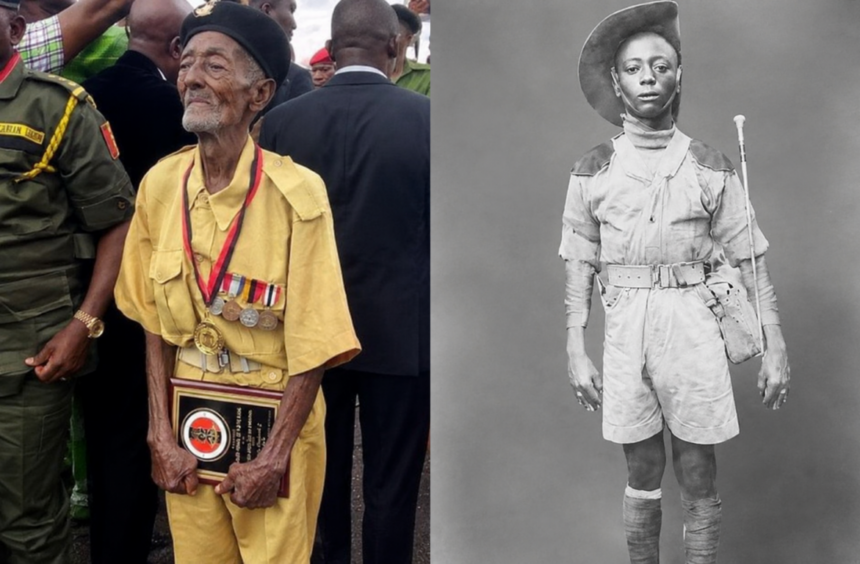
Adama Aduku was one of Nigeria’s World War II veterans, serving in the British colonial army before returning home to build a quiet life.
His story spans war, military service and some of the biggest changes in Nigeria’s history. Aduku became known as one of the country’s oldest surviving war veterans before his death on December 31, 2019, at the age of 101.
His death ended the life of a man who had witnessed more than a century of Nigerian history. Yet, many Nigerians knew little about his role in a global conflict that transformed millions of lives.
Aduku Joins the Colonial Army
Adama Aduku was born in 1918 in Abejukolo-Ife, in present-day Kogi State.
In 1942, during World War II, he joined the Royal West African Frontier Force (RWAFF). In interviews, Aduku recalled that he enlisted in Makurdi before receiving military training in Lagos.
His service would soon take him far beyond Nigeria.
Aduku was later deployed to India as part of the Nigerian troops serving under British command. He recalled spending time in Calcutta and described some of his experiences during the war.
Thousands of African soldiers served in the British military during World War II. Nigerian troops were deployed to different theatres of the conflict, including parts of Africa and Asia, as Britain and its allies fought the Axis powers.
Their service formed part of the wider contribution of African colonial troops to the Allied war effort.
From India Back to Nigeria
After the war ended, Aduku returned to Nigeria in 1946.
However, his military career did not end with his return home. He continued serving and was posted to the 4 Brigade Guard Group in Lagos.
He later left the army before returning to military service in 1950. This time, he served in Zaria.
Aduku remained in the army until 1957, when he was discharged as a private soldier.
His military career covered the final years of British colonial rule and ended just three years before Nigeria gained independence in 1960.
His life therefore connected two important periods in the country’s history: colonial Nigeria and the emergence of an independent Nigerian state.
Life After Military Service
After leaving the army, Aduku worked as a trader in Lagos before eventually returning to farming in Kogi State.
Despite living a relatively quiet life after his military career, he remained willing to speak about his experiences.
His memories provided a glimpse into the lives of Nigerian soldiers who travelled thousands of kilometres from home to serve in a global conflict.
In 2019, the Nigerian Army honoured Aduku during an Army Day event in Lagos. The recognition brought renewed attention to his life and military service.
Aduku also spoke about concerns surrounding his pension and the support available to veterans.
His experience highlighted a challenge that has affected some former service members: military service does not always guarantee financial security after retirement.
A Private Soldier Who Witnessed History
Adama Aduku was not a general or a famous military commander.
He served as a private soldier.
Yet, his life connected Nigeria to one of the most significant conflicts of the 20th century.
He travelled to India as part of the British war effort, returned to Nigeria after the conflict and continued his military career during the final years of colonial rule.
He then lived through independence and the many political and social changes that followed.
Few individuals can claim to have witnessed such a long period of Nigeria’s history.
Remembering Nigeria’s World War II Veterans
Adama Aduku died on December 31, 2019, but his story remains part of Nigeria’s military history.
His experience also helps draw attention to the Nigerian men who served overseas during World War II, many of whose stories have received less attention than those of European soldiers.
Remembering these veterans provides a broader understanding of Africa’s role in the war.
Aduku’s life shows that history is not only shaped by generals, commanders and political leaders. It is also carried by ordinary soldiers who travelled far from home, served under difficult circumstances and returned to lives that often received little public recognition.
His story is therefore more than the biography of a 101-year-old veteran.
It is a reminder that Nigeria’s history is connected to events far beyond its borders, and that the experiences of the Nigerians who participated in those events deserve a place in the national memory.